Search for a PDRN skin booster and the prices fan out so widely that the first honest reaction is confusion. If two vials both say PDRN, why does one cost a fraction of the other, and is the expensive one simply a markup on the same thing. The answer is that PDRN and PN are graded materials, not commodities, and a price is often a summary of decisions made long before the box was printed. This is a look at what those decisions are, so a price becomes something you can read rather than something you have to guess at.
What "PDRN" and "PN" actually name
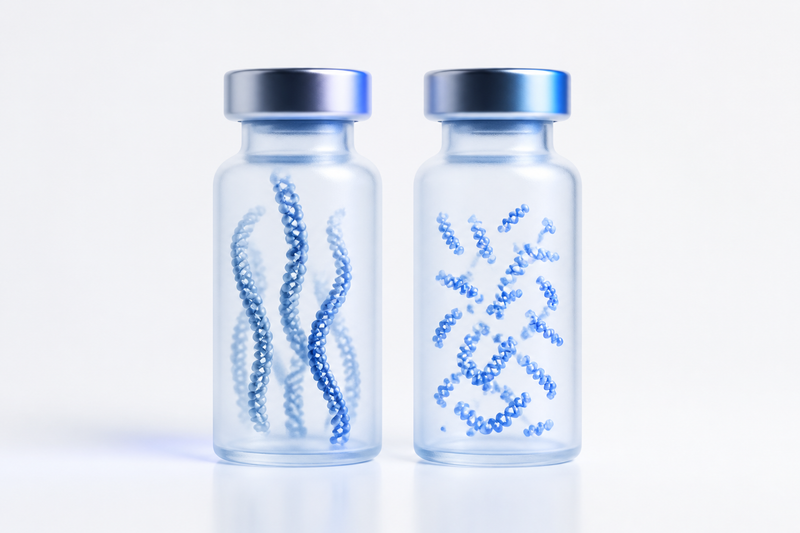
Before a price can be read, the material has to be understood, because PDRN and PN are related but not identical. PDRN, polydeoxyribonucleotide, is a mixture of DNA fragments, described in the literature as having a molecular weight broadly in the range of tens to around fifteen hundred kilodaltons, and it is typically sourced and refined from the gonadal tissue of salmon or trout.1 PN, polynucleotide, is the closely related longer-chain material, generally described as higher in molecular weight than PDRN.2 Both are, at heart, purified nucleic acid materials rather than a single standardized chemical.
That last point is the one that governs pricing. A single standardized chemical has one identity and therefore a narrow price range, but a purified biological material has a grade, and grade is a spectrum. Two products can both accurately be called PDRN while differing in the tissue they came from, the length distribution of their fragments, how thoroughly they were purified, and how tightly their manufacturing was controlled. The name is the category, not the specification, and the specification is where cost lives.
We have written the deeper science of the PDRN and PN distinction in PN vs PDRN by molecular weight and the spec-reading habit in reading a PDRN skin booster. This article assumes that groundwork and asks a different question: given that these are graded materials, what is a price actually a measure of, and when is a difference in price a difference in the thing rather than a difference in the margin.
Holding that frame changes the shopping question from "which is cheaper" to "what does this price describe." A cheaper PDRN is not automatically a worse deal, and a pricier one is not automatically a better product; each is a claim about a bundle of underlying attributes, and the useful skill is learning to unbundle it. The rest of this piece is that unbundling.
Why two products both labeled PDRN can cost very differently
The widest driver of price is that the same label can sit on top of very different production stories. Source tissue and species vary, the fragment-length profile varies, the purification depth varies, and the degree of manufacturing and regulatory control varies, and each of those is a real cost that a serious producer incurs and a cut-rate one may not. A price gap between two PDRN products is often the sum of these choices rather than an arbitrary premium, which is why the gap can be large without either product being mislabeled.
Purity is a clear illustration, because it is both measurable and expensive to achieve. The literature describes purified PDRN as being processed to greater than ninety-five percent purity, obtained through a high-temperature extractive process designed to yield a high percentage of nucleic acid without pharmacologically active proteins and peptides, with purity confirmable by an absorbance ratio around 1.9.1 Reaching and verifying that grade takes process and quality control, and process and quality control cost money. A product that invests in them and a product that does not can look identical on a shelf and differ materially in what the buyer is paying for.
Manufacturing and regulatory standing add another layer. A product made under tighter process controls, tested more thoroughly, and registered with the relevant regulators carries the cost of all of that infrastructure, while a product that skips steps saves the corresponding money. None of this is visible in the vial, which is exactly why price becomes an imperfect proxy for it: some of what you pay for in a premium product is the assurance work that a cheaper one may simply not have done.
The table below lays out the common cost drivers so a price can be decomposed rather than reacted to. The point is not that more expensive is always better, it is that a price difference usually corresponds to one or more of these differences, and knowing which one lets a buyer decide whether the premium is buying something they value.
| Cost driver | What it means | Why it moves price |
|---|---|---|
| Source tissue and species | Gonadal tissue of salmon or trout, or other origin | Source quality and consistency affect input cost |
| Molecular weight profile | The fragment-length distribution the product targets | A controlled, specified profile costs more than an unspecified one |
| Purity grade | Extent of purification and protein or peptide removal | Higher, verified purity requires more process and testing |
| Manufacturing control | Process controls, sterility, batch consistency | Quality systems are real, ongoing infrastructure cost |
| Regulatory standing | Registration and approvals in relevant markets | Compliance and documentation carry their own cost |
| Brand and channel | Reputation, packaging, and the sourcing channel | Can add cost that is real, or margin that is not |
Purity, and the proteins you are paying to remove
One of the least visible but most legitimate cost drivers is purification, because a large part of making a refined nucleic acid material is taking things out. The described process aims for a high percentage of nucleic acid while removing pharmacologically active proteins and peptides that come along with the raw biological source, and the resulting grade is verified rather than assumed.1 That removal is not a trivial step; it is a meaningful part of why a well-made material is a defined product rather than a crude extract.
This matters for reading a price because purity is a place where cutting corners saves money invisibly. A less thoroughly purified material can still be labeled with the same category name while carrying more of what a careful process would have removed, and the buyer cannot see the difference by looking. The premium attached to a rigorously purified, verified product is, in part, the cost of the steps that a cheaper product may have shortened, which is a real difference in the material even when it is not a visible one.
It also reframes what "paying more" can mean. In a purified biological material, some of the price is buying the absence of things, the impurities and unwanted fractions that were removed, rather than the presence of more active substance. That is a genuinely different kind of value than "more product for more money," and it is one a buyer can only weigh if they know that purification grade is a variable at all. Price without that knowledge looks arbitrary; price with it starts to resolve into specific, assessable choices.
Molecular weight, and why more is not automatically better
Molecular weight is where buyers most often misread a spec as a quality score, so it is worth stating carefully. PDRN sits in a broad molecular-weight range, and PN is generally the higher-molecular-weight material, but higher is a description of the material, not a grade of it.12 A larger number is not a synonym for a better product, because molecular weight is a property that different products specify differently on purpose, and the right profile is a matter of the product's design rather than a race to a bigger figure.
The reason this trips people up is that consumer intuition treats bigger numbers as better, and marketing sometimes leans on that intuition. But in a graded biological material, the meaningful question is whether the molecular-weight profile is controlled and specified, not whether it is high. A product that names and controls its profile is giving you information and consistency; a product that simply advertises a large number without control is offering a headline, and the two are not the same even when the number is.
For pricing, the takeaway is that molecular weight belongs in the "what am I paying for" analysis as a specification to be understood, not a leaderboard position to be won. A controlled, well-characterized profile is part of what a premium can legitimately buy, because control costs more than its absence. But a buyer should be wary of paying a premium purely for a bigger molecular-weight number presented without the control that would make it meaningful, since that is paying for the headline rather than the substance.
Is more expensive PDRN worth it?
The honest answer is that it depends entirely on what the premium is buying, and the whole point of the analysis above is to let you find out rather than guess. If a higher price corresponds to a more thoroughly purified, better-characterized, properly manufactured, and properly registered product, then the premium is buying real attributes that a buyer may reasonably value. If it corresponds only to brand and packaging on top of an otherwise ordinary material, then it is buying margin. Same price gap, two very different meanings, and only an examination of the inputs distinguishes them.
This is why "is it worth it" is the wrong question in isolation and "what does the premium buy" is the right one. Worth is relative to what a buyer values and what the extra money actually corresponds to, and a price tag carries neither of those on its face. A buyer who has decomposed the price into its drivers can answer the worth question for themselves, because they can see whether the premium maps onto attributes that matter to them or onto attributes that do not.
The same logic protects against the opposite error, which is assuming cheaper is always the smart buy. A lower price can reflect legitimately different but adequate choices, or it can reflect skipped purification, weaker manufacturing control, or absent regulatory standing, and those are not the same bargain at all. Cheap is only a good decision when you know why it is cheap, which again returns the question to the inputs rather than the number.
Cheap because different, or cheap because fake
There is one price signal that is not a grade difference at all, and it is the most important to separate out: a price that is low because the product is counterfeit. Everything above concerns legitimate variation among genuine products, where a lower price reflects real if different choices. A counterfeit is a different phenomenon, a product whose identity, composition, or source is misrepresented, and its low price is not a grade, it is a fraud.
The two can look similar on a listing and are completely different underneath. A genuinely cheaper product is still a known, accountable material made by a real manufacturer; a counterfeit is an unknown substance with no accountable maker, and no amount of purity or molecular-weight reasoning applies to it because its stated specs cannot be trusted in the first place. We spelled out why that matters in what a counterfeit injectable actually costs, and the short version is that a fake removes the very assurances this price analysis assumes.
This is why value analysis and authenticity checking are two separate tasks that both have to be done. Decomposing a price tells you what a genuine product's cost reflects; verifying authenticity tells you whether the product is genuine at all, using the product-side and vendor-side checks. A price far below the normal band, especially with urgency attached, is a reason to run the authenticity checks before the value analysis, because there is no point weighing the grade of a material that may not be what it claims to be.
How to read a price like a sourcing question
Put together, the method for reading a PDRN or PN price is to treat the number as a question rather than an answer. Instead of asking whether a product is cheap or expensive in the abstract, ask what this specific price is describing: which source, which molecular-weight profile, which purity grade, which manufacturing and regulatory standing, and how much is brand. The number does not volunteer these, but a serious product and an accountable seller will, and their willingness to is itself informative.
That reframing also tells you when a price is unreadable, which is its own useful signal. If a seller cannot or will not describe what sits behind a price, then the price cannot be decomposed, and an undescribable price is not a bargain no matter how low, because you are buying an unknown. The products worth considering are the ones whose price you can actually explain, because explicability is a sign that the choices behind the price were made deliberately and can be stood behind.
So the practical close is the same one that runs through all of this sourcing work. Understand the material as a graded thing, decompose the price into its drivers, verify authenticity separately and first when the price is suspiciously low, and buy from a channel that can describe what its price reflects. Do that, and "cheaper vs premium" stops being a gamble on a number and becomes a decision about which specific attributes you are choosing to pay for. The price was always a summary of choices. Reading it just means reading the choices.
Frequently asked questions
Frequently asked
Why do PDRN prices vary so much?
Because PDRN is a graded biological material, not a single standardized commodity. Two products both labeled PDRN can differ in source tissue, molecular-weight profile, purity grade, manufacturing control, and regulatory standing, and each of those is a real cost. A price gap is often the sum of these choices rather than an arbitrary markup, which is why the same category name can carry very different prices without either product being mislabeled.
Is more expensive PDRN worth it?
It depends on what the premium buys. If a higher price corresponds to more thorough purification, a better-characterized molecular-weight profile, tighter manufacturing control, and proper regulatory standing, it is buying real attributes. If it corresponds only to brand and packaging, it is buying margin. The way to answer the question is to decompose the price into its drivers rather than judging the number alone. This is not a claim that price predicts results, which is a separate clinical matter.
Does a higher molecular weight mean a better product?
No. Molecular weight is a specification, not a grade. PDRN sits in a broad range and PN is generally higher in molecular weight, but higher describes the material rather than ranking it. What matters is whether the profile is controlled and specified, not whether the number is large. Paying a premium purely for a bigger molecular-weight figure presented without that control is paying for a headline rather than the substance behind it.
Is cheaper PDRN just a fake?
Not necessarily. A lower price can reflect legitimately different but adequate choices in a genuine product. But a price far below the normal band, especially with urgency attached, can also signal a counterfeit, which is an unknown substance with misrepresented identity rather than a real grade of material. Because a fake's stated specs cannot be trusted, verify authenticity first when a price looks too low, and only then weigh the value of what remains.
Disclaimer. This article is general educational information, current as of its publication date, and is not medical advice or a treatment recommendation. It explains what a price can reflect in the material and manufacturing of PDRN and PN and makes no efficacy, outcome, or clinical comparison between products or price tiers. Suitability of any product is an individual clinical decision for a qualified professional, and whether a product is registered or permitted for use is decided by the relevant authorities.
Sources & references
- Squadrito F. et al., "Pharmacological Activity and Clinical Use of PDRN" (PDRN as a mixture of DNA fragments in a broad molecular-weight range, sourced from salmon or trout gonadal tissue; purified to greater than 95% and processed to remove pharmacologically active proteins and peptides; purity confirmable by absorbance ratio). PMC. ncbi.nlm.nih.gov
- "Versatile and Marvelous Potentials of Polydeoxyribonucleotide for Tissue Engineering and Regeneration" (molecular-weight characterization of PDRN and its relationship to the longer-chain polynucleotide material). PMC. ncbi.nlm.nih.gov
- U.S. Customs and Border Protection, newsroom release on interception of unapproved cosmetic injectables (counterfeit and unauthorized products described as unapproved, misbranded, adulterated, or otherwise not as represented). cbp.gov
From a sourcing standpoint, this is why KSTATION treats a price as something to be able to explain rather than just to post. The PDRN and PN products in the range are genuine materials sourced through an accountable channel, and the value question this article describes, what a given price reflects in source, purity, molecular weight, and manufacturing, is exactly the kind of question an accountable seller should be able to answer. The PDRN and PN boosters this applies to sit within the skin boosters and ampoules range. What KSTATION does not do is decide suitability or eligibility for you: whether a given product is appropriate and permitted remains a matter for a qualified professional and your local authority.