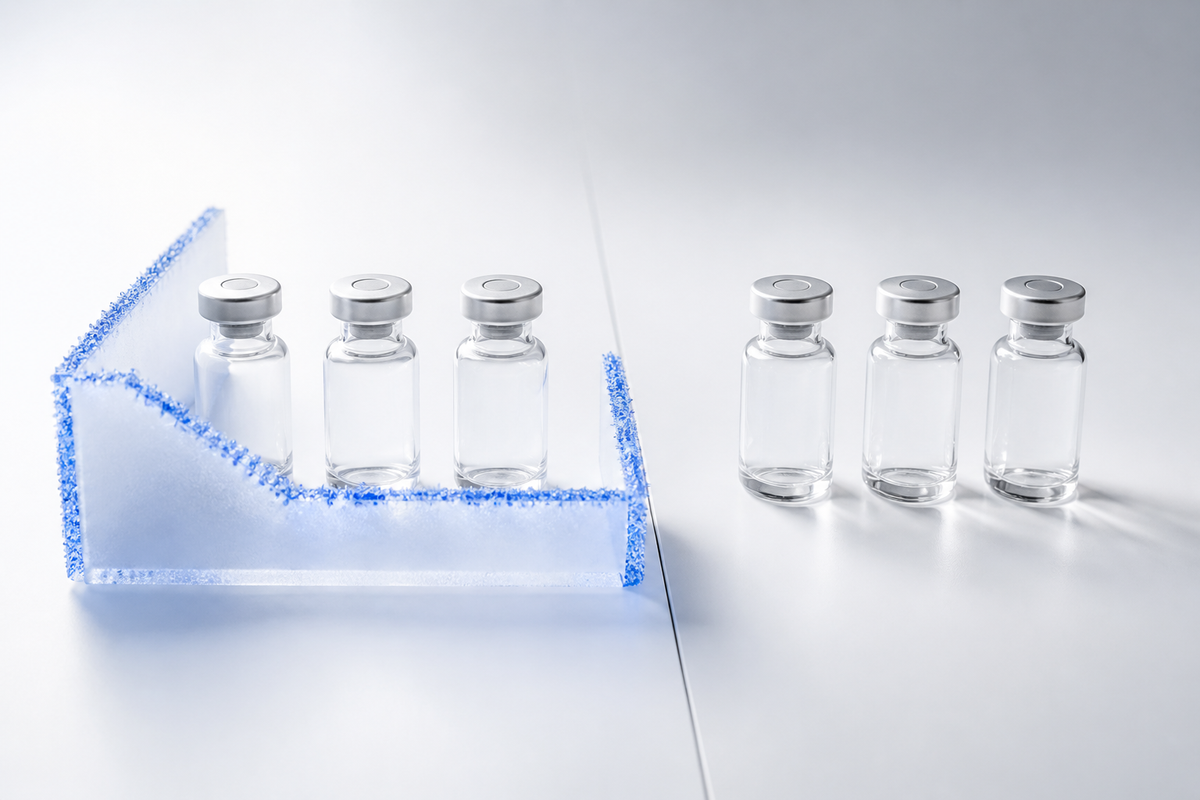
A lot of cross-border beauty buying runs on a quiet worry: that a product which sat in a warm warehouse, or spent a day in a delivery van, is somehow already ruined. The instinct is understandable, but it mixes two different things. Most skincare is not a vaccine, and the standards that govern storage are written as ranges over time, not a single perfect number. Knowing which of your products genuinely needs to travel cold, and which simply needs to arrive and then be stored sensibly, is the difference between real caution and needless anxiety.
Not everything that ships needs to ship cold
The phrase cold chain refers to a controlled, refrigerated path from origin to destination, the kind used for products that degrade outside a narrow band of temperature. It is a real requirement for a specific set of goods. It is also widely over-applied to categories that do not need it. A large share of skincare, including many serums, ampoules, and cosmetic formulations, is designed to be stable at ordinary indoor temperatures rather than in a refrigerator. The right question is never whether something traveled warm at some point, but what range its own label was built for.
What the storage standards actually say
Pharmaceutical storage uses defined temperature bands, and they are broader than most people assume. Controlled Room Temperature is set at 20 to 25 degrees Celsius, with permitted excursions between 15 and 30 degrees, and even brief transient spikes tolerated under specific conditions. Refrigerated, the true cold chain band, is a much tighter 2 to 8 degrees.1 These are not interchangeable, and the gap between them is exactly the point: a product built for room temperature is not living on the edge of a refrigerator setting.
| Storage class | Temperature band | Typically applies to |
|---|---|---|
| Controlled Room Temperature | 20 to 25 C, excursions 15 to 30 C | Many cosmetic formulations and room-stable injectables |
| Controlled Cold | 2 to 15 C | Products with a wider cool range on the label |
| Refrigerated (cold chain) | 2 to 8 C | Select biologics and products the label marks refrigerate |
Read against this, a label that lists a range such as 2 to 30 degrees is telling you something useful: the product is meant to hold across a wide span, with refrigeration neither required nor implied. Across the K-derma catalog, that wider, room-stable range is common on ampoules and contouring solutions, while a smaller set of items carry a stricter cold instruction. The label is the instruction, not the rumor.
Why a few warm hours is not the same as spoiled
Temperature standards are evaluated as exposure over time, not as a single reading. The relevant guidance treats an excursion by both its extent and its duration, using the idea of mean kinetic temperature to weigh how warm, for how long, rather than condemning a product for one warm afternoon.2 A short period outside the ideal band, within what the product was stability-tested to tolerate, is a normal part of real-world distribution. This is why a sealed product that spent a few hours warm in transit, then returned to a sensible range, is usually still within its intended conditions. The honest answer to does warmth ruin it is: it depends on how warm and how long, measured against that item's own label, not a momentary fear.

What to check before a cross-border order
For temperature, a short and practical checklist does more than any general worry:
- Read the storage range on the product itself, and take that band as the standard, not a refrigerator by default.
- Separate the genuinely cold-chain items, those marked 2 to 8 degrees or refrigerate, from the room-stable majority.
- For the cold-chain items, ask the seller directly how they are packed and shipped, and whether that lane suits your destination.
- Once a parcel arrives, store each item by its own label promptly, since storage after delivery is the part fully in your hands.
- Weigh transit time and clearance speed, because a shorter, more predictable journey narrows the window any product spends in transit at all.
Where transit time becomes a storage question
The last point is where shipping and storage meet. No general courier refrigerates a standard parcel, so for room-stable products the practical goal is not refrigeration but a short, predictable transit that limits how long anything sits in an uncontrolled environment, plus reliable clearance so a box is not stalled warm at a border. From a sourcing standpoint, that is the same logic behind a dedicated lane. For US orders, KSTATION moves shipments on a dedicated aesthetic and medical line rather than a general parcel network, with standard delivery quoted at about four to seven business days and customs clearance the line treats as its core job, reported by the store at over 97 percent over the past five years against roughly 60 to 70 percent for a standard courier.3 Those are the store's own figures, not an independent audit, and they describe transit time and clearance, not refrigerated packaging. For anything a label marks as genuinely cold, confirm handling for that specific item before you order.
You can see the full shipping breakdown on the customs clearance page, and the room-stable catalog those timelines apply to runs across the skin boosters and ampoules range. Whether a given product may be imported into your market remains a question for you and your local authority.
Frequently asked questions
Frequently asked
Does Korean skincare need refrigerated shipping?
Most does not. A large share of cosmetic formulations and many ampoules are built for Controlled Room Temperature, roughly 20 to 25 degrees with allowed excursions, rather than the 2 to 8 degree refrigerated band.1 The exception is any item whose label specifies refrigeration, which should be treated as a genuine cold-chain product.
What is controlled room temperature?
It is a defined storage band of 20 to 25 degrees Celsius, with permitted short excursions between 15 and 30 degrees. It is a range judged over time, not a single fixed point, which is why brief, limited warmth is usually within the intended conditions.1
Does a few hours warm in transit ruin a product?
Not by itself, for a room-stable product. Storage standards weigh an excursion by how warm and for how long, against what the item was stability-tested to tolerate.2 A short warm period followed by a return to a sensible range generally stays within range. Always read it against the specific product's label.
How can I reduce temperature risk on a cross-border order?
Buy by the label, separate any true cold-chain items and confirm handling for those, choose a shorter and more reliably cleared transit to limit time in an uncontrolled environment, and store each product by its own instructions as soon as it arrives.3
Disclaimer. This article is general educational information, current as of its publication date, and is not medical, pharmaceutical, or regulatory advice. Storage classifications, excursion allowances, and product-specific requirements differ by item and change over time; always follow the storage instructions on the individual product and confirm any cold-chain handling with the seller. Clearance and delivery figures cited are KSTATION's own published statistics, not an independent audit.
Sources & references
- USP packaging and storage temperature definitions, summarized: Controlled Room Temperature 20 to 25 C (excursions 15 to 30 C) and Refrigerated 2 to 8 C. Sensitech, USP <659> Packaging and Storage Requirements explained. sensitech.com
- USP General Chapter <1079>, Good Storage and Distribution Practices: excursion acceptability depends on both extent and duration of exposure, evaluated with mean kinetic temperature. Helmer Scientific summary. helmerinc.com
- KSTATION SHIPPING, customs clearance page (dedicated aesthetic and medical line; standard delivery about four to seven business days; stated over-97% clearance rate over five years against roughly 60 to 70 percent for standard courier). kstations.com/pages/customs-clearance