Most actives in an injectable cocktail are cooperative. They dissolve, they hold their concentration, and they sit next to their neighbors without incident. Vitamin C is not one of them. Ascorbic acid is acidic enough to change the character of whatever it is added to, unstable enough that oxygen and daylight are adversaries, and quick enough to degrade in the presence of a trace of dissolved metal that the container itself becomes part of the formulation. That is why, on most Korean price lists, vitamin C is the ingredient that arrives in its own vial.
This piece is about that fact and what follows from it. It is a formulation and sourcing reading, not a mixing guide: how the molecule behaves in solution, why compounded ampoules containing it are built the way they are, and what to check on a label when you are the one buying. Preparation and administration are clinical decisions for a qualified professional, and nothing here is a protocol.
What a mesotherapy blend is, in one paragraph
Mesotherapy is a delivery technique rather than a product: a series of small, superficial injections that place a solution into the skin rather than beneath it. What is placed varies, which is exactly the point of the category. Some solutions are single-active, some are compounded blends of hyaluronic acid, nucleotide polymers, amino acids, and vitamins, and the composition is what regulators, customs officers, and buyers actually read. We set the technique out in full in mesotherapy, explained; this piece narrows to one component of the blend and the trouble it causes.
The trouble is worth naming precisely, because it is not a marketing problem or a quality problem. It is chemistry. A blend has one pH, one oxygen exposure history, and one storage condition, and every component in it has to be compatible with the compromise. Vitamin C is the component with the least room to compromise.
The molecule that argues with its own container
L-ascorbic acid is a small, water-soluble molecule whose entire usefulness rests on being a reducing agent, which is another way of saying it is designed to be oxidized. In a body that is a feature. In a vial it is the central engineering problem, because the same reaction that makes ascorbate biologically interesting also proceeds quietly in solution, converting it to dehydroascorbic acid and onward to breakdown products with no antioxidant character at all.
pH: the number that decides what it can sit next to
Ascorbic acid is an acid, and not a mild one at concentration. Its first ionization constant sits near pH 4, which means that a concentrated aqueous solution of the free acid lands well down the acidic end of the scale, far from the near-neutral range an injectable solution is expected to occupy.1 Manufacturers resolve this by neutralizing: the free acid is partially or fully converted to its salt, sodium ascorbate, with sodium hydroxide or sodium bicarbonate, which brings the finished solution back toward a physiologically tolerable pH. That is why the two names appear on labels interchangeably and why a product that lists only "vitamin C" has told you less than it seems.
The consequence for blending is direct. A component that must be neutralized to be injectable brings a buffering demand with it, and ascorbate has meaningful buffering capacity of its own across roughly pH 3 to 5, extending upward at high concentration.1 Adding it to a blend does not simply add an active; it moves the pH of the whole solution and then resists moving back. Neighboring components that are only stable in a narrow band, or that precipitate outside it, are now constrained by a decision made about the vitamin.
Oxygen, light, and the metal you did not add
The second constraint is that ascorbate oxidizes readily in near-neutral aqueous solution, and the reaction is accelerated by dissolved oxygen, by light, and catalytically by trace transition metals such as copper and iron.1 Trace is the operative word. These are not added ingredients; they arrive as impurities in water, in excipients, or from contact surfaces, at concentrations too low to appear on any label but high enough to matter to a molecule this reactive.
This is the reason vitamin C products look over-engineered relative to their simple composition. Amber glass, nitrogen or inert-gas headspace, chelating agents to sequester metal ions, refrigerated storage, and cartons that are not meant to be opened until use are all responses to the same reaction. The FDA-approved intravenous ascorbic acid product in the United States, for example, is labeled for storage at 2 to 8 degrees Celsius, protected from light and kept in its carton until the time of use.3 When a spec sheet for an ampoule reads like a cold-chain document, the packaging is describing the molecule.
Temperature and time, the two variables nobody prints on the front
The third constraint is the least visible, because it acts on a schedule rather than an event. Ascorbate in a finished aqueous product does not fail suddenly; it declines, and the slope of that decline is set by storage temperature and elapsed time. Work on parenteral admixtures containing ascorbic acid has characterized exactly this pattern, with content holding above ninety percent of the declared value under refrigeration while degradation increases progressively with both warmer storage and longer standing.2
Two things follow for a buyer. The first is that "stable" is always a conditional claim, true within a stated temperature and a stated window, and a stability statement without both numbers has not said anything checkable. The second is that the interval between manufacture and use is part of the specification whether or not anyone writes it down. A product that has spent an unknown period at an unknown temperature has an unknown ascorbate content, and it will present exactly as it did on the day it left the plant.
Why it usually arrives in its own vial
Put the two constraints together and the packaging logic writes itself. A blend that contains ascorbate begins degrading from the moment it is mixed, at a rate set by its pH, its oxygen exposure, and whatever trace metal is present. Manufacturers therefore have three broad options, and the Korean range contains examples of all three.
| Approach | What it looks like | What the buyer reads for |
|---|---|---|
| Standalone vial | Ascorbic acid or sodium ascorbate as a single-active solution, combined at the point of use if at all | Stated form and concentration, pH or neutralization, storage and light protection |
| Lyophilized powder | Dry vitamin C reconstituted immediately before use, so the aqueous phase is as short as possible | Reconstitution volume and diluent, hydration and use-by window after reconstitution |
| Compounded ampoule | A pre-mixed multi-component solution in which vitamin C is one declared ingredient among several | Full ingredient declaration with quantities, buffering, expiry and storage for the finished blend |
The standalone vial is the most common presentation for straight ascorbic acid in the Korean catalog, and the reason is simply that it defers the compromise. Nothing is decided about pH or oxygen exposure until the product is actually used, which places responsibility on the professional rather than on a formulation that has been sitting in a warehouse. The lyophilized route is the same logic taken further, and it is the identical strategy used for glutathione, another antioxidant whose aqueous instability drives its packaging, as we covered in why glutathione ships as a freeze-dried powder.
The compounded ampoule is the interesting case, because it means a manufacturer took on the blending problem deliberately and holds the stability data for the finished solution rather than for its components. That is a legitimate and common approach; it simply moves what you have to verify.
Reading a compounded ampoule that already contains vitamin C
When vitamin C is one line in a multi-ingredient ampoule, the questions change. A single-active vial can be read on the strength of its molecule. A blend has to be read as a blend, because its stability is a property of the whole solution, not of the most fragile component alone. Four things carry most of the weight.
- The full declaration, with quantities. Every component named, each with an amount per unit volume. A list of ingredient names with no numbers is not a composition; it is a description. Quantities are also what customs authorities and importers will read.
- The form of the vitamin C. Ascorbic acid, sodium ascorbate, or a stated combination. This tells you what was neutralized and how, and it is the difference between two products that both say "vitamin C" on the front.
- Storage and light protection for the finished product. Not for ascorbate in general, but for this blend, at this pH, in this container.
- The expiry and the after-opening window. A compounded solution has a shelf life as a solution, and the interval after opening is usually far shorter than the interval before it.
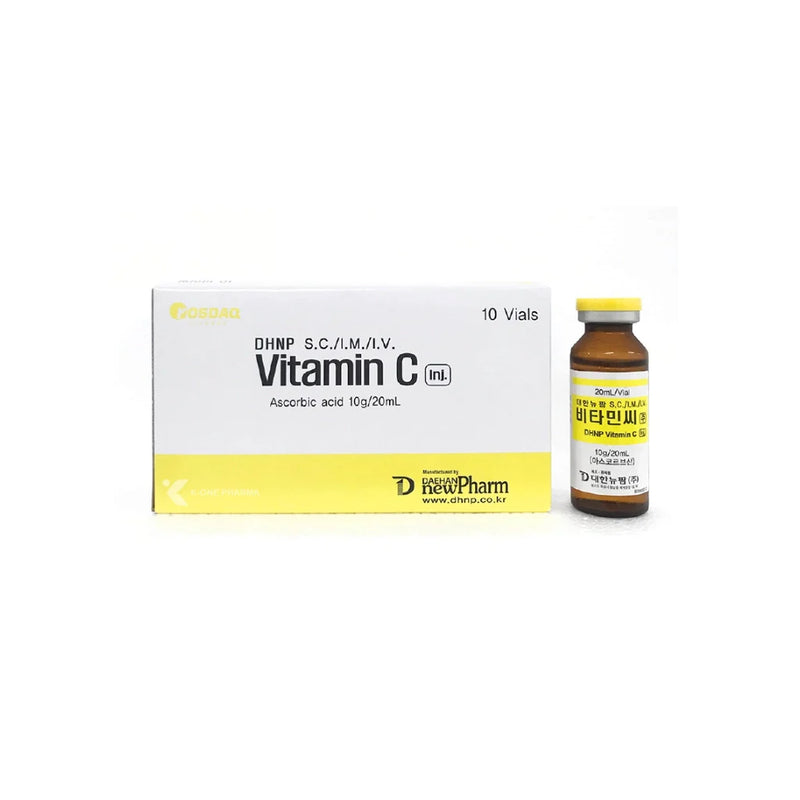
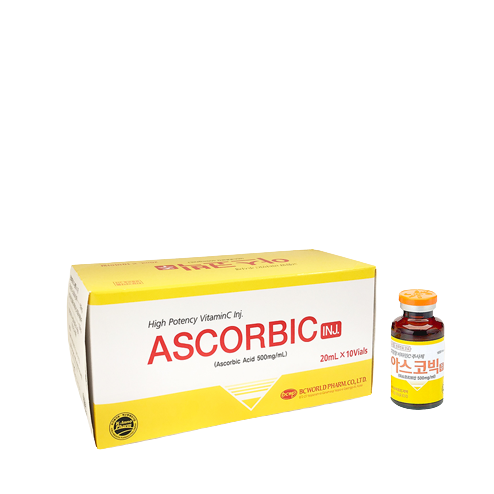
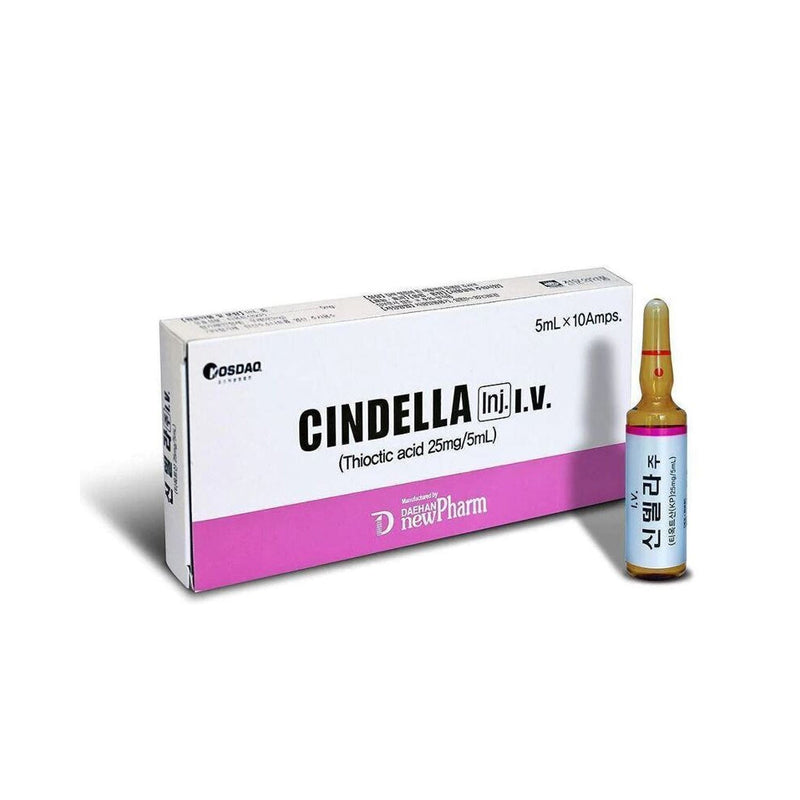
Two related products in the Korean range illustrate the split. Straight single-active vitamin C reaches the market as a plain injectable solution, of the kind sold as VITAMIN C Inj or BC ASCORBIC Inj, where the label is short and the reading is about form, concentration, and storage. Compounded ampoules such as CINDELLA Inj sit in the other category, where vitamin C is declared alongside other components and the stability data belongs to the finished blend. Both are in the vitamins and injectables range; they are read differently, and comparing their prices without noticing the difference compares two unlike things.
Concentration is not comparable across formats
One consequence deserves stating on its own, because it is where most quick comparisons go wrong. A milligram of ascorbate in a single-active vial and a milligram of ascorbate declared inside a compounded blend are not equivalent units for purchasing purposes. The first is a quantity you control at the point of use; the second is a quantity fixed by a formulation whose other components, buffering, and storage history you are also buying. Comparing the two on milligrams alone treats a formulation decision as if it were a bulk commodity.
The one signal the solution gives away
Ascorbate degradation is mostly invisible, but not entirely. As oxidation proceeds, the breakdown products of ascorbic acid absorb light differently from the intact molecule, and a solution that began water-clear can take on a yellow cast. This is the reason injectable labeling in this class routinely instructs a visual inspection for discoloration and particulate matter before use, and why ASCOR-type products specify light protection and carton storage in the same breath as their expiry.3
It is a genuinely useful signal and a badly limited one, and both halves matter. A discolored vitamin C solution has told you something definite. A perfectly clear one has told you almost nothing, because meaningful potency loss occurs well before any visible change. Colour is a floor, not a test: it can rule a vial out, but it cannot rule one in, and no inspection of the container substitutes for knowing how it was handled on the way to you.
What the blend cannot change
Formulation solves stability problems. It does not solve regulatory ones, and the two are routinely confused in this category.
In the United States, an intravenous ascorbic acid product does hold FDA approval, but its approved indication is narrow: short-term treatment of scurvy in patients for whom oral administration is not possible, insufficient, or contraindicated, with an explicit limitation that it is not indicated for vitamin C deficiency without the signs and symptoms of scurvy.3 That is the whole of the approved use. No injectable vitamin C is FDA-approved for aesthetic or skin-related purposes, and topical ascorbic acid is sold as a cosmetic only for as long as no drug-like claim is attached to it.4 In South Korea, injectable vitamin C is handled as a drug under the Ministry of Food and Drug Safety rather than as a cosmetic, which is why these products carry drug-style labeling and licensing rather than cosmetic ingredient lists.
Adding vitamin C to a blend does not move a product between those categories, and a compounded ampoule does not acquire a broader status than its components. Buyers occasionally read a multi-ingredient formulation as though complexity implied approval. It does not. Status is regional, product-specific, and changes over time; confirm it for the destination market with the relevant authority rather than inferring it from a composition.
Where sourcing fits
An antioxidant is the one class of product where provenance and potency are the same question. A vial of ascorbate that has been warm, bright, or old is still labeled as ascorbate; the label does not degrade with the contents. There is no visual inspection that resolves this, which puts the entire weight on the chain: who made it, under what license, how it was stored between the factory and the buyer, and whether that chain can be reconstructed on request.
That is the practical reason we treat the antioxidant lines as a sourcing-first category rather than a specification-first one. Manufacturer and licensing details are checked against MFDS records before a product is listed, storage handling is part of the assessment rather than an afterthought, and we stock officially sourced products only. The method is set out in our Editorial & Sourcing Policy, and the product-level authenticity checks that apply across injectables sit in our guide to verifying an authentic Korean booster.
For the single-molecule reading that sits underneath all of this, including form, concentration, and what a vitamin C label does and does not disclose, start with reading an injectable vitamin C. For where this active sits among the other antioxidants on the shelf, see antioxidant injectables, explained. The fuller compounded range sits under mesotherapy.
Frequently asked questions
Frequently asked
Why is vitamin C usually supplied in its own vial rather than pre-mixed?
Because ascorbate oxidizes readily in near-neutral aqueous solution, accelerated by dissolved oxygen, light, and trace metal ions, and because it is acidic enough to shift the pH of whatever it is blended into. Keeping it separate defers both problems until the point of use rather than fixing them in a formulation that then has to survive storage and shipping.
What is the difference between ascorbic acid and sodium ascorbate on a label?
They are the free acid and its sodium salt. Injectable products are neutralized so that the finished solution sits near a physiologically tolerable pH, which is typically achieved by converting some or all of the ascorbic acid to sodium ascorbate. A label that names only "vitamin C" has not told you which form or how it was neutralized.
Are compounded vitamin ampoules better than single-active vials?
Neither is better as a category; they place the formulation decision in different hands. A single-active vial defers pH and oxygen exposure to the point of use. A compounded ampoule fixes them in advance, which means the manufacturer holds stability data for the finished blend and the buyer should read the full quantitative declaration and the storage terms for that blend.
Is injectable vitamin C approved for aesthetic use?
No. In the United States the approved intravenous ascorbic acid indication is short-term treatment of scurvy where oral administration is not possible, with an explicit limitation excluding vitamin C deficiency that lacks the signs and symptoms of scurvy. In South Korea injectable vitamin C is regulated as a drug under the MFDS. Confirm the status of a specific product for the destination market with the relevant authority.
Disclaimer. This article is general educational information and is not medical advice. It describes how injectable vitamin C behaves in solution and how such products are specified, packaged, and regulated; it is not a preparation, mixing, or administration guide, and it makes no claim about what any product achieves for an individual. Products referenced are intended for professional use. Regulatory status varies by country and changes over time; confirm current requirements with the relevant authority.
Sources & references
- Stability of aqueous solutions of ascorbate for basic research and for intravenous administration (2023), oxidation in near-neutral solution, pKa and buffering range, metal-ion catalysis. pubmed.ncbi.nlm.nih.gov
- Extended Stability of Ascorbic Acid in Parenteral Admixtures: the role of storage temperature and container integrity. ncbi.nlm.nih.gov
- DailyMed, ASCOR (ascorbic acid injection) prescribing information: approved indication, limitation of use, and storage at 2 to 8 degrees Celsius protected from light. dailymed.nlm.nih.gov
- U.S. FDA, Is It a Cosmetic, a Drug, or Both? (Or Is It Soap?), structure/function vs. drug claims and market-specific regulation. fda.gov