As skin ages, the face loses volume. Fat pads shift and shrink, bone resorbs at the margins, and the soft tissue that once held a smooth contour begins to fall and fold. Dermal fillers are one tool clinicians reach for when the goal is to restore some of that lost structure, and this third part of the series looks at how they work and where they sit in a wider treatment plan rather than treating them as a single answer to facial aging.
Fillers are best understood as a category, not a product. The term covers materials with different chemistries, different behaviors in tissue, and different reasons for being chosen. Most of the conversation centers on hyaluronic acid, but the broader family also includes biostimulatory materials that work in a fundamentally different way. Keeping that distinction clear is the first step toward reading any claim about fillers honestly, and it is also why the dermal filler range spans several material types rather than one.
What are dermal fillers?
Hyaluronic acid is a sugar that occurs naturally in body tissue. The U.S. FDA describes it plainly: HA binds water and swells into a gel, which is what produces the filling and smoothing effect when it is placed under the skin.1 Because the body already contains and metabolizes HA, an HA filler is temporary by design. It adds volume by occupying space and holding water, and over months the gel is gradually resorbed.2
Not every filler works this way. A separate group of materials, including calcium hydroxylapatite (CaHA), poly-L-lactic acid (PLLA), and polycaprolactone (PCL), acts as a biostimulator. Rather than simply filling space, these products stimulate the body to produce its own collagen.3 The practical consequence matters: an HA filler and a biostimulator are not interchangeable "volume" products. PLLA (marketed as Sculptra) works gradually over weeks to months through fibroblast-driven collagen, while CaHA (Radiesse) gives an immediate lift that is followed by neocollagenesis.4 So the old shorthand that fillers deliver "immediate results" is true for HA and misleading for a biostimulator like PLLA.
The science of HA fillers
Pure hyaluronic acid would not last long in tissue, so manufacturers cross-link it, most commonly using BDDE (1,4-butanediol diglycidyl ether). Cross-linking ties the HA chains together to slow enzymatic degradation and stabilize the gel.2 How a filler then behaves is largely a matter of rheology. Its firmness and capacity to lift are governed by the elastic modulus, G prime, which describes projection and resistance to deformation, set against the viscous modulus, G double prime.5
HA fillers are also shear-thinning. Under the pressure of injection they flow well enough to extrude through a fine needle, then re-set once they are in the tissue.5 Beyond that, properties such as cohesivity, the degree of cross-linking, HA concentration, and molecular weight all act together to shape how a gel spreads and how long it persists.2 This is why two HA products can feel and behave quite differently, and why a clinician selects a specific gel for a specific tissue plane rather than reaching for a generic "filler."
What fillers are used for
The clinical uses follow from the chemistry. HA fillers are commonly placed to soften static folds such as the nasolabial lines, to restore volume in areas like the cheeks where fat has been lost, and to add definition to the lips. They are also used in contouring work around the nose and chin, and in some cases to address volume loss in the hands. Each of these sites makes different demands, which is part of why product families are sold in graded firmnesses.
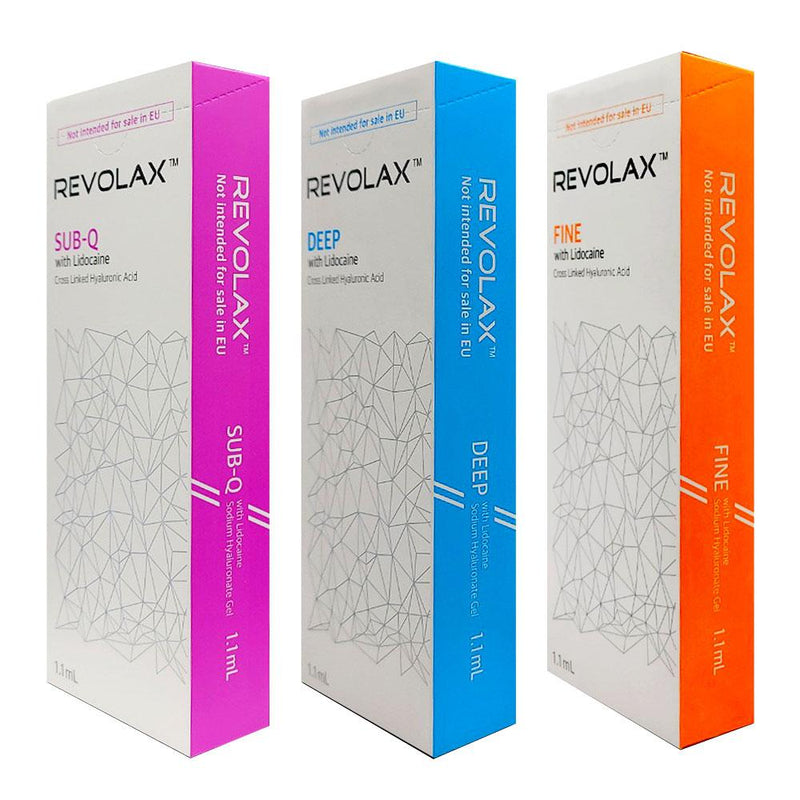
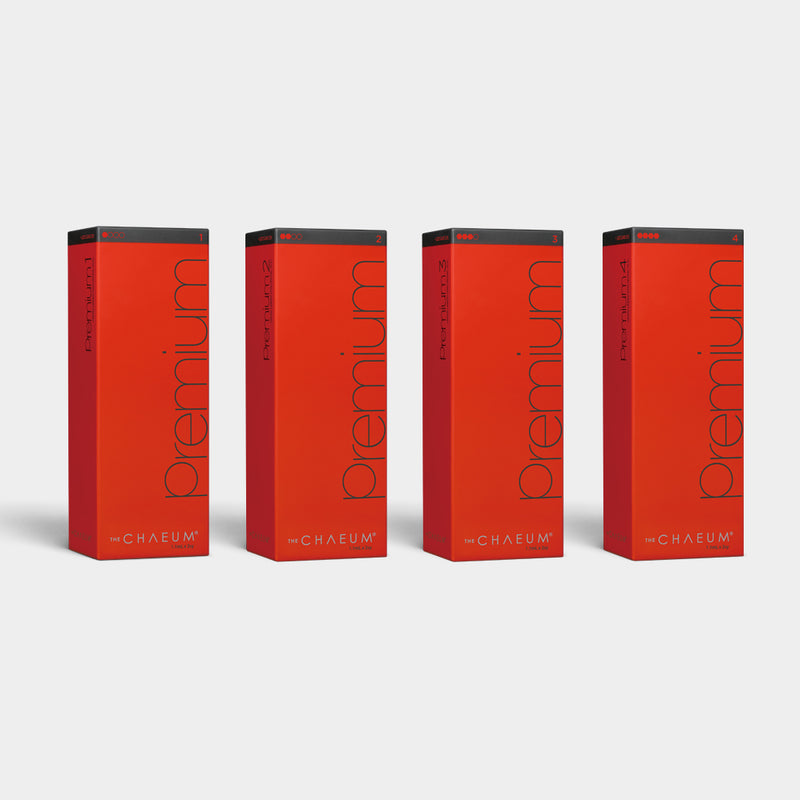
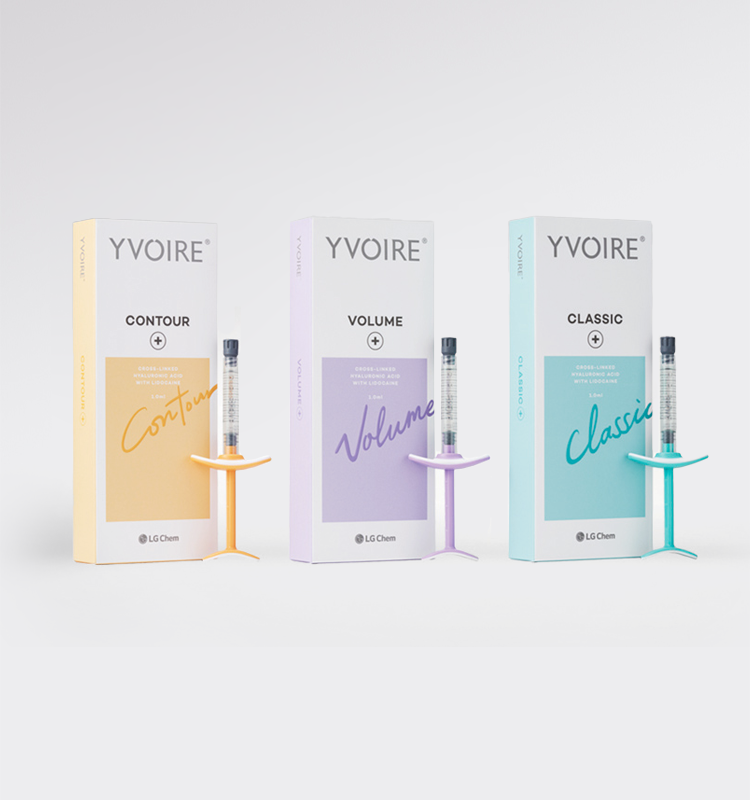
Korean HA portfolios are typically organized along exactly this logic. REVOLAX is offered as Fine, Deep, and Sub-Q variants matched to increasing depth and lift, and CHAEUM PREMIUM runs a numbered No.1 to No.4 range across the same spectrum. YVOIRE spans Classic, Volume, and Contour for fine lines through to structural projection. The naming differs, but the underlying idea is consistent: match gel rheology to the tissue plane and the correction at hand. None of this is a promise of a particular outcome, which always depends on the individual and the clinician.
Reversibility: a distinct advantage of HA
One property sets HA fillers apart from every other material in this category. They can be dissolved. Hyaluronidase, an enzyme that hydrolyzes hyaluronic acid, breaks the gel down and allows a clinician to reduce or remove product that has migrated, overcorrected, or, in an emergency, compromised a blood vessel.9 Biostimulators such as CaHA and PLLA do not share this; once placed, they cannot be enzymatically undone.9
It is worth being precise about the regulatory status. Hyaluronidase is FDA-approved as a dispersion agent for other drugs, and its use to reverse HA filler is off-label, guided by clinical consensus rather than a specific approval for that indication.9 That nuance does not diminish its value in trained hands; it simply belongs in any honest account of how the reversal works.
Safety, risks, and why a qualified professional matters
Most filler treatments are uneventful, but the procedure carries risks that should not be glossed over. The most serious are vascular: if filler is inadvertently injected into or compresses a blood vessel, it can cause vascular occlusion leading to skin necrosis, and in rare cases blindness or stroke.10 These events are uncommon, but they are why filler is a procedure for a trained, qualified injector who knows facial vascular anatomy and how to manage a complication if one arises.
This is also the strongest practical argument for HA's reversibility. A clinician who recognizes a developing vascular event can act with hyaluronidase, which is one reason many practitioners favor HA for higher-risk areas. None of this is reader how-to. Filler is a medical procedure performed by professionals, and the honest framing is that the material is only as safe as the hands and the setting it is administered in.
Where the supply side fits
A distributor cannot promise an outcome, and the science above is exactly why no responsible sourcing partner should. What we can stand behind is provenance. Dermal fillers are sterile, professional-use medical devices, and their integrity depends on authentic sourcing and an unbroken cold chain from manufacturer to clinic. We curate official-channel Korean fillers and keep that chain traceable for practitioners shipping to the US and EU.
For clinicians mapping the range, the HA families discussed here are available as REVOLAX, CHAEUM PREMIUM, and YVOIRE, each offered across graded firmnesses for different tissue planes. The fuller selection sits under dermal fillers, intended for use by qualified professionals.
Frequently asked questions
Frequently asked
How long do HA fillers last?
HA filler results are temporary, typically around 6 to 12 months, though this varies with the injection site, how much the area moves, and individual metabolism. The gel is gradually resorbed by the body.11
Can HA filler be dissolved if needed?
Yes. The enzyme hyaluronidase hydrolyzes hyaluronic acid and can break down HA filler. This use is off-label and guided by clinical consensus, and it is performed by a qualified professional. Biostimulators such as CaHA and PLLA cannot be reversed this way.9
How are HA fillers different from CaHA or PLLA?
Disclaimer. This article is general information for educational purposes and is not medical advice. Dermal fillers are professional-use medical devices, and injection is a medical procedure that should be performed only by a qualified professional. It does not describe what any product will do for an individual, and it is not a guide to self-treatment. Regulatory status, approved indications, and clinical practice vary by country and change over time; confirm current requirements with the relevant authority.
Sources & references
- U.S. FDA, Dermal Fillers (Soft Tissue Fillers) overview: HA is a sugar in body tissue that binds water and swells as a gel. fda.gov
- Peer-reviewed review on HA filler cross-linking (BDDE), cohesivity, concentration, and molecular weight as determinants of spread and longevity. pmc.ncbi.nlm.nih.gov
- Clinical overview of next-generation fillers: HA fills and resorbs, while CaHA, PLLA, and PCL biostimulate the body's own collagen. medicalsparx.com
- Same source: PLLA (Sculptra) works gradually via fibroblast collagen; CaHA (Radiesse) gives immediate lift then neocollagenesis. medicalsparx.com
- Peer-reviewed review on filler rheology: elastic modulus G prime (lift) vs viscous modulus G double prime, and shear-thinning behavior. ncbi.nlm.nih.gov
- U.S. FDA guidance: dermal fillers are regulated as Class III medical devices via the premarket approval (PMA) pathway. fda.gov
- Industry guide to major Korean filler brands (Neuramis/Medytox, Revolax/Hugel, Yvoire/LG Chem), MFDS-approved and many CE-marked. cheongdamskinclinic.com
- Regulatory status reference: as of 2025, Revolax and Neuramis are not FDA-approved for the US (CE/MFDS for EU/Korea). medsupplysolutions.com
- Peer-reviewed review on hyaluronidase: HA fillers are uniquely reversible; hyaluronidase is FDA-approved as a dispersion agent, and its use to reverse HA filler is off-label and consensus-guided. pmc.ncbi.nlm.nih.gov
- Peer-reviewed review on filler complications: rare but serious vascular occlusion leading to skin necrosis, blindness, or stroke from intravascular injection. ncbi.nlm.nih.gov
- Peer-reviewed reference on HA filler duration: results are temporary, typically around 6 to 12 months, varying by site, movement, and metabolism. pmc.ncbi.nlm.nih.gov