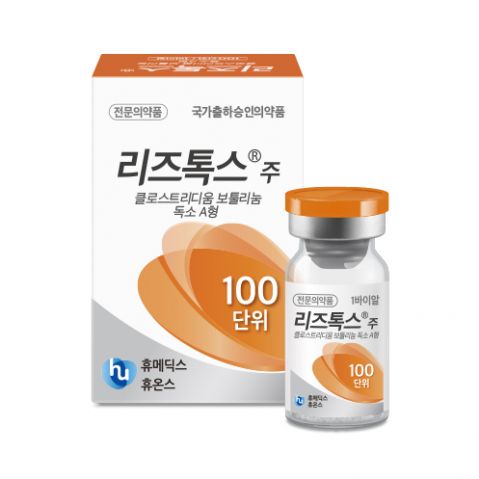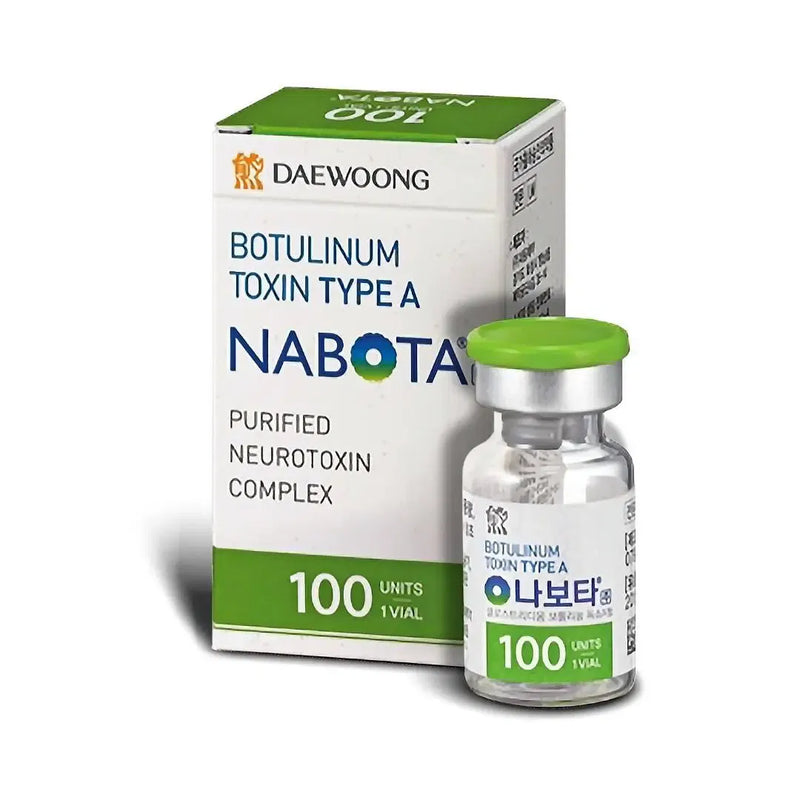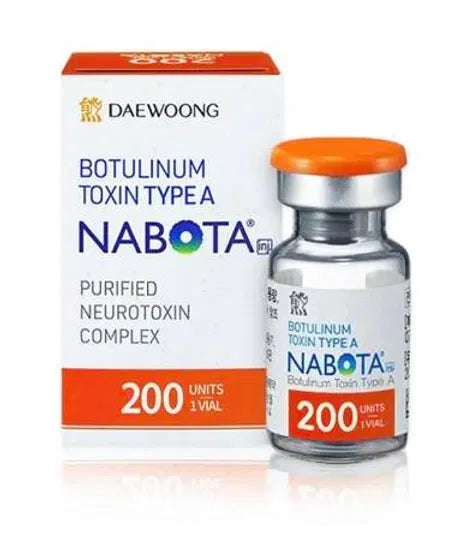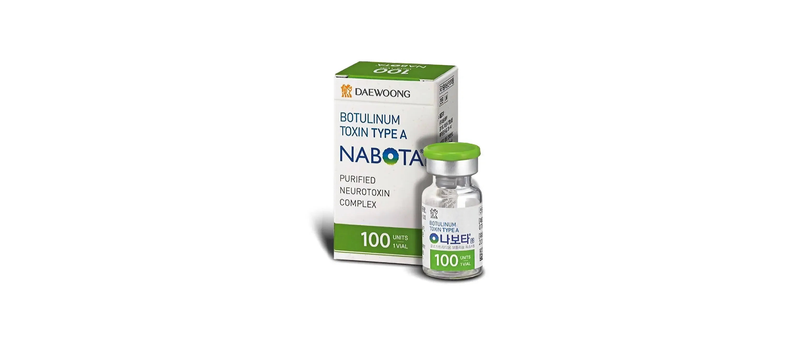
LIZTOX and NABOTA are both Korean botulinum toxin type A products, both refrigerated powders in a single vial, and both licensed as prescription medicines. Read field by field on the Korean drug register, they still differ in ways a buyer can check on a carton: who holds them, which unit sizes exist, how the dried product is described, what the albumin entry says, and whether an export name is written into the licence.
LIZTOX and NABOTA on the register, side by side
LIZTOX is held by Huons BioPharma and NABOTA by Daewoong Pharmaceutical. Each holds several filings, one per unit size, and the table compares the 100 unit filings, which are the oldest in each line.
| Field | LIZTOX 100 units | NABOTA 100 units |
|---|---|---|
| Licence holder | Huons BioPharma (휴온스바이오파마) | Daewoong Pharmaceutical (대웅제약) |
| Granted | 10 October 2016 | 29 November 2013 |
| Export name in the licence | Hutox (휴톡스주100단위) | None recorded |
| Declared additives | Sodium chloride, albumin | Sodium chloride, human serum albumin |
| Dosage form on file | White freeze-dried powder in a clear vial | White or pale yellow vacuum-dried product in a clear vial |
| Storage and shelf life | Sealed, refrigerated 2 to 8°C; 36 months | Sealed, refrigerated 2 to 8°C; 36 months |
| Re-examination period on file | 11 February 2025 to 10 February 2029 | 25 August 2023 to 24 August 2027 |
| Registered barcodes | 8800546000104, 8800546000111, 8800546000128 | 8806416056301, 8806416056318 |
Storage, shelf life, pack (one vial per box), ATC code and specification type are the same. Both filings list their specification as 별규, a separate specification that the open register does not publish, so neither record can be used to compare what is inside the vial beyond the declared ingredients. Everything that differs is in the rows above, and each of those rows is something a carton or a document can be checked against.
Unit sizes: NABOTA has a 150 unit filing, LIZTOX does not
NABOTA's four filings came in quick succession: 100 units in November 2013, 50 units in January 2015, 200 units in June 2015 and 150 units in May 2016. LIZTOX's first filing, at 100 units, was granted four and a half months after that last NABOTA filing, in October 2016. Its 50 and 200 unit filings followed in June and July 2021.
That leaves one size on one side only. A 150 unit filing exists for NABOTA and not for LIZTOX, and neither line has a 300 unit filing. A LIZTOX carton stating 150 units does not correspond to any Korean licence. The same check works in reverse for any size outside 50, 100, 150 and 200 on a NABOTA carton.
Freeze-dried and vacuum-dried: what each record says
Both products are dried powders that are reconstituted before use, and in English listings both are often called lyophilized. The register is more precise. Every LIZTOX filing describes a white freeze-dried powder (동결건조분말). Three of the four NABOTA filings, at 50, 100 and 150 units, describe a white or pale yellow vacuum-dried product (감압건조물). The 200 unit NABOTA filing says only that it is a white or pale yellow dried product, without naming the method.
Two practical points come out of that. The colour range differs: a NABOTA record allows white or pale yellow, a LIZTOX record says white. And a vacuum-dried cake can be very thin, so a NABOTA vial may look almost empty before reconstitution, a point we noted in our broader comparison of Korean toxins by maker and form. Neither description is a quality signal. Each is a check on whether the vial in hand matches the filing named on its carton.
The albumin entry is written two different ways
Both products declare two additives, sodium chloride and albumin, which is the common pattern among Korean toxins. The difference is in how the albumin is entered. NABOTA's filings list 사람혈청알부민, human serum albumin, under its own ingredient code. LIZTOX's filings list 알부민, albumin, under a different code, without naming a source in that field.
That is a difference in how each holder entered the ingredient, and the open record stops there. It does not say whether the albumin in the two products differs in source or grade, and we do not infer it. For a buyer, the use is narrower: if a carton or insert lists ingredients, the wording should match its own filing. The full set of LIZTOX additives and their relationship to WONDERTOX, made in the same plant, is covered in our WONDERTOX monograph.
Re-examination windows, opened on revision days
Both 100 unit filings carry a four-year re-examination period, a post-approval window recorded on the licence. Each one starts on the same day its filing's indications, dosage and precautions were revised: 25 August 2023 for NABOTA and 11 February 2025 for LIZTOX. NABOTA's 50, 150 and 200 unit filings carry the remaining portion of the same window, starting 1 February 2024 and ending with the 100 unit filing's on 24 August 2027.
The register records the dates and does not explain what prompted the revisions, and the revised indication text is outside the scope of this article. The practical point is about paperwork: insert wording printed before those dates may differ from current wording on both products while still belonging to the same filing.
Export names and barcodes
Every LIZTOX filing writes an export name into the licensed product name: 휴톡스주, Hutox, followed by the unit count. A carton reading Hutox can therefore be matched to a LIZTOX filing directly. NABOTA's filings record no export name. NABOTA is also approved in the United States under a different brand, as described in our NABOTA monograph, but that is a separate product registered in a separate market and does not appear in the Korean record.
The barcodes give the most direct check. LIZTOX codes begin 8800546 and NABOTA codes begin 8806416, and each unit size has its own set. A carton whose brand name and barcode prefix point to different companies is the clearest single sign of a relabelled box.
Sourcing LIZTOX and NABOTA
KSTATION supplies LIZTOX 100 Units, NABOTA 100 Units and NABOTA 200 Units through official Korean channels, one vial per box as on the filings. The rest of the range, with both makers' other sizes where we carry them, sits under botulinum toxins.
Frequently asked
What is the difference between LIZTOX and NABOTA?
On the Korean register they have different licence holders (Huons BioPharma and Daewoong), different unit lineups (NABOTA has a 150 unit filing), different dried-form descriptions (freeze-dried for LIZTOX, vacuum-dried for most NABOTA filings), different albumin entries, and different barcodes. Storage and shelf life are the same.
Is LIZTOX the same as Hutox?
Hutox is the export name written into each LIZTOX licence, for example 휴톡스주100단위 on the 100 unit filing. A Hutox carton should match a LIZTOX filing held by Huons BioPharma.
Is NABOTA freeze-dried or vacuum-dried?
The 50, 100 and 150 unit NABOTA filings describe a vacuum-dried product. The 200 unit filing describes a dried product without naming the method. LIZTOX filings describe a freeze-dried powder.
Does NABOTA come in 150 units?
Yes. NABOTA has a 150 unit filing granted in May 2016, alongside 50, 100 and 200 units. LIZTOX has filings at 50, 100 and 200 units only.
Sources and references
- Ministry of Food and Drug Safety (MFDS), Korean drug product licence register, detailed records for 리즈톡스주 50, 100 and 200 units and 나보타주 50, 100, 150 and 200 units, including holder, export name, declared additives, dosage form, storage, re-examination period, barcodes and change history, retrieved 8 October 2026.
- KSTATION product records for LIZTOX 100 Units, NABOTA 100 Units and NABOTA 200 Units, retrieved 8 October 2026.
- KSTATION editorial policy, on how product and register facts are separated in our writing.
Register figures are a reading taken on 8 October 2026. Licences and their detailed records change without notice. This article compares licence records and carton facts for professional buyers. It does not compare how the products perform, how they are prepared or used, or what they are indicated for.