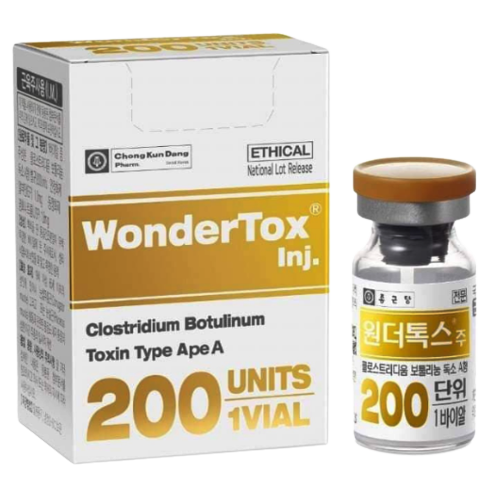
Pick up a box of WONDERTOX and two Korean company names can end up in front of you. One is Chong Kun Dang, which holds the licence. The other is Huons BioPharma, which makes the product under contract. A buyer who knows only one of those names will read the other as a warning sign. Both are correct, and knowing why is most of what it takes to verify this product.
What WONDERTOX is, as the Korean register records it
WONDERTOX is a botulinum toxin type A injection licensed in Korea as a prescription-only medicine. The Korean drug register holds three filings under the name 원더톡스, all currently valid and all held by Chong Kun Dang Pharmaceutical. They differ by unit content, and each unit size is its own licence rather than a pack variant of a single one.
| Licensed product name (English name on file) | Units per vial | Granted | Licence holder | Manufacturer on file |
|---|---|---|---|---|
| 원더톡스주100단위 (WonderTox Inj. 100unit) | 100 | 12 August 2019 | Chong Kun Dang | Huons BioPharma |
| 원더톡스주50단위 (WonderTox Inj. 50unit) | 50 | 15 June 2021 | Chong Kun Dang | Huons BioPharma |
| 원더톡스주200단위 (WonderTox Inj. 200unit) | 200 | 9 July 2021 | Chong Kun Dang | Huons BioPharma |
The rest of the record is short and consistent across all three. The declared active is Clostridium botulinum toxin type A. The two declared additives are albumin and sodium chloride. The product type code is [06320], toxins and toxoids, the classification every botulinum toxin in the Korean register shares. The dosage form is described as a white freeze-dried powder in a clear vial that forms a clear solution in saline, and the shelf life on file is 36 months from the date of manufacture. The ATC code is M03AX01, the international code for botulinum toxin.
None of that separates WONDERTOX from its neighbours, and it is not meant to. Toxin filings in Korea look alike at this level because the substance is the same and the regulator describes it in the same words. We have shown how little a spec sheet separates within this category in ten toxin brands, one ingredient line. What does separate WONDERTOX is in the last column of that table.
Licence holder and manufacturer are two different fields
A Korean drug licence names the company that holds it. That company answers to the regulator for the product: the filing, the labelling, the post-marketing record. Most of the time it also makes the product, and the register has nothing further to say. When it does not, the detailed record carries a second field for the contract manufacturer, the company whose plant actually produces the finished goods.
For WONDERTOX that field is filled on all three filings, and it names the same company every time: Huons BioPharma. Chong Kun Dang holds the licences. Huons BioPharma makes the product. The arrangement is visible in the public record, and it has been there since the first filing was granted in 2019.
This is the fact that confuses buyers, because it surfaces in places that were never designed to be read together. A carton or a distributor listing may lead with the licence holder. A specification sheet may list the manufacturer. Our own product pages show the effect: the WONDERTOX 200U page states Huons BioPharma in its specification block, while the product record names Chong Kun Dang. Neither is a mistake. They are answering different questions, and the register is where both answers sit side by side.
The practical rule follows directly. For WONDERTOX, seeing Huons BioPharma on paperwork is expected and is not evidence of substitution. Seeing a licence holder other than Chong Kun Dang would be. The distinction matters because a simple rule that treats any unfamiliar company name as a red flag would, applied to this product, raise a false alarm on genuine stock.
How often a Korean toxin is made by someone else
Reading every filing in the Korean drug register whose declared ingredient is Clostridium botulinum toxin type A, 57 are currently valid. Fourteen of those name a manufacturer other than the licence holder. Five of the fourteen are imported products, where the Korean licence holder is a local subsidiary and the named manufacturer is the overseas plant, which is how import licences are structured everywhere. That leaves nine domestic filings in which one Korean company holds the licence and a different Korean company makes the product.
| Named manufacturer | Licence holder | Filings |
|---|---|---|
| Huons BioPharma | Chong Kun Dang (WONDERTOX) | 3 |
| Huons BioPharma | Humedix | 1 |
| Medytox | Numeco | 2 |
| Daewoong Pharmaceutical | Daewoong Bio | 1 |
| Protox | Medica Korea | 1 |
| Cadila Pharmaceuticals and Korea BMI | ATGC | 1 |
Two things stand out. The first is that Huons BioPharma appears as manufacturer on four filings held by other companies, more than any other domestic plant. The second is that WONDERTOX accounts for three of the nine domestic contract filings on its own. Among the brands a buyer is likely to encounter by name, it is the clearest case in the register of a toxin whose licence holder and maker are different companies.
For contrast, the products most buyers compare it against carry no manufacturer field at all. Nabota's filings are held by Daewoong and name no separate manufacturer, and the same is true of Hugel's Botulax filings and of Medytox's own INNOTOX and Coretox. Those companies make what they hold. The difference is not a quality signal in either direction. It is a structural fact that changes which names you should expect to see.
WONDERTOX and LIZTOX, read side by side
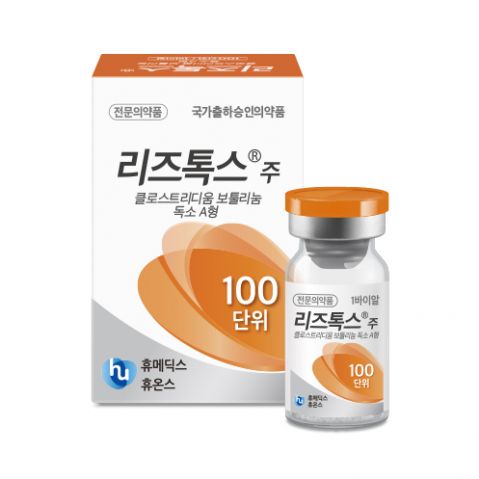
Huons BioPharma also holds its own toxin licences, sold domestically as LIZTOX and carrying the export name Hutox. Put the two sets of filings next to each other and the overlap is hard to miss.
Both lines have filings at 50, 100 and 200 units. The 50 unit filings for WONDERTOX and LIZTOX were both granted on 15 June 2021. The 200 unit filings were both granted on 9 July 2021. Both declare the same two additives, albumin and sodium chloride. The dosage form description is word for word the same, and when the description on the 200 unit filings was revised, the change was recorded on the same day, 6 August 2026, on both.
The differences are just as clear. The licence holders are different companies. The LIZTOX filings carry an export name and WONDERTOX carries none. The barcodes registered to each filing are different, and none of the barcodes on file for WONDERTOX appears on a LIZTOX filing. The 100 unit filings were granted almost three years apart, LIZTOX in October 2016 and WONDERTOX in August 2019.
What the register does not say is that the two products are the same. The specification field on every one of these filings reads 별규, meaning a separate specification that is not published in the open data. The public record can tell you that the same plant makes both lines and that their filings move in step. It cannot tell you whether the contents are identical, and anyone who states that they are, or that they are not, is going beyond the record. For sourcing purposes this is the useful conclusion: a vial is WONDERTOX or LIZTOX according to the carton, the licence holder and the barcode, not according to who made it. A supplier who offers one as a substitute for the other is offering a different licensed product.
Unit sizes: three filings, two in our range
The three WONDERTOX filings cover 50, 100 and 200 units per vial. There is no filing for any other size. That makes unit content one of the simplest checks available: a WONDERTOX carton that states 150 or 300 units does not correspond to any Korean licence, whatever else it gets right.
KSTATION stocks the 100 unit and 200 unit presentations, one vial per box, which matches the pack unit recorded in the register for both filings. The 50 unit filing is valid but not in our range. If you are comparing prices across suppliers, compare like with like: a price per vial means nothing until the unit content on the carton has been confirmed, and the carton is the place to confirm it, since the vial label is small and the outer box carries the full product name.
How to verify WONDERTOX before it ships
Confirm the licence holder. Every WONDERTOX filing is held by Chong Kun Dang. The Korean name on the carton, the product name 원더톡스주 followed by the unit count, and the licence holder should agree. A carton or document that presents another company as the licence holder for WONDERTOX is describing something the register does not contain.
Expect the manufacturer, do not flag it. Huons BioPharma named as manufacturer is consistent with all three filings. If a supplier's documentation shows it, that is a point of agreement with the register, not a discrepancy. If a supplier cannot tell you who the manufacturer is, that is worth noting, because the answer is public.
Match the unit content to a filing. 50, 100 or 200 units, one vial per box. Anything else is not a WONDERTOX licence.
Check the barcode against the product, not the brand. Each filing has its own registered barcodes, and they differ between WONDERTOX and LIZTOX even where the manufacturer is the same. A barcode that resolves to a different product is the most direct sign of a relabelled or substituted carton. Our general method for reading what is printed on a carton, including batch and expiry fields, is set out in reading an injectable label.
Watch for the substitution offer. Because the two lines share a manufacturer, the claim that WONDERTOX and LIZTOX are interchangeable circulates in this trade. Treat an offer to supply one in place of the other as what it is: a different licensed product, however close the underlying record looks. You are entitled to receive what you ordered.
Sourcing WONDERTOX
KSTATION supplies WONDERTOX 100 Units and WONDERTOX 200 Units through official Korean channels. For readers weighing it against the other Korean toxins, how the main brands differ by maker and by form is covered in Korean botulinum toxins compared, and the full range sits under botulinum toxins, where LIZTOX is listed as its own product under its own licence.
Frequently asked
What is WONDERTOX?
WONDERTOX is a botulinum toxin type A injection licensed in Korea as a prescription-only medicine. Three filings exist, at 50, 100 and 200 units per vial, all held by Chong Kun Dang Pharmaceutical. The declared additives are albumin and sodium chloride, and the product is supplied as a freeze-dried powder in a vial.
Who makes WONDERTOX?
The Korean register names Huons BioPharma as the contract manufacturer on all three WONDERTOX filings, while Chong Kun Dang holds the licences. Seeing Huons BioPharma on WONDERTOX documentation is therefore consistent with the register rather than a sign of substitution.
Is WONDERTOX the same as LIZTOX?
The public record shows the same manufacturer, the same declared additives, and 50 and 200 unit filings granted on the same days. It also shows different licence holders, different barcodes, and an export name on LIZTOX that WONDERTOX does not carry. The product specifications are not published, so the register does not say whether the contents are identical. They are separate licensed products and should be supplied as ordered.
What is the difference between WONDERTOX and Nabota?
They are held by different companies and made differently. Nabota's filings are held by Daewoong and name no separate manufacturer, so Daewoong makes what it holds. WONDERTOX is held by Chong Kun Dang and made under contract by Huons BioPharma. Neither arrangement is a quality signal on its own. It changes which company names you should expect on the paperwork.
Sources and references
- Ministry of Food and Drug Safety (MFDS), Korean drug product licence register, product name queries 원더톡스 (3 valid filings) and 리즈톡스 (3 valid filings), with detailed records including contract manufacturer, additives, dosage form and barcodes, retrieved 18 September 2026.
- MFDS drug product licence register, active ingredient query Clostridium Botulinum Toxin Type A (58 filings, 57 valid), detailed records read for the contract manufacturer field, retrieved 18 September 2026.
- KSTATION product specifications for WONDERTOX 100 Units and 200 Units as listed on our product pages, retrieved 18 September 2026.
- KSTATION editorial policy, on how product and register facts are separated in our writing.
Register figures are a reading taken on 18 September 2026. Licences and their detailed records change without notice. This article describes licence holders, manufacturers and carton facts for professional buyers. It says nothing about what the product is indicated for, how it is prepared or used, or how it compares clinically with other products.