Turn a Korean injectable carton over and there is usually a barcode with thirteen digits printed under it. Most buyers either ignore it or scan it and take whatever appears on their phone as confirmation. It can do more than that. The Korean licence for the product lists the barcodes registered to it, and in the records we read, no code belongs to more than one licence. That makes the number under the bars a direct link from the box in your hand to one specific filing.
Where Korean drug barcodes are recorded
Each Korean drug licence has a detailed record behind it, published by the Ministry of Food and Drug Safety through Korea's public data portal. Alongside the dosage form, the additives, the pack units and the licensed shelf life, that record carries a barcode field: a list of the thirteen digit product codes registered for that licence.
We read that field for every currently valid injectable filing in six ingredient groups that make up much of what aesthetic practices buy from Korea: botulinum toxin type A, glutathione, ascorbic acid, thioctic acid, hydroxocobalamin and human placenta extract. That is 207 filings. Between them they list 741 barcodes.
Four facts about those 741 codes set up everything that follows. Every one is thirteen digits long. Every one begins with 880. Every one passes the arithmetic check that the thirteenth digit is designed to provide. And no code appears on more than one filing. Within this set, a code identifies one licence and only one.
How many codes one licence carries
A licence rarely has just one barcode. Across the 207 filings the count runs from none to fourteen, and the most common number is three.
| Barcodes listed | Filings |
|---|---|
| None | 5 |
| 1 | 1 |
| 2 | 43 |
| 3 | 92 |
| 4 | 24 |
| 5 to 6 | 25 |
| 7 to 10 | 15 |
| 12 or 14 | 2 |
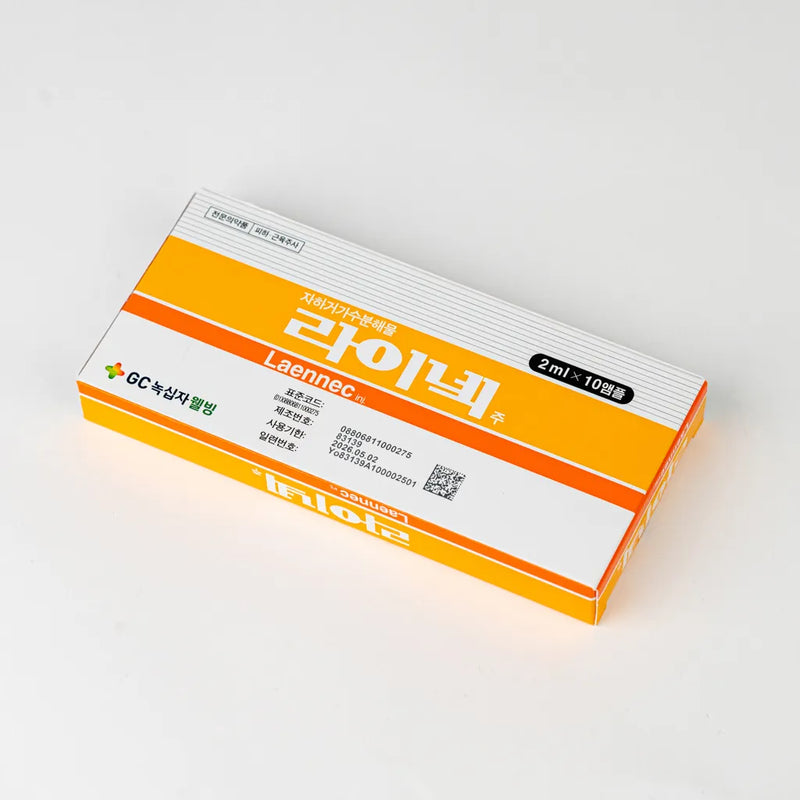
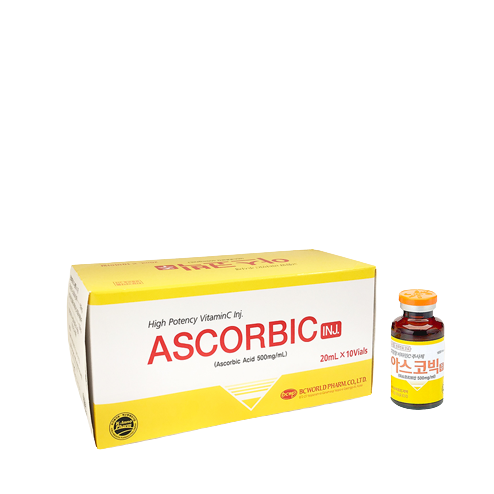
Some of the high counts follow the pack list. The two LAENNEC filings held by GC Wellbeing, one for ampoules and one for vials, each list ten barcodes, although the ampoule filing covers a 10 and a 50 ampoule box and the vial filing a 10 vial box only. The ascorbic acid filing with fourteen codes covers two vial sizes. A filing held by Daehan New Pharm with twelve codes separates its domestic presentation from three export presentations in its pack list.
But the count does not simply equal the number of presentations. The WONDERTOX 100 unit filing covers a single presentation, one vial per box, and lists four barcodes. Nabota's original filing, also one vial per box, lists two. The detailed record does not say which code belongs to which packaging level, market or print run. So the right way to use the list is as a set: the code on your carton should be one of the codes on the licence. It is not safe to assume that a particular position in the list corresponds to a particular box.
The five filings with no barcode listed are worth a note. Three of them are export-only thioctic acid licences. The other two are toxin licences granted in 2022 and in November 2025. An empty field is not evidence of anything wrong with the product, but it does mean this particular check cannot be run against those licences, and verification has to rest on the other fields.
Reading the thirteen digits
The first three digits. All 741 codes start with 880. In the GS1 system, 880 is the prefix range assigned to GS1 Korea, the organisation that issues codes to Korean companies. It tells you where the code was issued. It does not tell you where the product was made, and a code starting with 880 is not by itself a statement that the contents are Korean. That is a common misreading. In our own set, the Korean licences for imported toxins, held by the local companies of Ipsen, AbbVie and Merz, all list codes beginning with 880, even though the licence records name manufacturing sites outside Korea.
The middle digits. After the prefix come a company number and an item number assigned by the code's owner. It is tempting to read the digits immediately after 880 as a company identifier and match them to the licence holder. We tried that on this data set and it does not hold up well enough to rely on. Company numbers in the GS1 system vary in length, and in our set the same leading seven digits appear on filings held by different companies in ten cases. Match the whole code, not a slice of it.
The last digit. The thirteenth digit is a check digit, calculated from the first twelve. Its job is to catch a mistyped or misprinted number, and every one of the 741 registered codes passes it.
The check digit, worked through once
Take one of the codes registered to the WONDERTOX 100 unit filing: 8806433084707. The check works like this.
Write out the first twelve digits: 8, 8, 0, 6, 4, 3, 3, 0, 8, 4, 7, 0. Multiply them alternately by 1 and by 3, starting with 1: 8, 24, 0, 18, 4, 9, 3, 0, 8, 12, 7, 0. Add those together to get 93. Take the amount needed to reach the next multiple of ten, which is 7. That is the check digit, and it matches the thirteenth digit of the code.
The check is useful for exactly one thing. A number copied by hand from a photo, typed into an email, or printed badly on a label will usually fail it, and a failure means the number you have is not a valid code of this type, before any lookup. What it cannot do is tell you that a valid number belongs on the box it is printed on. Anyone producing packaging can calculate a check digit. The lookup against the licence is the step that carries weight.
Registered codes come in blocks
Set aside the check digit and read the first twelve digits of each code as a single number. On most licences, the registered codes sit next to each other: 727 of the 741 codes have a neighbour on the same licence whose number differs by exactly one. Of the 202 filings that list any barcode, 169 list a single unbroken run of consecutive numbers. Nabota's original filing is the simplest case, two codes whose twelve digit bodies end 05630 and 05631. Twenty-six filings list two separate runs, and a handful list more.
Where a filing has two runs, the runs can sit far apart. WONDERTOX 100 units is one of the 26: two consecutive codes beginning 8806433 and two more beginning 8806706. The imported toxin filings show the same shape. The record does not say why a licence carries two blocks, and we would not read a reason into it. For checking a carton, the point is only that both blocks are registered, so a code from either one is a match.
The blocks also explain a near miss that catches people out. A carton code that differs from a registered code by a single step, one number above the end of a run, looks almost right, and on a licence where codes come in consecutive pairs it is easy to assume it belongs. It does not, unless it is on the list. Neighbouring item numbers are issued to whatever the code owner chooses, and the next number along can belong to a different product or presentation entirely. Treat an off-by-one code exactly as you would any other mismatch.
The one-dimensional code and the square code
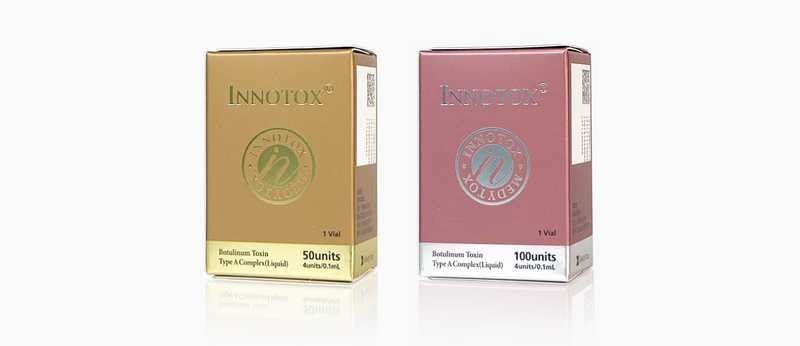
Many Korean prescription cartons also carry a small square two-dimensional code. We have described what that symbol is expected to contain, including batch and expiry information, in INNOTOX: what it is and how to source it and in our routine for verifying an authentic Korean botulinum toxin.
The link between the two is simple. In the GS1 system, the product code inside a two-dimensional symbol is normally carried as a fourteen digit number, and a thirteen digit code becomes fourteen digits by adding a leading zero. So a scanner app that reads the square code and shows 08806433084707 is showing the same product code as the thirteen digit barcode 8806433084707. When you check a carton, the product code from either symbol should resolve to the same entry in the licence's barcode list, and if the square code and the printed barcode disagree with each other, the carton has a problem that no lookup will fix.
How to check a carton, step by step
Read the full thirteen digits. From the printed number under the bars, or from a scan. If you are working from a photo sent by a supplier, ask for one where the digits are legible, and treat a request for a clearer photo as ordinary rather than awkward.
Identify the licence the carton claims. Use the full product name and strength printed on the carton. The fields a Korean carton carries, and where to find them, are set out in reading an injectable label.
Find the code in that licence's barcode list. The detailed record lists every registered code. If the carton's code is on the list, the carton and the licence agree. If it is not, look for the code on other licences, because a code that belongs to a different product is the clearest sign of relabelling there is.
What a matching barcode does not prove
A barcode is printed. It can be copied from a genuine carton onto a counterfeit one, and a copied code will match the licence perfectly. A matching code therefore shows that the packaging is consistent with a licensed product. It does not show that the contents are what the packaging says. That is why the barcode check sits alongside, not in place of, the other checks: the batch identifiers on carton and unit, the dates, the seal, and above all where the goods came from.
A barcode does not identify a batch. The thirteen digit product code is the same on every carton of that product and presentation. Batch-level identity lives in the batch number and, where present, in the two-dimensional code's additional fields.
Using this with our range
Several products in our catalogue sit inside these six ingredient groups, including LAENNEC Inj, WONDERTOX 100 Units and BC ASCORBIC Inj, and the method above applies to each of them. If you run the check on a carton you have received from us and something does not line up, send our team the product name, the code and a photo of the carton, and we will look at it with you. The wider range sits under botulinum toxins and the related injectable collections.
Frequently asked
How do you check the barcode on a Korean injectable?
Read the full thirteen digit code, confirm its check digit, identify the licence the carton claims from the product name and strength, and look for the code in that licence's registered barcode list in the Korean drug register's detailed record. A code on the list means carton and licence agree. A code that belongs to a different licence is a sign of relabelling.
What does the 880 prefix on a barcode mean?
It is the prefix range of GS1 Korea, the body that issues product codes to Korean companies. It indicates where the code was issued, not where the product was made. All 741 barcodes registered to the 207 injectable filings we read begin with 880.
Can a barcode prove a Korean product is authentic?
No. A barcode is printed and can be copied onto counterfeit packaging. A matching code shows that the carton is consistent with a licensed product. Authenticity also rests on batch identifiers, dates, seals and the supply chain the goods came through.
Sources and references
- Ministry of Food and Drug Safety (MFDS), Korean drug product licence register, active ingredient queries for Clostridium Botulinum Toxin Type A, Glutathione, Ascorbic Acid, Thioctic Acid, Hydroxocobalamin and Human Placenta, injectable filings only, detailed records read for the barcode and pack unit fields, retrieved 18 September 2026.
- GS1 General Specifications, on GTIN structure, the 880 prefix range assigned to GS1 Korea, and check digit calculation.
- KSTATION editorial policy, on how register facts are separated from product claims in our writing.
Register figures are a reading taken on 18 September 2026. Barcode lists on licence records can change. This article describes how to compare a printed product code with a licence record. It is one check among several and does not establish authenticity on its own.