Search a Korean skin booster listing for the word collagen and it will very likely be there. On 22 October 2026, 74 of the 186 active listings on our store used it somewhere in their description. Only 17 of those name collagen itself as an ingredient. The rest use the word for something the other ingredients are said to encourage.
That gap matters to anyone who arrived here after reading about collagen injections, which have been a recurring topic in DIY aesthetics communities this autumn. This article reads our own listings line by line and sorts them into the two claims they make.
Two sentences that look alike on a listing
A listing that says a product "stimulates collagen" or "supports collagen production" is describing an intended effect of something else in the vial: polylactic acid, polynucleotides, hyaluronic acid, a peptide or a vitamin. Collagen is not on the ingredient line. A listing that names atelocollagen, hydrolyzed collagen or recombinant collagen in its composition is making a different statement: that collagen, in some form, is part of what is in the vial.
The first kind of sentence is by far the more common one. It appears across PLLA and PDLLA powders, PN and PDRN boosters, HA fillers, vitamin injectables and fat-dissolving solutions. Our earlier guide to the skin booster family by active sorts those products by their main ingredient. Collagen is not the main ingredient of any of them.
Four ways a listing names the collagen it contains
Among the 17 listings that put collagen in the composition, the word appears in four forms.
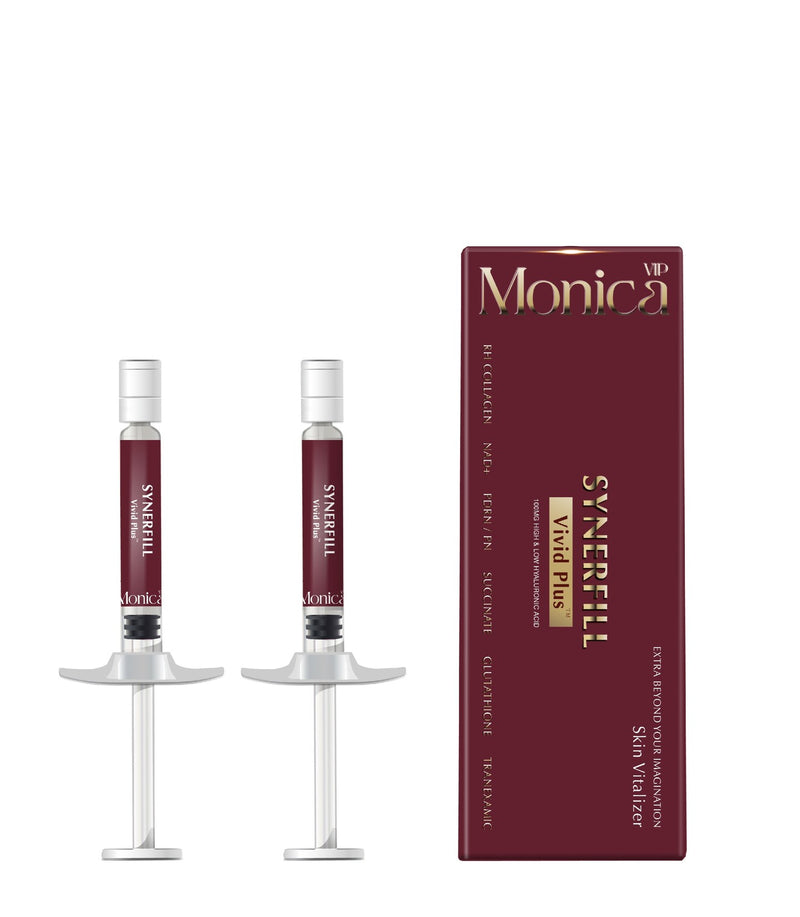
Recombinant collagen, sometimes written RH collagen for recombinant human, is produced by engineered cells, usually bacteria or yeast, that carry a human collagen gene, rather than extracted from animal tissue. Two listings use this form: SYNERFILL Vivid Plus and Beads Max Whitening Skin Booster.
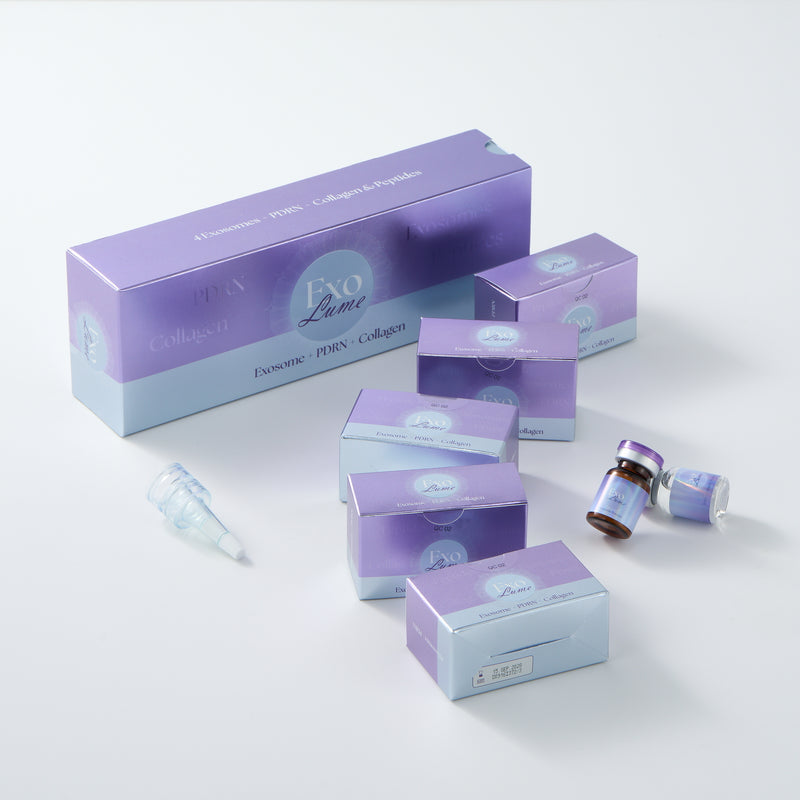
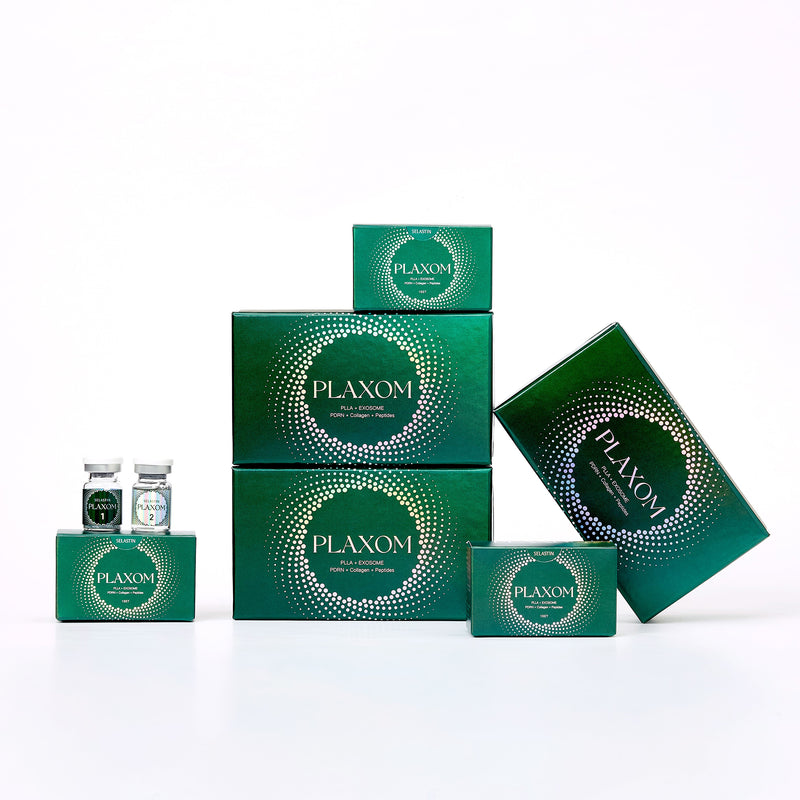
Atelocollagen is animal collagen treated with the enzyme pepsin, which cuts away the short telopeptide ends of each molecule and leaves the triple-helix body. ExoLume, PLAXOM, LACTO EXO COLLA and NAD+ Luma all name it, and NAD+ Luma specifies hydrolyzed atelocollagen.
Hydrolyzed or low-molecular-weight collagen is collagen broken into shorter fragments. RED EXO COLLA lists hydrolyzed collagen, NAD+ EXO COLLA lists low-molecular-weight collagen, and ExoLume and PLAXOM pair it with atelocollagen in what they call a collagen complex.
Collagen peptides, short chains derived from collagen, appear as a supporting ingredient in the REJUBEAU Eye Deal listing and inside the peptide group of the REJUBEAU Aqua Bomb listing. Two more listings, Rejuva Heal and CURENEX Intense Glow & Shine, write only "collagen" without saying which form.
One listing separates the version with collagen from the one without
SYNERFILL sells two closely related boosters, and its listing is the only one in the group that says, in plain terms, which version carries collagen. The comparison table on the SYNERFILL Vivid Plus listing describes SYNERFILL Vivid, the vial version, as using standard PDRN and PN concentrations "without RH Collagen". Vivid Plus, the pre-filled syringe, is the one that adds it. For a buyer specifically looking for recombinant collagen, that table settles which of the two to look at.
The same listing also places the collagen within the rest of the formula. RH collagen appears on one composition line together with hyaluronic acid, sodium succinate, PDRN and PN, NAD+, glutathione and tranexamic acid. Collagen is one supporting component among many rather than the centre of the product, which is the pattern across all 17 listings.
No other brand in the group draws a with-and-without line between sibling products. Elsewhere, a buyer has to compare composition lines listing by listing.
Collagen on the ingredient line does not make a product an injectable
Two listings in the group are hair and scalp products. The VELASH EXO Plus listing names atelocollagen among its components and states that the product is "not intended for injectable use". It is designed for application to the scalp. Collagen in a composition says nothing about how the product is meant to be applied, and that is written in a separate place.
That place is the application line, and among the injectable listings it varies. PLAXOM states subcutaneous injection or microneedling. NAD+ Luma states topical application with a microneedling system, or intradermal micro-injection. RED EXO COLLA states topical application after microneedling, or micro-injection. A buyer comparing collagen-containing products should read the application line of each one rather than assume they are interchangeable because the ingredient word matches.
What none of these is
Every one of the 17 listings is a multi-ingredient formula in which collagen is a supporting component. The products that came up in community discussions this month, injectables where collagen itself is the principal active, are a different category. As of 22 October 2026, our catalogue does not carry one.
The distinction is worth keeping in view when a listing is described in shorthand as a collagen booster. In our catalogue that phrase can mean a product built around a collagen-stimulating material such as PLLA, which our biostimulator map covers, or a booster that carries a small amount of collagen alongside other actives. It does not mean an injectable made of collagen.
The listings named here
KSTATION supplies SYNERFILL Vivid Plus in packs of two pre-filled syringes, ExoLume as five powder vials with five solvent vials, and PLAXOM as three powder and solution sets. The full range sits in our skin boosters and ampoules collection, where each listing's composition line is the place to check for collagen. For products that rely on a collagen-stimulating polymer instead, Korean PLLA products compared reads what each one declares alongside the PLLA.
Frequently asked
What is the difference between recombinant collagen and atelocollagen?
Recombinant collagen is made by engineered microorganisms or cells carrying a collagen gene. Atelocollagen is extracted from animal tissue and then treated with pepsin to remove the telopeptide ends of the molecule. Both can be written as collagen on a label.
Why do telopeptides get removed?
The telopeptides are the short non-helical ends of the collagen molecule. Research literature identifies them as a main site of collagen's antigenicity and of cross-linking between fibres. Pepsin-treated atelocollagen, which lacks them, is used in a range of medical materials.
Is microbial production the usual route for recombinant collagen?
It is the most common one. Reviews of recombinant collagen manufacturing describe bacteria and yeast such as Pichia pastoris as the main hosts for large-scale production, with plant, insect and mammalian cell systems used less because of cost.
Sources and references
- Minakuchi Y. et al., "Atelocollagen-mediated synthetic small interfering RNA delivery for effective gene silencing in vitro and in vivo", Nucleic Acids Research, 2004 (PMC506824), on pepsin treatment and telopeptide removal.
- "Status and developmental trends in recombinant collagen preparation technology" (PMC10761200), on expression systems for recombinant collagen.
- KSTATION product listings for SYNERFILL Vivid Plus, SYNERFILL Vivid, Beads Max Whitening Skin Booster, ExoLume, PLAXOM, NAD+ Luma, LACTO EXO COLLA, NAD+ EXO COLLA, RED EXO COLLA, REJUBEAU Eye Deal, REJUBEAU Aqua Bomb, Rejuva Heal, CURENEX Intense Glow & Shine and VELASH EXO Plus, retrieved 22 October 2026.
- KSTATION editorial policy, on how product facts are separated from product claims in our writing.
Listing counts are a reading of our store taken on 22 October 2026 and change as products are added, edited or removed. This article describes what listings declare about their composition. It does not describe how any product is prepared, applied or used, and it makes no claim about results.