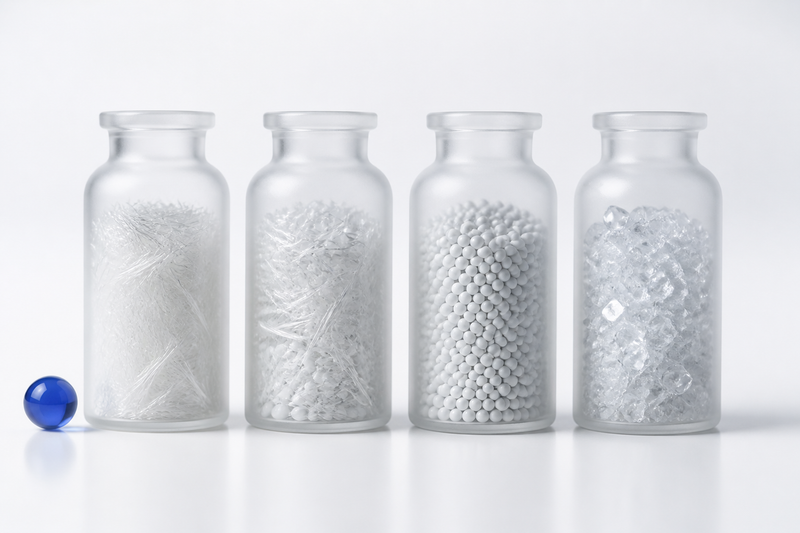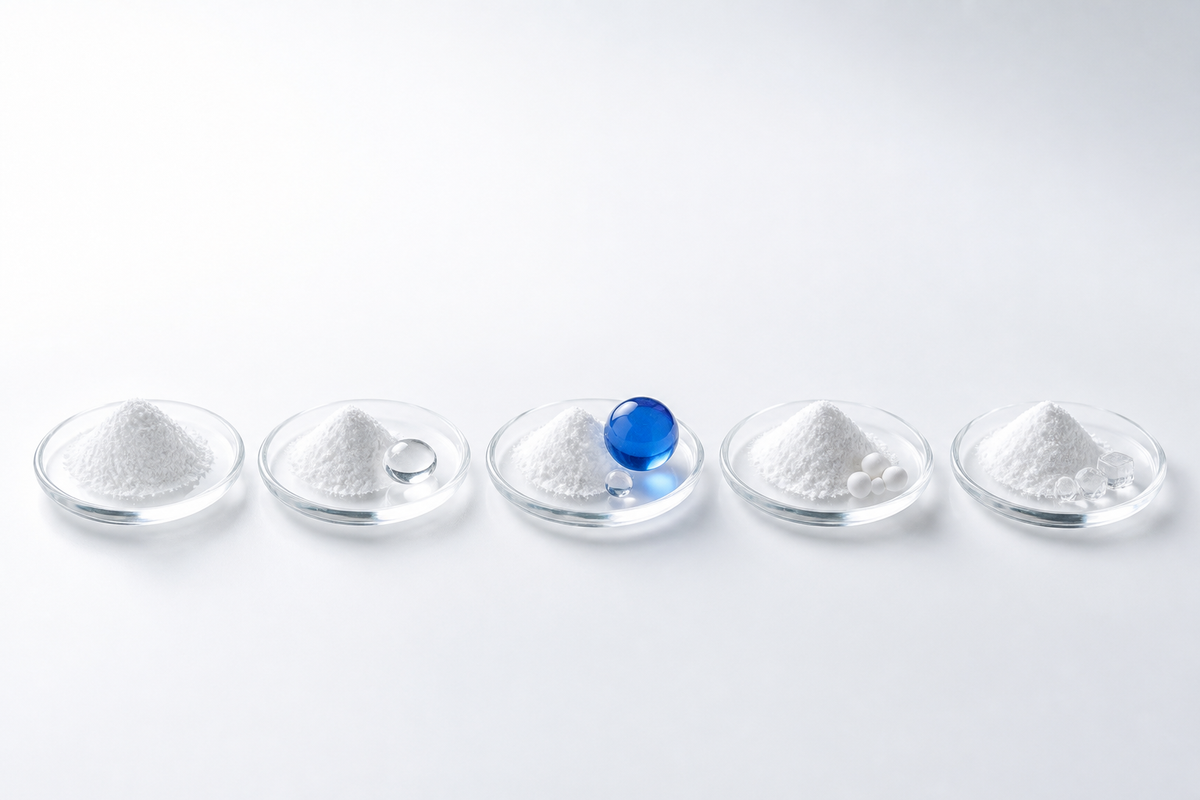
Every product in this comparison is sold as PLLA, poly-L-lactic acid, and every one of them is a freeze-dried powder in a vial. That is where the similarity ends. Read the product pages closely and each one declares something different alongside the PLLA: a second polymer, a cellulose gel carrier, hyaluronic acid, polynucleotides, or nothing at all. For a buyer choosing between them, those additions are the useful part of the specification.
The five, side by side
We read the specification on each PLLA product in our range that is currently available to order, and took only what each page declares. Where a page does not state something, the cell says so rather than filling the gap.
| Product | Declared per vial | Declared alongside PLLA | Declared particle size |
|---|---|---|---|
| OLIDIA | PLLA 365 mg | Not stated | Not stated |
| CURENEX Sculp | 360 mg, PLLA as primary active | Not stated | Not stated |
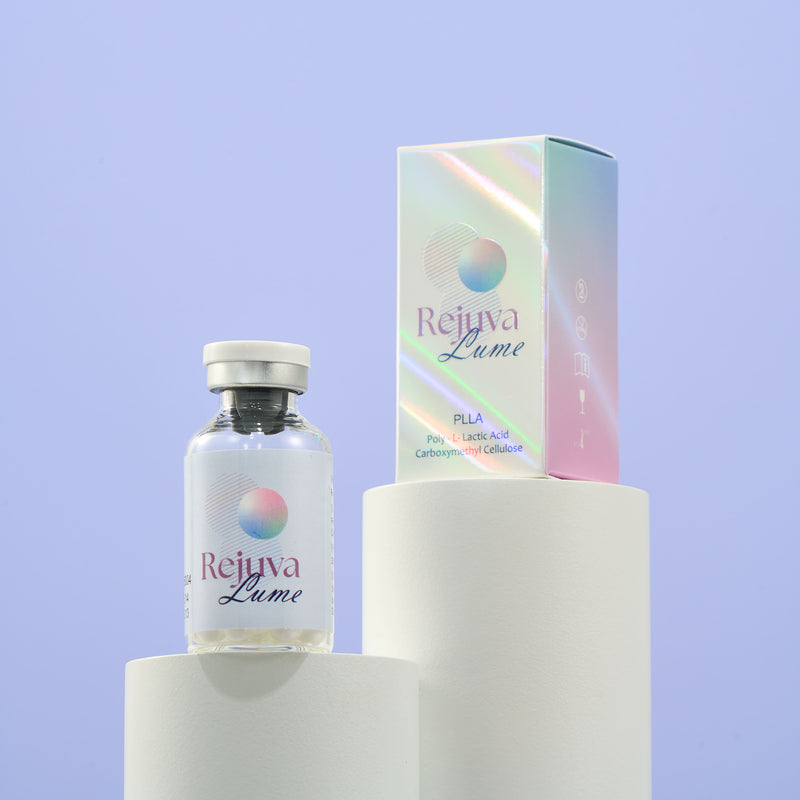
| Rejuva Lume | 360 mg | CMC (carboxymethyl cellulose), ratio not stated | Not stated |
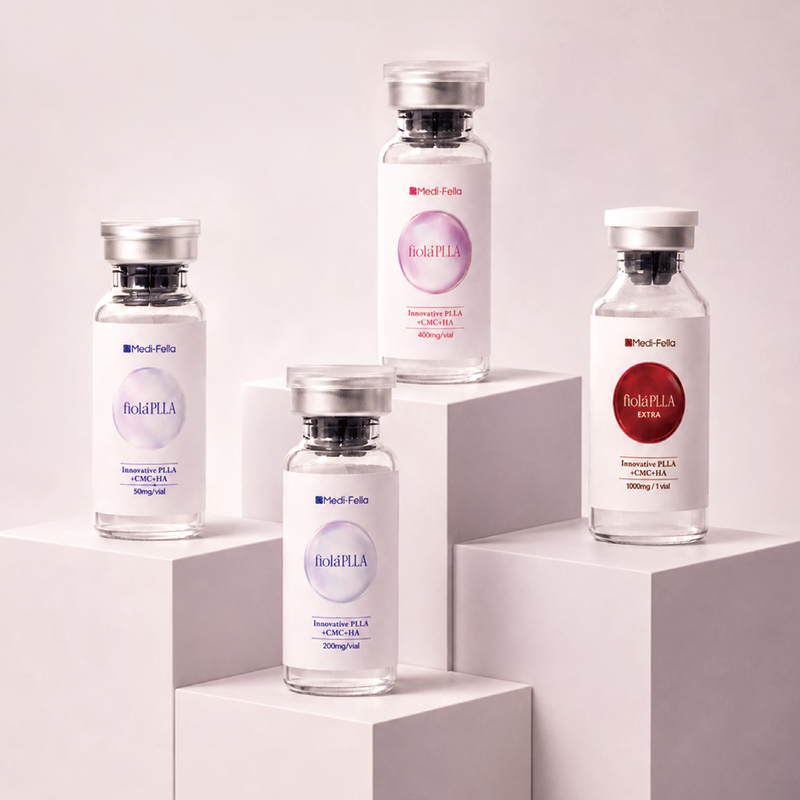
| Fiola PLLA | 50, 200, 400 or 1000 mg | HA and CMC, PLLA to HA and CMC at 85 : 15 | About 30 µm (50 mg), about 50 µm (200 and 400 mg), 80 to 120 µm (1000 mg) |
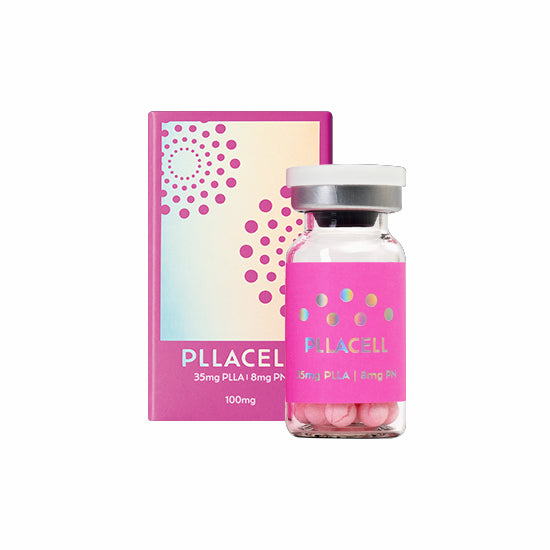
| PLLACELL | 100 mg, of which PLLA 35 mg | PN (polynucleotide) 8 mg, plus glutathione, vitamin C and sodium hyaluronate, amounts not stated | 30 to 80 µm |
Three patterns sit in that table. Two products declare PLLA and nothing else. Two pair PLLA with a carrier gel, and one of those also adds hyaluronic acid. One treats PLLA as a single component in a mixed powder, at about a third of the vial's stated weight. These are different kinds of product that happen to share their headline ingredient.
PLLA alone: OLIDIA and CURENEX Sculp
OLIDIA declares 365 mg of PLLA per vial, and CURENEX Sculp declares 360 mg with PLLA named as its primary active. Neither page lists a second ingredient in its specification. That does not establish that nothing else is in the vial, since a specification can be brief, but it is what each page commits to in writing.
The two figures are close, and the 360 mg also appears on Rejuva Lume. A buyer comparing these two on paper has very little to separate them beyond the 5 mg difference. The difference between them is not in the declared formulation.
PLLA with a carrier: Rejuva Lume and Fiola PLLA
Rejuva Lume declares its powder as PLLA plus CMC. Carboxymethyl cellulose is a cellulose-derived gel former, commonly used in PLLA powders as a suspending agent for the particles. Rejuva Lume does not state the proportion of each.
Fiola PLLA, which joined our range on 30 September, declares the proportion, and adds a third component. Its pages state PLLA together with hyaluronic acid and CMC, in a ratio of 85 to 15. It is also the only product here sold in tiers rather than as one vial size: 50, 200, 400 and 1000 mg, labelled Soft, Mid, Hard and Extra. The tiers come with different declared particle sizes, about 30 µm at the smallest, about 50 µm in the middle two, and 80 to 120 µm at the largest. Among the five, it is the only one that ties particle size to vial size, which makes the tier name and the milligram figure on the carton worth checking against each other.
PLLA as one ingredient among several: PLLACELL
PLLACELL is the outlier. Its vial is stated at 100 mg, of which 35 mg is PLLA and 8 mg is polynucleotide, PN, the DNA-derived ingredient more familiar from skin boosters. The page also lists glutathione, vitamin C and sodium hyaluronate without amounts, which accounts for the rest of the weight. Its declared particle size is 30 to 80 µm.
The practical consequence for comparison is that PLLACELL's 100 mg and OLIDIA's 365 mg are not measuring the same thing. One is the weight of PLLA alone. The other is the weight of a mixed powder in which PLLA is a little over a third. We set out why a milligram figure on a vial needs that kind of reading in when mg and mL appear on the same box.
When the label says PLA, check which one
Three more products in our range use a lactic-acid polymer, and they show why the letters on the front of the box are worth reading twice.
Sunnyfill PLA and MENNUS both use PLA in their product names. Their pages then name the polymer in full as poly-D,L-lactic acid, which is PDLLA, not PLLA. Sunnyfill PLA declares it at 77 percent alongside CMC at 23 percent, with particles of 30 to 50 µm. MENNUS declares 200 mg of PLA and CMC combined. Caratfill PDLLA puts PDLLA in its name outright.
PLLA and PDLLA are related polymers from the same lactic-acid family, built from different arrangements of the same building block, and they are not interchangeable labels. PLA on its own is the family name and does not tell you which form is meant. Our map of biostimulator materials sets out how the two differ as materials. For buying purposes the rule is simple: when a product says PLA, read on until the page names the polymer in full.
What these specifications do not tell you
Every figure above is what a product page declares. PLLA is not a drug ingredient in Korea, as we noted for CURENEX Sculp in an earlier piece, so there is no drug licence record to check these declarations against in the way there is for a toxin. Products of this kind are handled as medical devices, and Korea's public device records do not publish a product's raw materials, so even where a device licence exists it does not confirm the composition stated on a product page. The comparison is therefore a comparison of stated specifications. It does not rank the products, and it says nothing about how they perform, how long a result lasts or where they are used. Our guide to reading a PLLA biostimulator covers what else to look for on a specification sheet.
Sourcing Korean PLLA
All five products are in the biostimulators collection, along with MENNUS and Caratfill PDLLA. Sunnyfill PLA is listed under derma fillers. Each page carries the specification quoted here. If a supplier's description of any of them differs from what is declared above, particularly on the polymer named or the amount per vial, that difference is worth resolving before ordering.
Frequently asked
What Korean PLLA products are available?
In our range, five products declare PLLA as their polymer and are currently available: OLIDIA, CURENEX Sculp, Rejuva Lume, Fiola PLLA and PLLACELL. All are freeze-dried powders in a vial.
What is the difference between Korean PLLA biostimulators?
Mainly what each declares alongside the PLLA. OLIDIA and CURENEX Sculp declare PLLA only. Rejuva Lume adds CMC. Fiola PLLA adds hyaluronic acid and CMC at a stated 85 to 15 ratio and is sold in four tiers. PLLACELL is a mixed powder in which PLLA is 35 mg of a 100 mg vial, with polynucleotide and other ingredients.
Is PLA the same as PLLA?
Not necessarily. PLA is the family name for lactic-acid polymers. PLLA and PDLLA are two different forms. Two products in our range use PLA in their names and declare PDLLA in full on their pages, so read the full polymer name rather than the abbreviation.
Can these products be checked against a Korean licence?
Not in the way a toxin can. PLLA is not a drug ingredient in Korea, and Korea's public medical device records do not publish raw materials, so the comparison rests on what each product page declares.
Sources and references
- KSTATION product pages for OLIDIA, CURENEX Sculp, Rejuva Lume, Fiola PLLA, PLLACELL, Sunnyfill PLA, MENNUS and Caratfill PDLLA, specification and ingredient fields, retrieved 1 October 2026. Only listings available to order on that date are included.
- KSTATION, reading CURENEX: one name, five products, on the register status of CURENEX Sculp.
- KSTATION editorial policy.
Specifications are a reading of our product pages taken on 1 October 2026 and may be updated. This article compares declared composition and particle size only. It does not describe indications, preparation, use, duration or results, and it does not rank the products.