CURENEX arrives in most conversations as a single thing. People ask what CURENEX is, whether CURENEX works for their concern, how long CURENEX takes, as though the word named one formula in one vial. It names five products. Their declared actives are polydeoxyribonucleotide, polynucleotide, poly-L-lactic acid, glutathione and an unnamed botanical complex, and those five actives do not sit together anywhere in the Korean regulatory record. Two of them return hundreds of licences from the drug register. Two return nothing at all. This piece reads what each product declares, and reads the register back at it.
Five products, four different regulatory neighbourhoods
The five products carrying the CURENEX name in the KSTATION range are INTENSE GLOW & SHINE, eye, SNOW PEEL, Sculp and LIPO. Every one of them is filed in our own catalogue under the same product type, and four of the five sit in the same collection. That shared shelf is convenient for browsing and misleading for sourcing, because the thing a buyer actually needs to know is what is declared inside, and on that measure the five have almost nothing in common.
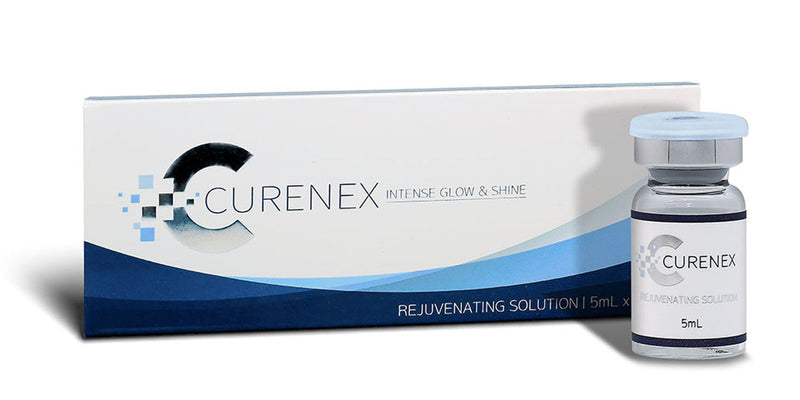
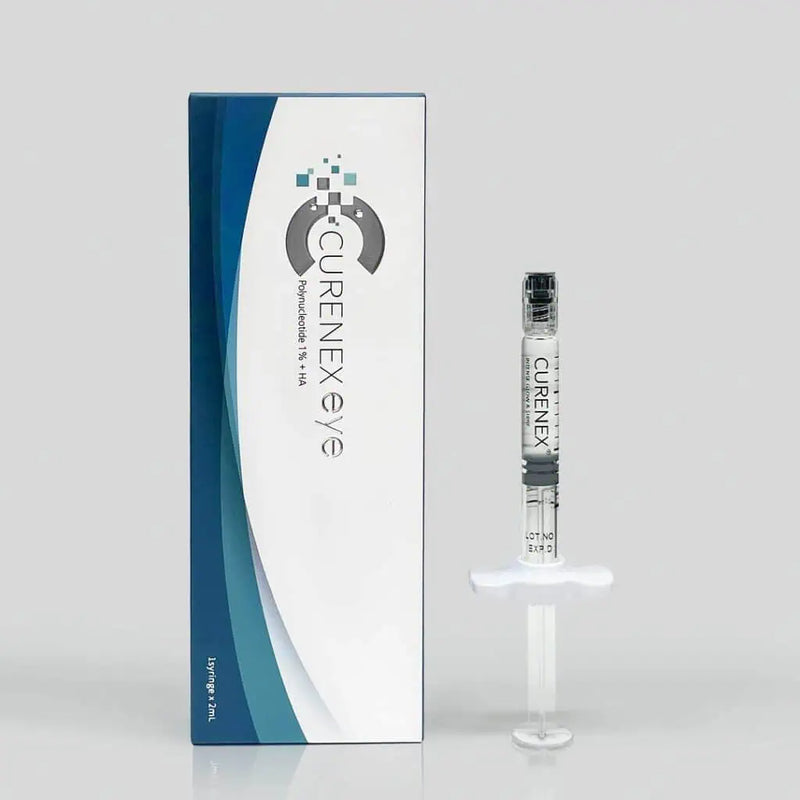
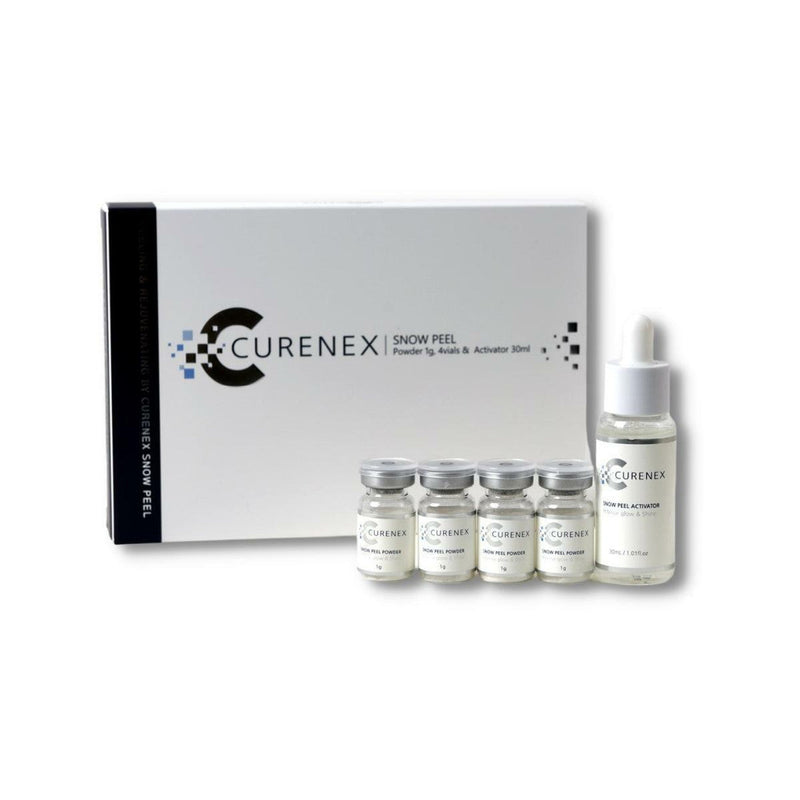
The declared actives are as different as the category allows. Glow declares PDRN together with glutathione and a peptide complex. eye declares polynucleotide at one percent, hyaluronic acid at one percent, and lidocaine at 0.3 percent. SNOW PEEL declares PDRN and glutathione again, but arrives as a two part system of powder plus activator rather than a syringe. Sculp declares a single active, poly-L-lactic acid at 360 milligrams, supplied as a lyophilised powder. LIPO declares a botanical lipolytic complex and states that it is free of PPC.
Line those five up against the Korean registers and they scatter. PDRN and glutathione are both substantial drug register entries with dozens of licences each. Polynucleotide, spelled that way in English, returns nothing from the drug register at all. Poly-L-lactic acid returns nothing either, because a material used to stimulate volume is regulated as a device rather than a drug in Korea, and devices sit in a different register with different fields. The botanical complex has no ingredient name to query, so there is nothing to look up.
The form factors reinforce the point, because they are not interchangeable either. Glow and LIPO arrive as multi vial packs of liquid, eye arrives as a single prefilled syringe, and Sculp and SNOW PEEL arrive as powders that require a separate solvent or activator before use. A powder and a prefilled syringe impose different storage, different handling and different shelf life considerations on a distributor, and they generate different questions at customs. Two products can share a brand name, a shelf and a product type field in a catalogue while behaving as entirely separate logistics items.
| Product | Declared active | Form | Drug register, that ingredient name |
|---|---|---|---|
| INTENSE GLOW & SHINE | PDRN, glutathione, peptide complex | 5mL vial | PDRN 51 licences, glutathione 85 |
| eye | Polynucleotide 1%, HA 1%, lidocaine 0.3% | 2mL syringe | Polynucleotide 0, HA 4, lidocaine 263 |
| SNOW PEEL | PDRN, glutathione, niacinamide | Powder plus activator | PDRN 51, glutathione 85, niacinamide 0 |
| Sculp | Poly-L-lactic acid 360mg | Lyophilised powder | 0 (device register territory) |
| LIPO | Botanical complex, stated PPC free | 10mL vial | No ingredient name to query |
PDRN and glutathione: the two the drug register holds in depth
Two of the declared actives are well represented in the Korean drug register, and both appear in more than one CURENEX product. Polydeoxyribonucleotide returns 51 licences, of which 47 remain valid. Glutathione returns 85, of which 75 remain valid. Those are mature entries with many licence holders rather than thin ones held by a single company, which tells you the ingredient itself is long established in Korean pharmaceutical practice.
Both entries split cleanly by route of administration, and the split runs the same direction. Every one of the 28 valid injectable PDRN licences is classified prescription-only, and every one of the 19 valid non-injectable licences is over-the-counter. Glutathione follows the same shape with one exception: all 38 valid injectable licences are prescription-only, while 36 of the 37 valid oral licences are over-the-counter and a single oral licence is not. The classification codes differ between the two, with injectable PDRN filed under [04900] and injectable glutathione under [03990], which is a statement about which part of the pharmacopoeia each belongs to rather than about what is in the vial.
Here is where a careful reader has to slow down, because this is the point at which register data is most often misused. The register was queried for ingredients, not for products. Finding 51 PDRN licences establishes that the substance is licensed in Korea in defined forms and classes. It establishes nothing whatsoever about whether any particular CURENEX product holds one of those licences, and it would be wrong to read the count as evidence about the product on the shelf. An ingredient query answers a question about the ingredient. That distinction was set out at more length in how a professional peel reads against the register, and it applies with full force here.
What the two entries do give a buyer is a frame of reference. If a supplier describes a PDRN or glutathione product as an injectable and simultaneously describes it as freely available, those two claims sit against a register in which every injectable licence under both ingredients is prescription-only, without exception across 66 valid injectable licences. The consequences of that classification for anyone importing are covered separately in what prescription-only means when you import. The deeper composition questions, molecular weight and purity for PDRN and grade and sourcing for glutathione, have their own readings in reading a PDRN skin booster and reading a glutathione injectable.
The eye syringe declares polynucleotide, and that English name returns nothing
CURENEX eye declares polynucleotide at one percent. Query the Korean drug register for polynucleotide as an ingredient and it returns zero licences. That is a genuine result rather than a typing error, and it is worth stating precisely what it does and does not mean, because a zero is the easiest number in this field to misread.
It does not mean the substance is absent from Korean practice. PDRN, which returns 51 licences, is itself a polynucleotide by chemistry, and the two terms are used interchangeably in a great deal of marketing copy. What the zero means is narrower and more useful: the register does not carry an ingredient entry under that English spelling. Ingredient records are indexed under the names the licence holders filed, and a substance filed as polydeoxyribonucleotide will not surface when you search for polynucleotide, no matter how closely related the chemistry is.
There is a second limit on that zero that has to be declared rather than glossed over. The register interface we query accepts English ingredient names, and it returns nothing for Korean ones. We confirmed this with a control: querying 아스코르브산, the Korean name for a substance the same interface returns results for in English, produces zero. So a Korean language cross-check on polynucleotide is not available to us through this route, and the honest statement of the finding is that the English ingredient name returns nothing, not that no such filing exists anywhere in Korean records. Reporting the second when you have only tested the first is how a search limitation gets published as a fact about a product.
The other two declared actives in the same syringe behave differently again, and one of them is instructive. Hyaluronic acid returns only four drug licences, all injectable and all prescription-only, which looks impossibly low for a material that appears in hundreds of products sold in Korea. It is low because most HA in aesthetics is regulated as a device rather than a drug, so the drug register sees only the small remainder. That split is the whole subject of why your HA filler is not in the drug register. Lidocaine, by contrast, returns 263 licences, a deep and old entry going back to 1979.
Sculp declares PLLA, which the drug register does not hold at all
CURENEX Sculp declares a single active, poly-L-lactic acid, at 360 milligrams in a lyophilised powder. Query poly-L-lactic acid against the drug register and the result is zero licences. Unlike the polynucleotide zero, this one has a straightforward structural explanation rather than a naming one.
Materials that restore or support volume in soft tissue are regulated in Korea as medical devices, filed under the device category 조직수복용생체재료, which translates as biomaterials for tissue restoration. That category holds 609 licences of which 458 remain valid, held across 105 licence holders. It is a substantial register in its own right, and it has fields the drug register does not: the licence number prefix records the acquisition route, with 제허 marking domestically manufactured products and 수허 marking imports, and the valid population splits 428 domestic against 30 imported.
So the correct reading of the PLLA zero is not that the material is unregistered. It is that a buyer looking for it in the drug register is looking in the wrong register, which is an easy mistake to make when the other four products in the same brand family have actives that do live there. This is exactly the situation where a single brand name spanning categories creates real sourcing friction: the verification path for Sculp runs through a different register, with different identifiers, than the verification path for Glow. What PLLA particles, reconstitution and sourcing look like in detail is covered in reading a PLLA biostimulator.
One caution about the device register belongs here, because its coverage is not what most people assume. The public dataset behind it is effectively complete only through 2023, which we have confirmed by testing unrelated product categories that show the same cutoff. Absence of recent licences in that register is therefore not evidence that none were granted. Anyone citing device register year over year trends needs to state that coverage limit alongside the numbers, and anyone reading such a trend without a stated limit should discount it.
LIPO declares a complex, which is not an ingredient name
CURENEX LIPO declares a botanical lipolytic complex and states that it is PPC free. Those two statements do different kinds of work, and only one of them can be checked against a register.
The PPC free statement is a negative claim about a specific, nameable substance, phosphatidylcholine, and negative claims of that kind are the more checkable sort because they narrow rather than expand. The positive half, botanical lipolytic complex, is a category description rather than an ingredient name. There is no register entry for a complex, because registers index the substances that were filed, one name at a time. Querying it is not difficult so much as impossible: there is no string to query.
The practical consequence for a buyer is a question of expectations rather than of trust. It is reasonable to ask a supplier which of the five CURENEX products you are being quoted, what its declared composition is, and which register that composition would be found in if it were filed. It is not reasonable to expect a public ingredient query to settle a composition question about a product declared as a complex. Knowing in advance which of your questions the public record can answer saves you from treating silence as evasion when it is simply the wrong instrument.
SNOW PEEL is the one that needs two registers and a second spelling
SNOW PEEL declares three actives, and each one lands somewhere different. PDRN and glutathione behave as described above, with deep drug register entries whose injectable forms are uniformly prescription-only. The third, niacinamide, returns zero from the drug register under that spelling and 878 licences under nicotinamide, which names the same vitamin B3 amide. That naming split is not specific to this product and we have set out its mechanics separately in reading a copper peptide booster, where the same trap appears with panthenol and dexpanthenol.
The form factor compounds it. SNOW PEEL arrives as a powder plus an activator rather than as a ready liquid, so the composition question splits again into what is in the powder and what is in the activator. A register query answers neither of those, because registers index licensed products and their declared ingredients rather than the internal division of a two part kit. That distinction between what a peel declares and what a register can confirm is the whole subject of how a professional peel reads against the register.
What a five product brand means for sourcing checks
The single most useful habit this brand teaches is to stop treating the brand name as the unit of verification. Product identity in this catalogue lives at the level of the individual item, and four of the five CURENEX products would require a different check than the one you performed on the fifth. A supplier confirmation that says CURENEX and nothing more has confirmed almost nothing.
The order of the checks matters too. Establish the product first, then the declared active, then which register that active would be filed in, and only then ask what the register shows. Running those steps out of order produces the two failures visible throughout this piece: querying the drug register for a device material and concluding it is unregistered, or querying one English spelling and concluding a substance is absent. Both are search failures dressed up as findings, and both are avoidable by asking which register before asking what it says.
Across the KSTATION range, the five CURENEX items sit in the skin boosters and ampoules collection with the exception of Sculp, which sits among the biostimulators, and LIPO, which is filed under contouring. That shelving reflects what each product is for rather than what it is made of, which is the right organising principle for a storefront and the wrong one for a verification checklist. Composition is where the differences are, and composition is where the checking has to happen.
Frequently asked
What is CURENEX?
CURENEX is a brand name applied to five distinct products rather than a single formulation. In the KSTATION range those are INTENSE GLOW & SHINE, eye, SNOW PEEL, Sculp and LIPO. Their declared actives are PDRN with glutathione, polynucleotide with hyaluronic acid and lidocaine, PDRN with glutathione and niacinamide, poly-L-lactic acid, and an unnamed botanical complex respectively. Asking what CURENEX contains has no single answer.
Are all CURENEX products the same thing?
No. They differ in declared active, in form factor and in which regulatory register their active would be filed under. Two of them declare PDRN and glutathione, which return 51 and 85 drug licences respectively. One declares poly-L-lactic acid, which returns nothing from the drug register because tissue restoration materials are filed as devices. One arrives as a powder and activator rather than a liquid. Verification of one product tells you nothing about the others.
Does CURENEX Sculp appear in the Korean drug register?
Its declared active, poly-L-lactic acid, returns zero results from the drug register, and that is expected rather than anomalous. Materials for soft tissue restoration are regulated in Korea as medical devices under the category 조직수복용생체재료, which holds 609 licences of which 458 are valid. A drug register query is simply the wrong instrument for that class of product. Note also that an ingredient query cannot confirm that any specific product holds a licence.
Why does a search for polynucleotide return nothing when PDRN returns 51 licences?
Because registers index the ingredient names that licence holders filed, not the chemical relationships between them. PDRN is filed as polydeoxyribonucleotide and surfaces under that string. A search for polynucleotide does not reach it. There is a second limit worth stating: the interface accepts English ingredient names and returns zero for Korean ones, which we confirmed with a control query, so a Korean language cross-check on this particular zero is not available through that route.
Is niacinamide really absent from the Korean drug register?
The substance is not absent; the spelling is. Niacinamide returns zero licences and nicotinamide returns 878, of which 660 are valid, and they name the same vitamin B3 amide. Cosmetic ingredient naming and pharmacopoeial naming assign different preferred names to a number of substances, so a zero result should always be retested under the alternative naming system before it is read as an absence.
Sources & references
- Ministry of Food and Drug Safety (MFDS), Korean drug product licence register, ingredient query "Polydeoxyribonucleotide" (51 licences, 47 valid, route and supply classification breakdown), retrieved 2026-08-27. data.go.kr
- MFDS Korean drug product licence register, ingredient query "Glutathione" (85 licences, 75 valid, route and supply classification breakdown), retrieved 2026-08-27. data.go.kr
- MFDS Korean drug product licence register, ingredient queries "Nicotinamide" (878 licences) and "Niacinamide" (0), retrieved 2026-08-27. data.go.kr
- MFDS Korean drug product licence register, ingredient queries returning zero: "Polynucleotide", "Poly-L-Lactic Acid". Control query "아스코르브산" also returned zero, establishing that the interface indexes English ingredient names, retrieved 2026-08-27. data.go.kr
- MFDS Korean drug product licence register, ingredient queries "Hyaluronic Acid" (4 licences) and "Lidocaine" (263 licences), retrieved 2026-08-27. data.go.kr
- MFDS medical device licence register, product category query 조직수복용생체재료, biomaterials for tissue restoration (609 licences, 458 valid, 105 holders, 428 domestic and 30 imported by licence prefix). Public dataset coverage is effectively complete through 2023. Retrieved 2026-08-27. data.go.kr
- KSTATION product pages for CURENEX INTENSE GLOW & SHINE, eye, SNOW PEEL, Sculp and LIPO (declared actives, stated concentrations and form factors as presented by the manufacturer). kstations.com
- KSTATION, Editorial & Sourcing Policy (register-first verification of ingredient name, licence holder and supply classification). kstations.com
Disclaimer. This article is general educational information and is not medical advice. It describes what five products sold under the CURENEX name declare as their actives, and what the Korean drug and medical device registers return for those declared ingredient names. An ingredient query establishes facts about an ingredient and does not establish that any specific product holds a licence. Stated concentrations are manufacturer declarations taken from product presentation, not register values. This article makes no claim about what any product does and gives no dosing, preparation or administration guidance. Injectable products in the ingredient families discussed are prescription-only in Korea and are supplied for professional use by licensed practitioners. Regulatory status varies by country and changes over time.