Two products on the same shelf can both be called a professional peel and have almost nothing in common. That is not a marketing failure. The word peel describes what a product is meant to do, not what it is made of or how it is regulated, so it can sit on a box built from salmon DNA and on a box built from a strong acid without contradiction. The Korean drug register will not resolve the ambiguity for you either, but it will tell you exactly where each ingredient stands, and it will be honest about the ones it cannot see.
Peel names an effect, not a category
Most product words in this field name a substance or a format. Filler names a material class, ampoule names a container, booster names a delivery intent. Peel names none of those. It names an outcome, the removal or turnover of surface skin, and any composition that a manufacturer positions toward that outcome can carry the word.
This matters more than it sounds, because buyers reasonably assume a shared category implies shared properties. With fillers that assumption mostly holds, since the products really are variations on a material family. With peels it fails immediately. Two boxes carrying the same word can differ in active ingredient, in mechanism, in the regulatory family their components belong to, and in whether a public register can say anything about them at all.
The imprecision is not evenly distributed across the field either, which is why it catches people out. Ampoule tells you a container and nothing else, but it never pretended otherwise. Booster is vague about mechanism yet reliably narrow about format. Filler is specific enough that two products carrying the word will almost certainly both be injectable gels made of a material designed to occupy volume. Peel sits at the far end of that spectrum: it constrains almost nothing, while sounding as specific as the others.
The practical consequence is that a peel product cannot be evaluated at the category level. There is no useful sentence beginning "professional peels are…" that survives contact with two actual products. The evaluation has to happen one ingredient at a time, which is slower and also the only method that returns real answers.
Two Korean peels, read side by side
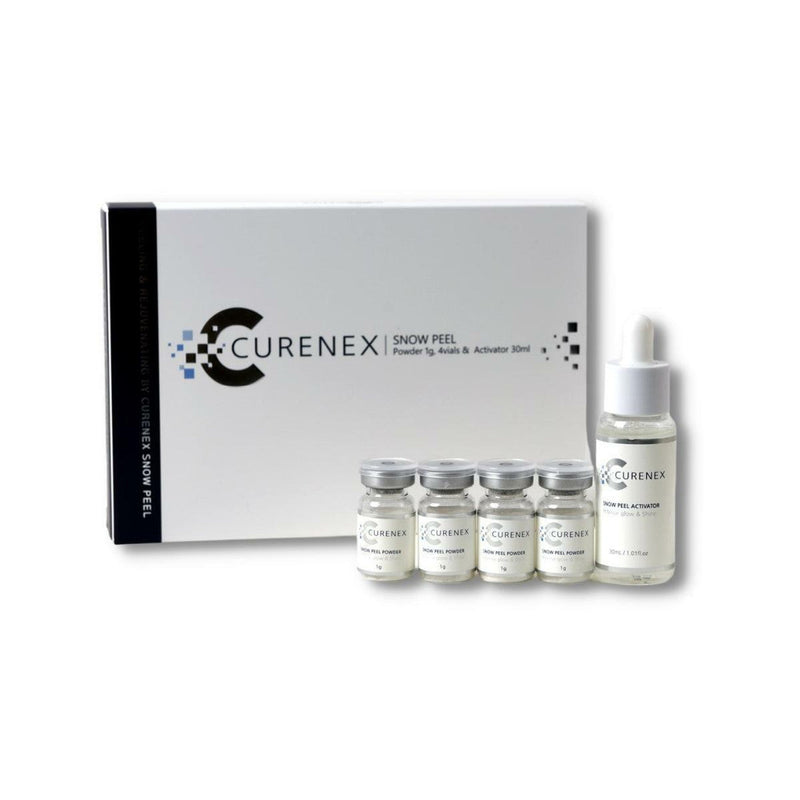
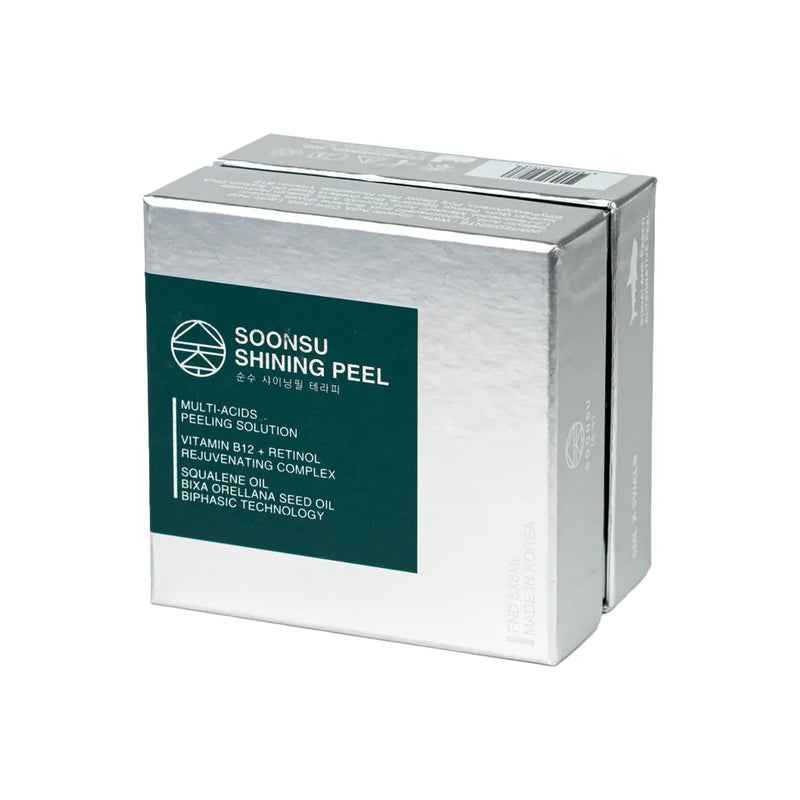
Take two that are commonly stocked together. One is built around polydeoxyribonucleotide, glutathione and peptides, supplied as four vials of powder with a separate activator and applied topically, often alongside a micro-needling system. The other is a biphasic solution declaring trichloroacetic acid at 35 percent together with retinol, supplied as five vials of liquid.
Read those two declarations without the shared word on the front and nothing connects them. The first is a reconstitution system whose actives are biological molecules also found in injectable products. The second is an acid solution whose active is a small industrial-scale organic compound. Their storage conditions differ, their formats differ, their handling differs, and as the next section shows, a register lookup returns completely different results for each.
The format difference alone carries consequences that the shared word hides. A powder-plus-activator system is assembled at the point of use, which means the preparation exists only after someone combines two components correctly and has a limited window before it is discarded. A pre-mixed liquid in a sealed vial has no assembly step and no mixing window; whatever the manufacturer put in it is what comes out. Those are different operational profiles with different failure modes, and a purchasing decision that treats them as interchangeable has already gone wrong before any ingredient is considered.
None of this makes either product better or worse than the other. They are different things that were given the same label, and the point of reading them separately is not to rank them but to stop treating one as evidence about the other.
What the register returns for each ingredient
The Korean drug register is searchable by ingredient, which makes it a fast way to see where a component stands before any product-level question is asked. Running the four actives from those two boxes returns four very different pictures.
Polydeoxyribonucleotide returns 51 licences, 47 of them currently valid. Twenty-eight are injectables, all prescription-only, all filed under [04900], the class for tissue and cell function preparations. The remaining nineteen are non-injectable and all over-the-counter, and they split across classification codes rather than sitting together: thirteen under [01310] for ophthalmic preparations and six under the external preparation codes [02690] and [02600]. The oldest injectable licence dates to September 2008.
That split inside the polydeoxyribonucleotide entry is worth a second look, because it is not a rounding artefact. The thirteen ophthalmic licences are a different therapeutic world from the injectables, filed under a different code, sold under a different supply class, and reaching patients through a different channel. One molecule, two established regulatory identities, neither of which is a peel. A count of 47 valid licences is therefore not a measure of how established this molecule is in aesthetics; it is a measure of how many separate places the pharmacopoeia found for it.
Glutathione returns 85 licences, 75 valid. Thirty-eight are injectables, all prescription-only, almost all filed under [03990] for metabolic preparations not otherwise classified. Thirty-seven are non-injectable, all but one over-the-counter, with thirty-four of those filed under [03920] as antidotes. The oldest entry in the whole set is a 1971 oral tablet, which is a reminder that a molecule can be decades old in the pharmacopoeia and recent in aesthetics.
Retinol returns 245 licences, 156 valid, and this is where a count becomes misleading if read carelessly. The overwhelming majority are vitamin A preparations: 148 non-injectable licences spread across vitamin classes such as [03190], [03160] and [03110], plus eight injectables. A peel product declaring retinol is not drawing on that population. The register is recording a different use of the same molecule, and the number tells you nothing about topical resurfacing formulations.
Trichloroacetic acid returns zero. Not a small number, zero. The search was run against three English spellings and two Korean transliterations, and the medical device register returned nothing for chemical peeling as a product category either. The same tool, on the same day, returned 245 licences for retinol, so this is a real absence rather than a broken query.
| Ingredient | Licences | Injectable | Non-injectable |
|---|---|---|---|
| Polydeoxyribonucleotide | 51 (47 valid) | 28, prescription-only, [04900] | 19, over-the-counter, ophthalmic and external codes |
| Glutathione | 85 (75 valid) | 38, prescription-only, [03990] | 37, mostly over-the-counter, [03920] antidotes |
| Retinol | 245 (156 valid) | 8, prescription-only | 148, vitamin A classes, not resurfacing formulations |
| Trichloroacetic acid | 0 | 0 | 0 |
What an ingredient entry does not settle
Here is the part that is easy to get backwards, and getting it backwards is worse than not looking at all. Finding an ingredient in the register does not put a product in the register.
Polydeoxyribonucleotide has 47 valid licences, and none of them is a topical peel system. Those licences belong to injectables and to eye and external preparations that went through their own approvals. A peel product that declares the same molecule is a separate article that was never part of that population. The register is telling you that this molecule is known to the Korean pharmacopoeia and has an established regulatory identity in certain formats. It is not telling you that the box in front of you inherited any of that.
The same logic runs in the other direction, and it is the more important half. A zero result does not classify a product. Trichloroacetic acid returning nothing means the drug register has no licence recording it as an active, and that is all the sentence can carry. It is not a statement that a product containing it is unapproved, unregulated, prohibited, or filed somewhere specific instead. Those are different questions answered by different records, some of which are not public ingredient databases at all, and a distributor who converts a zero into a classification is inventing a fact.
What the zero does do is mark a boundary. For polydeoxyribonucleotide and glutathione, a buyer can independently confirm that the molecule has a documented regulatory identity in Korea and see exactly how it is classified by format. For trichloroacetic acid, that particular check is simply unavailable, and confirmation has to come from product-level documentation held by the manufacturer and the importer. Knowing which of the two situations you are in before you buy is the entire value of running the lookup.
Where the register stops, on every ingredient
Even for the ingredients it covers thoroughly, the register answers a narrow set of questions. It records the declared active, the route, the supply classification, the classification code, the licence holder and the grant date. It is authoritative on those and silent elsewhere.
It records nothing about what a preparation does. There is no efficacy field and no outcome data, so no register lookup supports or refutes a claim about results, on either of these products or on any other.
It records nothing about concentration in a finished cosmetic-facing product, nothing about the other components in a blend, and nothing about how a formulation behaves when combined with a device or another product. Those are formulation questions, and the register was never a formulation database.
A concrete version of that gap: the register can tell you that polydeoxyribonucleotide injectables are prescription-only and filed under [04900], and it will still tell you nothing about how much of that molecule is in a topical powder vial, what the activator contains, how the two behave once combined, or how long the combination remains as intended. Every one of those is a purchasing-relevant fact, and none of them is a register field. The lookup narrows uncertainty; it does not close it.
And it records nothing about handling. Questions about how strong a preparation is appropriate, how it interacts with a given skin type, or what to do when an application goes further than intended are clinical questions belonging to a qualified practitioner. They sit outside this article deliberately, and no amount of register detail brings them inside it.
Running the check yourself
The lookup takes a few minutes and needs nothing but the declared composition.
Two failure modes account for most bad lookups, and both are avoidable. The first is searching a brand name and reading the result as a statement about the ingredient, which returns one row or none and creates false confidence in either direction. The second is accepting the first zero. Registers are indexed by specific strings, and a molecule that appears under a hyphenated spelling, a different transliteration or a salt form will hide from a query that is technically correct but textually wrong.
- Start from the declaration, not the product name. Write down each active as the manufacturer states it, including concentration where given. A category word on the front of the box is not an input to this process.
- Search by ingredient, not by brand. Brand names are held by individual licence holders and return one row at best. The ingredient index returns the whole population, which is what makes the classification pattern visible.
- Try spelling variants before accepting a zero. Transliterations and hyphenation differ between records, and a single spelling returning nothing is not the same as an absence. Confirm with a second query that you expect to succeed, so you know the index is responding.
- Read the classification split, not just the total. A large number can be recording a different use of the same molecule entirely, as retinol's 245 licences do. The split by route and class is where the meaning is.
- Write down which questions the lookup did not answer. That list is what you take to the supplier. A supplier who can produce product-level documentation for the gaps is doing their job; one who answers by repeating the ingredient search has answered a question you already asked yourself.
How peel products are handled in KSTATION sourcing
Both product types described here sit in the current range. CURENEX SNOWPEEL is the polydeoxyribonucleotide and glutathione system, supplied as powder vials with a separate activator for topical use. SOONSU Shining Peel is the biphasic trichloroacetic acid and retinol solution. Both are supplied for professional use, and they are listed as what they are rather than as two versions of one category.
Listing them separately is a deliberate choice rather than a formatting one. Grouping products by the category word would put a reconstitution system and a pre-mixed acid solution under a single heading and imply a comparison that their compositions do not support, which is the exact confusion this article is about.
Before listing, declared composition, manufacturer and, where a public register covers the ingredient, its classification are checked and recorded; the method is in the Editorial and Sourcing Policy. Where a public register does not cover an ingredient, that is noted as an open item rather than filled in with an assumption, which is the same discipline applied to the register's silence on efficacy throughout this article. Related items sit in the wider skin boosters and ampoules range.
Frequently asked
Are all professional peels the same category?
No. Peel describes an intended effect rather than a composition, so products carrying the word can share no active ingredient, no format and no regulatory family. Two commonly stocked Korean examples are built respectively on polydeoxyribonucleotide with glutathione and on trichloroacetic acid with retinol, and an ingredient lookup returns completely different results for each.
Is TCA in the Korean drug register?
An ingredient search of the Korean drug register returns zero licences for trichloroacetic acid, across three English spellings and two Korean transliterations, and the medical device register returns nothing for chemical peeling as a product category. That result describes what those two registers contain. It is not a statement about a product's regulatory status, which is determined by records beyond public ingredient databases and by product-level documentation.
If an ingredient is in the register, does that mean the product is approved?
No, and this is the most common misreading. Polydeoxyribonucleotide holds 47 valid licences, none of which is a topical peel system; they belong to injectables and to eye and external preparations approved in their own right. A product declaring the same molecule is a separate article and does not inherit those licences.
Why does retinol return 245 licences?
Because the register is recording vitamin A preparations. 148 of the non-injectable licences sit in vitamin classification codes, and eight injectables are filed similarly. That population has no relationship to a resurfacing formulation that happens to declare retinol, which is why the classification split matters more than the headline count.
How do I check what a peel product actually contains?
Work from the manufacturer's declared composition rather than the product name, search the register by ingredient rather than brand, try spelling variants before accepting a zero result, and read the split by route and classification instead of the total. Then list the questions the lookup did not answer, since that list is what a supplier should be able to document.
Sources & references
- Ministry of Food and Drug Safety (MFDS), Korean drug product licence register, ingredient query "Polydeoxyribonucleotide" (51 licences), retrieved 2026-08-24. data.go.kr
- MFDS Korean drug product licence register, ingredient query "Glutathione" (85 licences) and "Retinol" (245 licences), retrieved 2026-08-24. data.go.kr
- MFDS Korean drug product licence register, ingredient queries "Trichloroacetic acid", "Trichloracetic Acid" and "Chloroacetic Acid" (zero licences each), and MFDS medical device register, product category query for chemical peeling (zero records), retrieved 2026-08-24. data.go.kr
- KSTATION, Editorial & Sourcing Policy (register-first verification, and recording of open items where a register does not cover an ingredient). kstations.com
Disclaimer. This article is general educational information and is not medical advice. It describes how ingredient lookups in the Korean drug and medical device registers behave for components declared in professional peel products, and what those lookups do and do not establish. It makes no claim about what any product does, makes no determination of any product's regulatory status, and provides no guidance on concentration, application or aftercare. The products referenced are supplied for professional use by qualified practitioners. Regulatory status varies by country and changes over time.