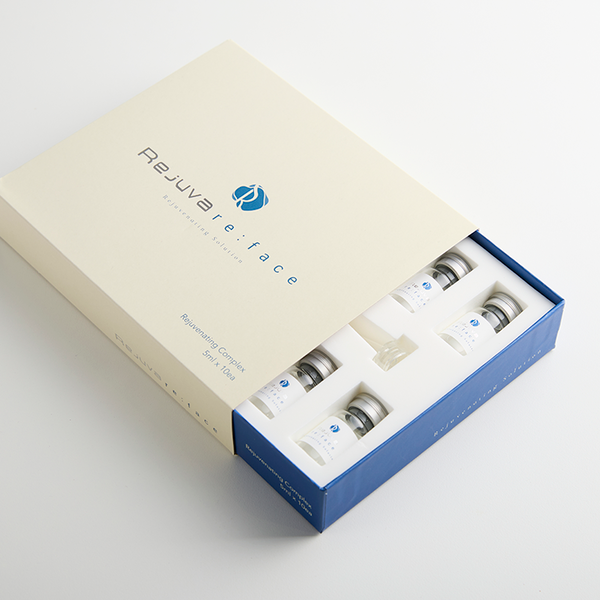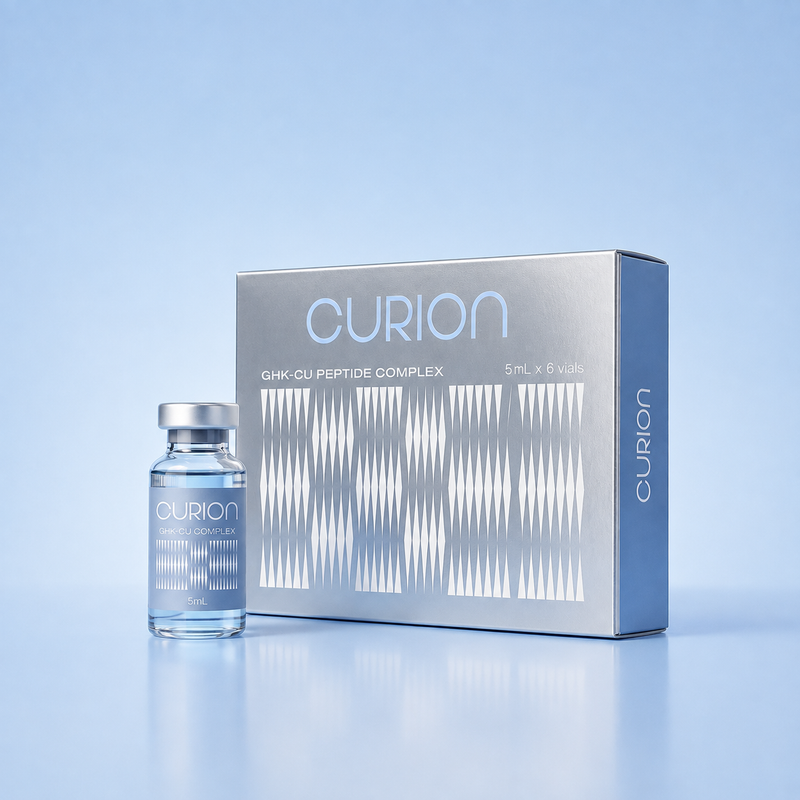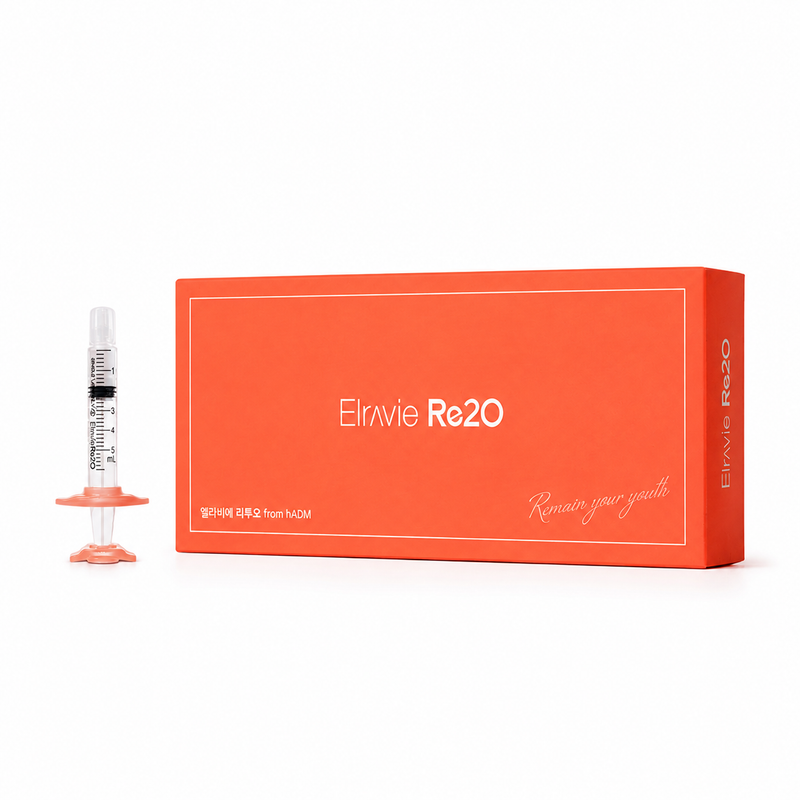
Two vials arrive in the same box. Both are 5 mL, both are clear glass with a flip-off cap, both were sold under the word booster, and both list actives you recognise. One of them is meant to be placed in the dermis. The other is meant to be spread on the surface of the skin and never enters it at all. Nothing about their size, their glass, or their ingredient list will tell you which is which. Only a declaration on the packaging does, and that declaration is easy to miss and easier to misread.
This is not an edge case at the far end of the catalogue. It is a structural feature of how Korean skin preparations are sold. The category name that buyers use, booster, describes an intent rather than a route, so it holds both kinds at once. Buyers who have learned to verify a toxin or read a filler carton competently still walk past this one, because it is not a question of authenticity or specification. It is a question of what the product is licensed to be.
One shelf, two routes: what a booster catalogue actually contains
We swept our own Skin Boosters and Ampoules collection on 13 August 2026 to see how the split falls in practice. Across 81 SKUs, five declare topical or external use only in plain language. Fifty-nine describe an injection route explicitly, whether intradermal placement, subcutaneous delivery, mesotherapy technique, or cannula work. The remaining seventeen, about one in five, say nothing that resolves the question either way.1
Five out of eighty-one sounds marginal until you consider how those five are shelved. They sit in the same collection, under the same category label, next to products that are placed in the dermis by a licensed practitioner. A buyer scrolling a supplier catalogue sees a uniform grid of vials and syringes. The route is not a facet you can filter on, it is not in the product name, and in most storefronts it is not in the first paragraph of the description either. It surfaces only when someone reads far enough down, or reads the physical carton after the box has already arrived.
The seventeen unresolved SKUs are the more honest finding, and we include our own catalogue in that count rather than exempting it. Product copy in this category is written to describe what a formulation contains and what it is used for, not to declare how it enters the body. That convention holds across suppliers, brand sites and marketplaces alike, because the copy is inherited from manufacturer material that assumes a professional reader who already knows the answer. The assumption breaks the moment the product crosses a border into a market where the same actives exist in both routes.
"Do not inject" means two opposite things
Here is the trap, and it is a good one. In the same 81 SKU sweep, 29 products carry a phrase built from the words do not inject. Almost none of them are topical products.1
The overwhelming majority read do not inject intravascularly, or do not inject into blood vessels, or must not be injected into blood vessels. Those are instructions to a practitioner who is about to inject the product, telling them which compartment to avoid while doing so. The phrase is a vascular safety warning, and its presence is positive evidence that the product is an injectable. A handful of others use the same three words to mean the opposite: this product is not for injection at all, apply it to the surface.
Read the words that follow do not inject before you read the phrase itself. If the next words name a compartment (intravascularly, into blood vessels, into a vein), the product is an injectable and you are reading a technique warning. If the phrase terminates, or is followed by language about the skin surface, you are reading a route declaration.
We can vouch for how easy this is to get wrong, because we got it wrong first. Our initial sweep used a pattern that matched the bare phrase, and it returned 33 supposedly topical products including several that are unambiguously injectable, among them well known polynucleotide and poly-L-lactic acid preparations. The pattern had caught every vascular warning in the catalogue and filed each one as a prohibition on injection. Only checking the matched sentences rather than the match count exposed the error. A buyer skimming a carton at speed is running the same faulty pattern, without the ability to go back and audit the result.
What the container cannot tell you
The most common shortcut is to read the vessel. A pre-filled syringe means injectable, a vial with a rubber septum means injectable, a small ampoule means topical. Each of those inferences fails against the catalogue in front of us.
Pre-filled syringes are used for topical delivery routinely, because a syringe is simply a precise way to dispense a measured, viscous dose onto skin, and because it keeps a single-use presentation sterile until the moment of use. Of the five topical-only products in our sweep, one is supplied in syringes. Conversely, glass vials with septa hold both injectables and preparations intended to be applied after a microneedling or laser step, where the vessel choice reflects shelf stability rather than route.
Ingredient identity is an equally unreliable proxy, and this is the part that catches experienced buyers. Glutathione, niacinamide, polynucleotides, exosome preparations and growth factor complexes all exist in both injectable and topical presentations, frequently from the same manufacturer, sometimes under names that differ by a single suffix. Recognising the active tells you what the formulation is built around. It tells you nothing about how the manufacturer intends it to enter, or what they have licensed it as.
Where the route is actually declared
Route declarations tend to appear in four places, in descending order of reliability.
| Location | What it looks like | Weight |
|---|---|---|
| Printed carton and unit label | A dedicated line such as for external use only, topical use only, or a stated injection route | Highest. This is the manufacturer's declaration on the object itself |
| Insert or accompanying documentation | A usage section describing application to the skin surface, or a needle gauge and depth | High, when the insert matches the carton |
| Manufacturer product page | Category placement and usage description on the brand's own site | Moderate. Useful corroboration, not a substitute |
| Reseller listing copy | Marketing description written for a storefront | Lowest. Often inherited, condensed, or silent on route |
The ranking matters because the four sources disagree more often than buyers expect. Reseller copy is where route information degrades fastest: it is rewritten for length, translated, and optimised for search, and a line like for external use only is exactly the kind of unglamorous sentence that gets cut. When the carton and the listing disagree, the carton governs, because the carton is what the manufacturer put their name on.
There is a further wrinkle specific to Korean packaging. Products regulated as cosmetics carry cosmetic labelling conventions, which include usage and precaution blocks but do not carry a drug-style route of administration field, because cosmetics are not administered. The absence of an injection route on a cosmetic carton is itself informative, but it is informative by omission, which is a weaker signal than a positive declaration and one that a buyer scanning quickly will not register as a signal at all.
When the carton is genuinely silent and the insert does not resolve it, the correct move is to ask the supplier for the manufacturer's stated route in writing rather than to infer one. A supplier who cannot produce that answer for a product they stock has told you something useful about their own sourcing chain.
Why the distinction is not a formality
It would be easier to treat this as paperwork if the failure mode were benign. It is not. The clinical literature on skin boosters notes that introducing preparations intended for surface use into the dermis can place immunogenic particulate matter where the body will respond to it, and describes local and systemic hypersensitivity reactions and foreign body granulomas among the reported consequences.2
The mechanism is not exotic. A topical formulation is developed against a barrier that will exclude most of what is in the bottle. Preservative systems, solubilisers, fragrance-free but not necessarily particle-free carriers, and the tolerances for endotoxin and sterility are all specified for a product that will sit on intact stratum corneum. Sterility requirements for an injectable are categorically different, and so are the acceptance criteria for particulate matter. Placing the first into the compartment designed for the second removes every assumption the formulation was built on.
The direction of the error is also asymmetric, which is worth internalising. Applying an injectable-grade preparation to the skin surface is wasteful and probably pointless, since the formulation was never designed to cross the barrier, but it is not usually a safety event. Injecting a topical-grade preparation is the direction that carries the risk. Any uncertainty should therefore resolve toward the surface, not toward the needle.
Jurisdiction is a separate axis from the label
The first question is what the manufacturer declares the product to be. That is answered by the carton, and it is the same answer everywhere in the world. The second question is what a given jurisdiction permits, who may perform the procedure, and under what licence a product may be imported or held. That is answered by the regulator where the practitioner works, and it varies substantially between markets. The same preparation can be routine clinic stock in one country, restricted to a narrower use in another, and unapproved in a third, without a single word on the carton changing.
The practical division of labour is clean. Establishing the declared route is a reading task and it belongs to whoever is holding the box. Establishing eligibility to import, hold and use a given preparation is a licensure question and it belongs to the practitioner and their regulator. The first does not answer the second, and confirming the first does not discharge the obligation to check the second.
Sorting a box before it reaches your fridge
A short routine catches most of this at receiving, before stock enters rotation and before anyone reaches for it mid-session.
- Read the carton for a positive declaration first. Look for a dedicated line naming either external or topical use, or naming an injection route and depth. Read it on the printed carton, not on the invoice or the listing you ordered from.
- Parse every occurrence of the phrase do not inject. Check the words immediately after it. A named vascular compartment means the product is an injectable and you are reading a technique warning, not a prohibition.
- Check the insert against the carton. A usage section describing application after microneedling, without a gauge or a depth, points topical. A stated needle gauge, injection depth or point spacing points injectable. Disagreement between insert and carton is a question for the supplier, not a judgement call.
- Ignore the vessel and the actives. Syringes, vials, volumes and ingredient names carry no route information. Do not let a familiar active substitute for a declaration.
- Segregate anything unresolved. Stock that does not declare a route should not be shelved next to injectables. Keep it separate until the supplier confirms the manufacturer's stated route in writing.
- Record the route where your team will see it. Route belongs on the shelf label and in your inventory record, alongside lot and expiry. The person reaching for the box mid-session is not the person who read the carton at receiving.
Step six is the one most often skipped and the one that pays back. Reading the carton correctly once protects nothing if the knowledge stays with the person who unpacked the shipment.
What the declared route does not settle
A route declaration is not an authenticity check. A counterfeit carton will carry whatever text the counterfeiter copied, including a correct route line, so reading the route tells you what the packaging claims rather than whether the packaging is genuine. Authentication runs on a separate track through licence records, holder names, lot agreement across carton and unit, and seller provenance, which we cover in our guide to verifying an authentic Korean skin booster.
Nor is route a quality or grade statement. Two injectables with identical route declarations can differ substantially in purity, molecular weight distribution, carrier system and manufacturing controls, and those differences are read from specification fields rather than from the route line. Our breakdown of what units, kDa, expiry and lot numbers actually tell you covers that layer, and it assumes the route question has already been settled.
Route also says nothing about depth or technique among injectables, where intradermal, subdermal and subcutaneous placement produce materially different outcomes with the same product. That distinction is its own subject, handled in our comparison of intradermal and subdermal injection depth. And because the word booster is used loosely across both technique and product class, the adjacent confusion between a delivery method and a product category is worth reading alongside this one in our mesotherapy versus skin boosters explainer.
Where route declarations fit in KSTATION sourcing
The sweep behind this article was run against our own catalogue, and it found seventeen SKUs where the route is not resolvable from the product page as it stands. We are publishing that number rather than a flattering one because the alternative is to write a guide about reading declarations while quietly failing to make them.
Frequently asked
How do I know if a Korean ampoule is topical or injectable?
Read the printed carton for a positive declaration, which will either name external or topical use or name an injection route and depth. Do not infer it from the container, the volume, or the active ingredients, since syringes, vials and familiar actives all appear on both sides of the line. If the carton and insert are both silent, ask the supplier for the manufacturer's stated route in writing rather than assuming one.
Does do not inject mean the product is topical only?
Usually not. In a sweep of 81 booster and ampoule SKUs, 29 carried a phrase built from those words and the large majority read do not inject intravascularly or do not inject into blood vessels, which are technique warnings addressed to someone who is injecting the product. Check the words immediately after the phrase: a named vascular compartment means the product is an injectable, while a phrase that terminates or turns to the skin surface means it is a route declaration.
Can I inject a topical ampoule if it comes in a syringe?
The container is not a licence. Syringes are used for topical products because they dispense a measured dose and keep a single-use presentation sterile, and one of the five topical-only products in our sweep is supplied that way. If the carton declares external or topical use, the syringe does not override it.
What happens if a topical only product is injected?
The clinical literature on skin boosters describes the introduction of preparations intended for surface use into the dermis as a route for immunogenic particulate matter, with local and systemic hypersensitivity reactions and foreign body granulomas among the reported consequences. Topical formulations are specified against an intact skin barrier, so their sterility and particulate acceptance criteria differ from those applied to injectables. The error is asymmetric, which is why uncertainty should resolve toward the surface rather than toward the needle.
Where is the route of administration declared on a Korean ampoule?
Most reliably on the printed carton and unit label, then in the insert, then on the manufacturer's own product page, with reseller listing copy last. Products regulated as cosmetics will not carry a drug-style route field at all, since cosmetics are not administered, so on those cartons the signal is the presence of external use language rather than the absence of an injection route.
Sources & references
- KSTATION catalogue sweep, 13 August 2026. All 81 products in the Skin Boosters and Ampoules collection were read across product description and structured product-page fields (usage, protocol, precaution and notice fields). Classification counted a positive topical declaration (external use only, topical use only, not for injection) as topical, an explicitly named injection route (intradermal, subcutaneous, mesotherapy technique, cannula or micro-injection placement) as injectable, and everything else as unresolved: 5 topical, 59 injectable, 17 unresolved. A separate count of products carrying a vascular avoidance warning built from the words "do not inject" returned 29. Counts reflect a single sweep date; catalogue copy is revised continuously.
- Injectable "Skin Boosters" in Aging Skin Rejuvenation: A Current Overview. PMC11560330. Consulted 13 August 2026 for the reported consequences of introducing preparations intended for topical use into the dermis, including hypersensitivity reactions and foreign body granuloma formation.
Disclaimer. This article is general educational information, current as of its publication date, and is not legal, medical or regulatory advice. It describes how to locate a manufacturer's declared route of administration on packaging. It does not state the approval or regulatory status of any product in any market. Whether a specific preparation may be imported, held or used, and by whom, is determined by the relevant authorities and depends on approval status, classification and professional licensure in your own market. Confirming eligibility is the buyer's responsibility and runs through the appropriate licensed professional.