Ask which of PN and PDRN is better for the under-eye area and you will get confident answers pointing both ways, which is usually a sign that the question is framed wrong. The two ingredients are close relatives, and the products actually sold for that area differ from their full-face siblings in ways that have little to do with which acronym is on the box: they are built at lower concentrations, blended with other actives, and packaged in small fine-tipped syringes. This piece takes the question seriously, and then shows why the label answers it better than the acronym does.
The question people ask, and the question a label answers
PN versus PDRN for under eyes is one of the most common comparison questions in the polynucleotide category, and it deserves a straight treatment rather than a dodge. A straight treatment starts with scope. This article is about what the two ingredients are, how under-eye products built on them are actually composed, and what to check before buying one. It is not injection guidance: depth, technique, and whether any injectable belongs near an orbit are clinical decisions for a licensed practitioner, and these are professional-use products.
With scope set, the honest structure of the answer has three layers. First, what separates PN from PDRN as molecules, which is a shorter story than the marketing suggests. Second, what actually changes when a Korean manufacturer builds the eye version of a booster line, which is a longer story than the marketing suggests. Third, what published practice patterns say about how these ingredients are used around the eyes, which is where the question has real, checkable footing.
PN and PDRN: one source, different cut lengths
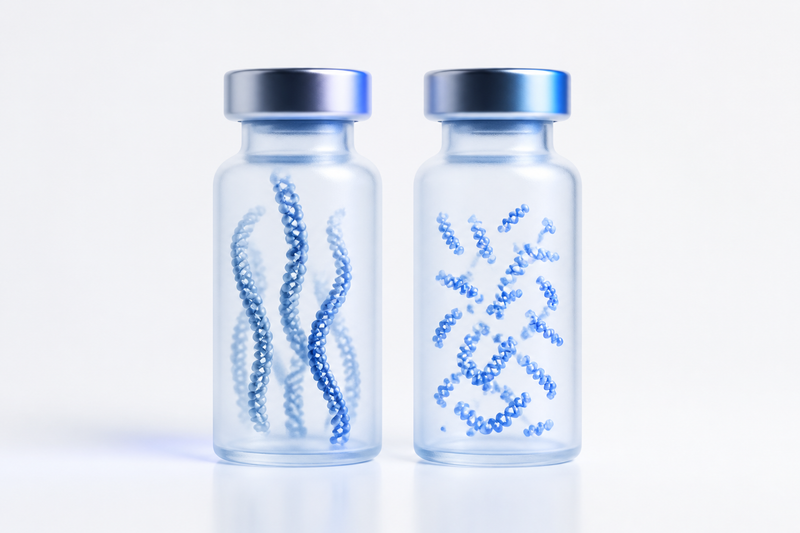
Both ingredients are purified DNA from salmonid sources, and the working distinction between them is size. PDRN (polydeoxyribonucleotide) refers to shorter DNA fragments, commonly described in the tens to hundreds of kilodaltons, while PN (polynucleotide) refers to longer chains that can run into the thousands of kilodaltons; recent review work treats the boundary explicitly as a size-based definition rather than a difference in kind.1 The pharmacology literature attaches mostly to the shorter form: PDRN has been characterized as a mixture of DNA fragments studied for tissue-repair signaling.2
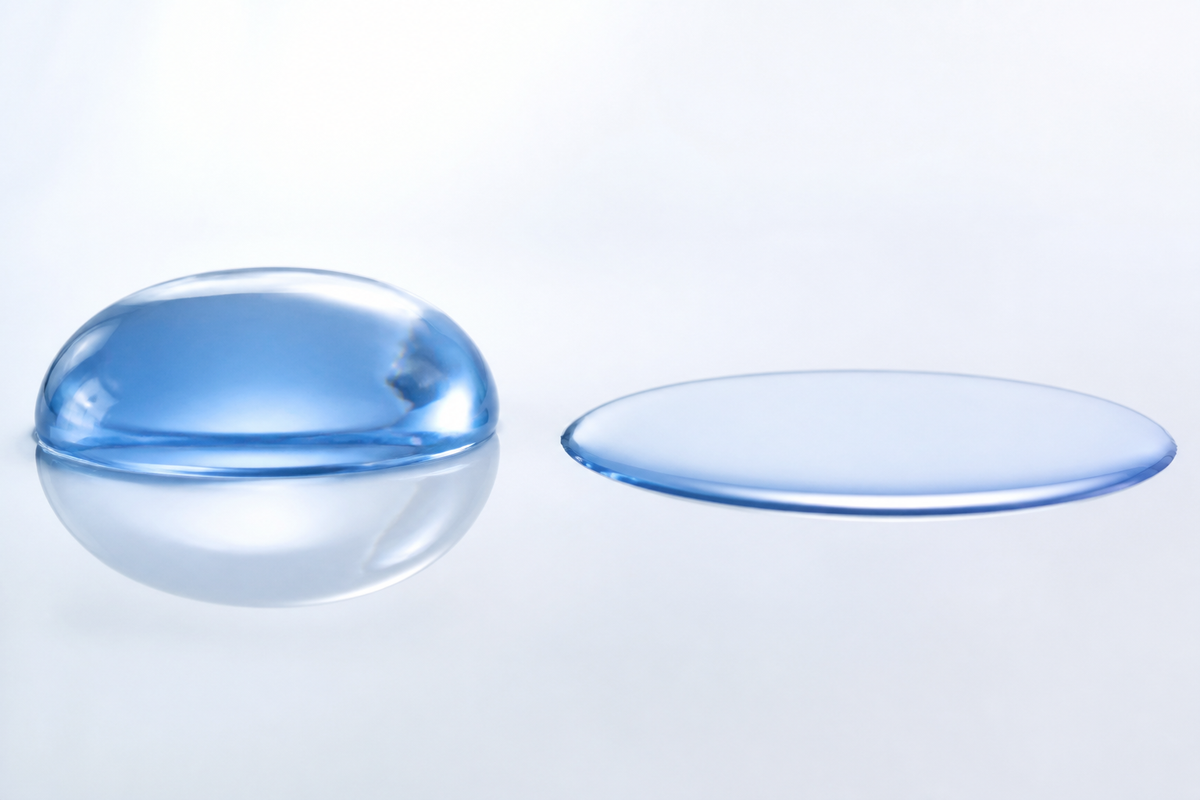
Chain length is not an abstract spec, because it is what you feel in the syringe. Longer chains entangle more, so PN solutions at a given concentration run thicker and more gel-like, while PDRN solutions of the same concentration run thinner and more watery. That physical difference, viscosity, is the main practical consequence of the acronym, and it is why the two ingredients drifted toward different product positionings: PN toward structure and skin-quality framing, PDRN toward lighter regenerative framing. The full molecular comparison, including why the kilodalton line between the two is blurrier than vendors imply, is laid out in PN vs PDRN by molecular weight.
Why does the under-eye area get its own product formats?
The skin below the eye is among the thinnest on the body, and the products positioned for it reflect that in composition rather than just in marketing copy. Read the declarations across a Korean booster range and a consistent pattern appears: the eye-labeled product is not the flagship in a smaller box. It is a different formulation.
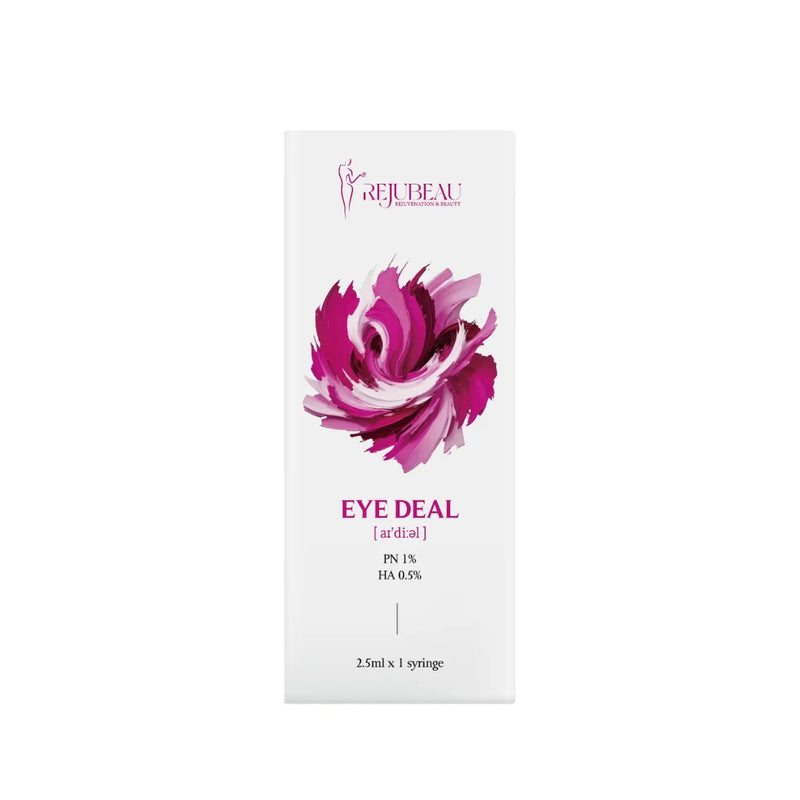
The clearest illustration comes from reading one line end to end. In the REJUBEAU range, the full-strength product, REJUBEAU PN Healer, declares PN at 2 percent, or 20 mg/mL. The eye-positioned product in the same line, REJUBEAU Eye Deal, declares PN at 1 percent, blended with sodium hyaluronate at 0.5 percent and a glutathione component, in the same 2.5 mL pre-filled syringe format. Half the polynucleotide concentration, plus blend partners, for the same volume. That halving is not a defect or a dilution scandal; it is the design. The manufacturer built a thinner, lighter product for a thinner, less forgiving area.
Format follows the same logic. Eye-positioned boosters arrive overwhelmingly as small pre-filled syringes, 2 to 2.5 mL, rather than the 5 mL multi-vial boxes that dominate face-format mesotherapy solutions. A pre-filled syringe is a statement about intent: the manufacturer sealed this exact preparation at this exact concentration, leaving nothing to be reconstituted, diluted, or mixed at the point of use. For an area where small volumes and light formulations are the norm, that factory-sealed precision is part of what the buyer is paying for, and it is also why per-milliliter prices in the eye segment look startling next to vial products until the format difference is taken into account.
How PN and PDRN each show up in eye formats
Both acronyms appear in eye-positioned products, which is the first sign that the category has not crowned a winner. What differs is the shape they arrive in.
| PN (polynucleotide) | PDRN (polydeoxyribonucleotide) | |
|---|---|---|
| What it is | Longer-chain salmon-derived DNA polymer | Shorter salmon-derived DNA fragments |
| Feel at equal concentration | Thicker, more gel-like | Thinner, more fluid |
| Typical eye-format move | Concentration lowered, blended with HA | Already low-viscosity; blended with HA and vitamins |
| Practice-pattern evidence | Korean dermatologist survey places infraorbital and periorbital fine lines among top PN indications | Larger pharmacology literature; less area-specific survey data |
| What to read on the label | Declared PN percent or mg/mL, blend partners | Declared PDRN mg/mL, blend partners |
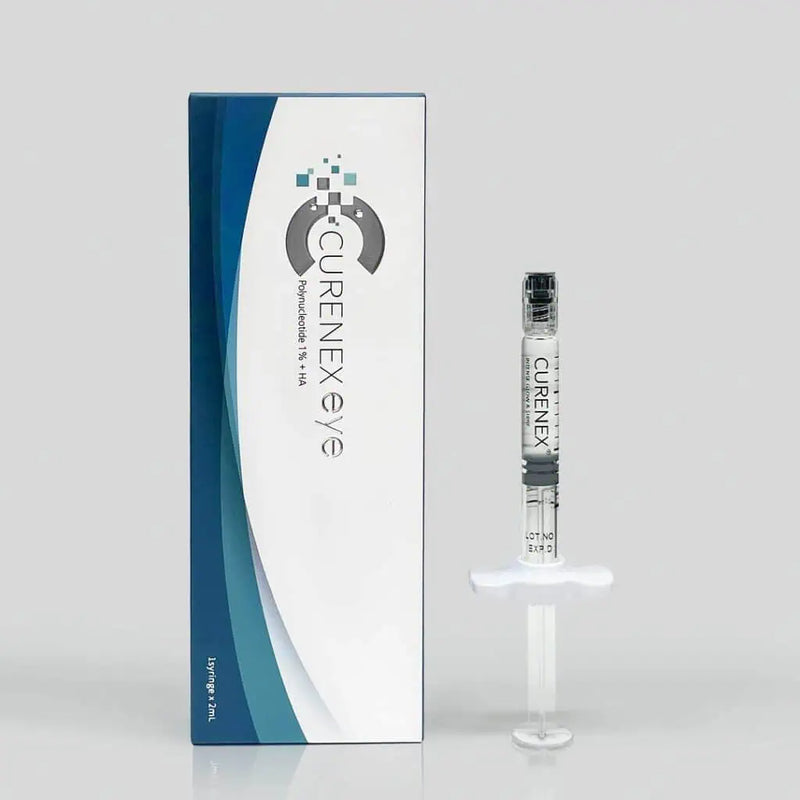
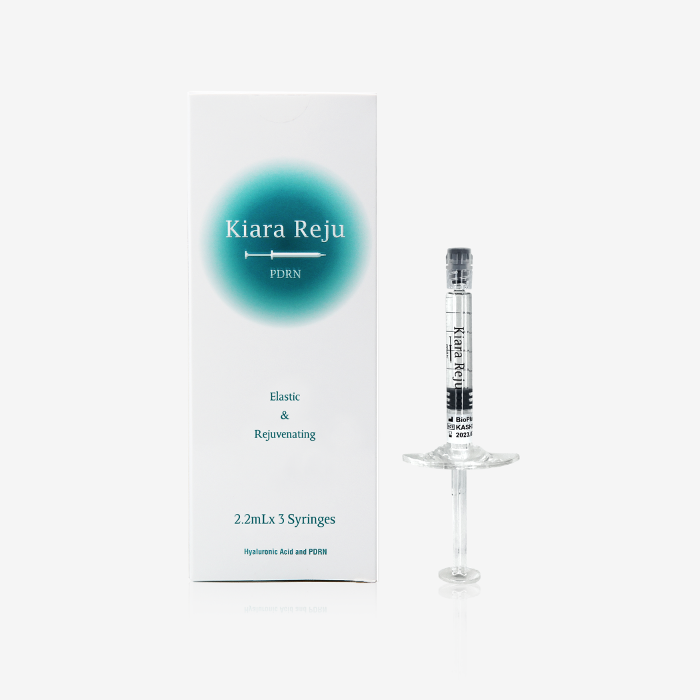
Concrete examples make the pattern easier to see. CURENEX eye is a 2 mL pre-filled syringe positioned specifically for the eye area, built on a polynucleotide and hyaluronic acid pairing, sitting alongside the broader CURENEX range whose face products are PDRN-led blends. KIARA REJU, a PDRN example, declares PDRN at 5 mg/mL alongside hyaluronic acid at 20 mg/mL and niacinamide, a composition where the DNA component is one voice in a chorus rather than a soloist. Reading those three declarations side by side tells you more about what you would actually be buying than any PN-versus-PDRN debate thread.
What Korean practice patterns actually show
The most useful published data point for the under-eye question is not a head-to-head trial, because no convincing one exists. It is a practice survey. A 2024 survey of 235 Korean board-certified dermatologists found that 88 percent of respondents practiced PN injection, and when asked for their indications, the top answers after fine lines on the cheek were infraorbital fine lines and periorbital fine lines.3 In other words, in the country where these products are licensed and most heavily used, the area around the eyes sits at the very top of what professionals reach for PN to address.
Two honest qualifications belong next to that finding. First, a practice pattern is evidence of professional habit and comfort, not proof of outcome; surveys record what clinicians do, not what a controlled trial would conclude. Second, the survey studied PN as a class and does not compare it against PDRN, so it cannot answer the versus question on its own. What it does establish is that the under-eye area is not a fringe use case for polynucleotides in Korean practice. It is close to the center of it.
The Rejuran question, named honestly
It is worth saying out loud what usually sits behind the PN-versus-PDRN-for-under-eyes search, because pretending otherwise makes the comparison less useful. The under-eye polynucleotide conversation was largely created by one product family: Rejuran, the Korean PN line whose eye-specific variant became famous enough that the brand name is often used as shorthand for the entire category. Much of the traffic on this question is really asking a different question, namely what the Rejuran-style approach is and whether other products in the category are built the same way.
The literacy answer is that the famous product follows exactly the pattern described above, and so do its category neighbors. The eye-specific variant of a PN line is a lighter preparation of the same ingredient class in a small syringe, positioned for the thin-skinned periorbital area. That design logic is not proprietary; it is visible in the declarations of other Korean eye formats, which is why reading concentration and blend gets a buyer further than brand recognition does. A brand name certifies a manufacturer and a track record, both of which have real value and neither of which changes what the label discloses. Two consequences follow. If a buyer wants the famous name, the check that matters is authenticity, since well-known names attract the most convincing counterfeits. If a buyer wants the composition, the check that matters is the declaration, since the composition is not exclusive to the name. Either way, the acronym debate is the least load-bearing part of the decision.
So which one is better for under eyes?
The defensible answer has three parts. There is no head-to-head clinical literature that crowns PN or PDRN for the under-eye area, so anyone declaring a winner on evidence is ahead of the evidence. Korean professional practice leans visibly toward PN around the eyes, as the survey above shows, and the best-known eye-positioned products in the category are PN-led, which is why the acronym carries the reputation. And the pharmacology literature is deeper on PDRN, which has been studied longer as a defined ingredient.2
For a buyer, though, the more useful conclusion is that the acronym is the least informative line on the label. Two PN products can differ from each other more than a PN product differs from a PDRN one, because concentration, blend, and format do the real work of defining what is in the syringe. A 1 percent PN blend with hyaluronic acid and a 2 percent straight PN product share an acronym and almost nothing else. If you have decided the polynucleotide category is what you want to buy, the deciding questions are the ones below, not PN versus PDRN.
There is also a quieter reason to distrust any confident verdict here: the two acronyms are not policed. The size boundary between a long PDRN fragment and a short PN chain is a convention, manufacturers on both sides of it choose their label term partly for positioning, and the same salmon-DNA raw material stream can feed products wearing either name.1 A versus question only has a clean answer when the two sides are cleanly separated. In this category they are two overlapping regions of one spectrum, which is precisely why the declared numbers on a specific product beat the category words printed above them.
Reading an under-eye booster label: four lines that matter
Whichever acronym is on the front, the same four declarations decide what the product actually is.
- Declared concentration. Look for an explicit percent or mg/mL for the polynucleotide itself. Eye formats typically run lower than face formats within the same line; what matters is that the number is stated at all. A label that names the ingredient without quantifying it has disclosed a theme, not a formulation.
- Blend partners. Sodium hyaluronate, glutathione, vitamins, and peptides are common companions in eye formats. Each changes what the product is: an HA-heavy blend is buying hydration alongside the polynucleotide. None of it is wrong, but a blend priced as if it were a straight high-concentration polynucleotide is worth noticing.
- Format and volume. Eye-positioned products ship small: 2 to 2.5 mL pre-filled syringes rather than 5 mL multi-vial boxes. A pre-filled syringe also tells you the manufacturer intended this exact preparation, whereas vial formats imply on-site handling by a professional.
- Manufacturer and license. Korean polynucleotide injectables are manufactured under named companies with checkable registrations. The manufacturer's identity, and whether the seller can state it, separates products with a paper trail from products with a story. How to run that check line by line is covered in reading a polynucleotide injectable.
- Molecular weight, if stated. Some spec sheets quote a kilodalton figure for the DNA component, and this is the one line where the PN-versus-PDRN distinction becomes concrete: the number tells you where on the fragment-length spectrum the product actually sits, regardless of which acronym the front of the box chose. Most consumer-facing labels omit it, which is itself information about how much the seller expects you to read. What a kDa figure means and how to interpret one is covered in reading an injectable label.
Price sits downstream of all four. The question of whether premium polynucleotide products earn their premium over cheaper ones, and where the money actually goes, has its own treatment in cheaper vs premium PDRN and PN.
Sourcing PN and PDRN eye formats, and what to verify
Eye-positioned boosters are small, expensive per milliliter, and carried by reputation, which makes them exactly the kind of product where provenance deserves more attention rather than less. Before an eye-format polynucleotide is listed at KSTATION, the manufacturer and licensing are checked against MFDS records and the declared composition is checked against the manufacturer's own documentation; the method is set out in the Editorial & Sourcing Policy. In the current range, the eye-positioned polynucleotide formats include REJUBEAU Eye Deal and CURENEX eye, with full-strength and PDRN-led alternatives such as REJUBEAU PN Healer and KIARA REJU sitting in the wider skin boosters and ampoules collection. All are professional-use products.
Frequently asked
PN vs PDRN: which is better for under eyes?
No head-to-head clinical study crowns either one for the under-eye area. Korean dermatologist practice patterns place infraorbital and periorbital fine lines among the top indications for PN, and the best-known eye-positioned products are PN-led, while PDRN carries the larger pharmacology literature. For a buyer, the declared concentration, blend, and format of a specific product say more about what you are getting than the acronym does.
What is the actual difference between PN and PDRN?
Both are purified salmon-derived DNA. The distinction is size: PDRN refers to shorter DNA fragments and PN to longer chains, which makes PN solutions thicker and more gel-like at the same concentration. Recent reviews treat the boundary as a size-based definition rather than a difference in kind.
Why are under-eye boosters lower in concentration than face products?
Eye-labeled products in Korean booster lines are typically built as distinct formulations: lower polynucleotide concentration, blended with hyaluronic acid or other actives, in small pre-filled syringes. The under-eye area has some of the thinnest skin on the body, and manufacturers formulate lighter products for it. Compare declared active content, not just price per milliliter.
Is Rejuran PDRN or PN?
Rejuran is a PN (polynucleotide) line. The confusion is common because both PN and PDRN are purified salmon-derived DNA and the two terms are used loosely in marketing; the distinction is chain length, with PN referring to the longer chains. Because the brand name became shorthand for the whole under-eye polynucleotide category, products described as comparable to it may be built on either ingredient, which is why the declared concentration and blend on a specific label settle the question more reliably than the brand association does.
Are these products something I can use at home?
No. Injectable polynucleotide products are professional-use products, and everything about placement near the eye area is a clinical decision for a licensed practitioner. This article covers product composition and label literacy only, not administration.
Sources & references
- From Polydeoxyribonucleotides (PDRNs) to Polynucleotides (PNs): Bridging the Gap (2025), size-based definition of the PDRN and PN classes. pmc.ncbi.nlm.nih.gov
- Squadrito F. et al., Pharmacological Activity and Clinical Use of PDRN, characterization of PDRN as a defined mixture of DNA fragments. pmc.ncbi.nlm.nih.gov
- Rho NK et al., A survey on the cosmetic use of injectable polynucleotide: the pattern of practice among Korean dermatologists, Journal of Cosmetic Dermatology (2024): 235 board-certified respondents; infraorbital and periorbital fine lines among the top PN indications. pubmed.ncbi.nlm.nih.gov
- KSTATION, Editorial & Sourcing Policy (official-channel sourcing and traceable provenance). kstations.com
Disclaimer. This article is general educational information and is not medical advice. It describes how polynucleotide products are composed, labeled, and positioned; it makes no claim about what any product will do for an individual, and it does not provide injection guidance. Products referenced are for professional use by licensed practitioners. Regulatory status varies by country and changes over time.