One of the recurring questions in serious aesthetic discussion is whether skin boosters are being placed too superficially to do what people expect of them. It is a good question, and it points at something the marketing rarely mentions: the same injectable can behave very differently depending on the layer of skin it lands in. Depth is not a footnote to what an injectable does; in many cases it is part of the mechanism. This is a look at the skin's layers, why placement changes the result, and why depth is a technique variable that belongs to a trained practitioner rather than a specification printed on the box.
The skin is layered, and depth decides which layer you reach
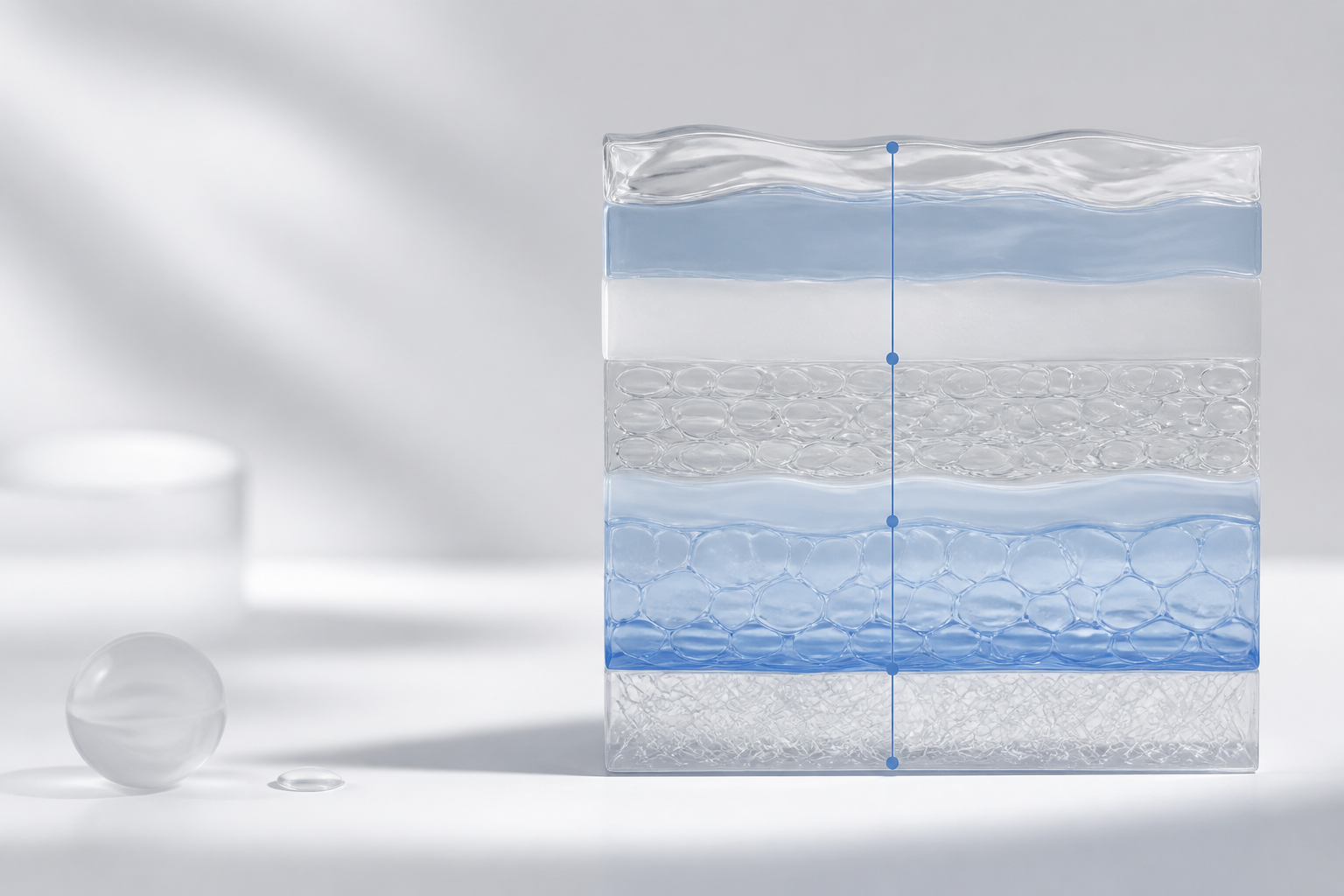
To understand why depth matters, the first thing to hold clearly is that skin is not a single uniform material but a stack of distinct layers, each with a different composition. From the surface down, an injection passes through the epidermis, then the papillary layer of the dermis, then the reticular layer of the dermis, and then the subcutaneous layer beneath.1 These are not arbitrary divisions; they differ in what they are made of and what they do, which is exactly why the layer a material reaches changes how that material behaves.
The dermis in particular is worth resolving into its two parts, because the difference between them is central to this whole discussion. The papillary layer is made of loose connective tissue and sits just under the epidermis, while the reticular layer below it is denser, built from heavier collagen fiber bundles.2 These are physically different environments, and a material placed in the loose papillary dermis is sitting in a different neighborhood, with different mechanics and vascularity around it, than the same material placed in the dense reticular dermis or in the fatty subcutis below.
The scale involved also explains why this is a precise craft rather than a rough one. The dermis is only on the order of a small fraction of a millimeter to around a millimeter thick in many areas, with the papillary layer thinner still, which means the difference between one plane and the next is measured in fractions of a millimeter.1 That is a demanding target, and it is one reason placement is a trained skill: the layers a product is meant for are thin, close together, and not interchangeable.
Holding this layered picture in mind reframes the whole question of what an injectable does. A product does not simply go into the skin as if the skin were one thing; it goes into a specific layer, and that layer is part of what determines the outcome. Once that is clear, the idea that placement is central rather than incidental stops being surprising and starts being obvious, which is the foundation the rest of this piece builds on.
Intradermal: placing material within the dermis
Intradermal placement means the material is deposited within the dermis itself, in the papillary or mid-dermal range rather than deeper, and this is the plane most associated with skin-quality work. The logic is that many boosters are designed to act on the dermis, the layer responsible for a great deal of the skin's support and quality, so placing them within that layer puts the material where its intended action is meant to happen. A booster whose premise is dermal hydration and quality is a dermal-plane product by design.
The character of this plane comes from its being relatively superficial and, in the papillary region, loosely structured and well supplied with small vessels. That makes it accessible and appropriate for materials meant to distribute through the dermis and support it, but it also means the plane is delicate and the margin for placement is small. Material intended for the dermis has to actually reach the dermis, not stop short in the epidermis above it or drop past into the fat below, and doing that reliably is a matter of technique.
This is where the too superficial concern has a real basis, because a product meant to act within the dermis will not do what it is designed to do if it is placed too shallow. The mechanism of many boosters assumes dermal placement, so a deposit that lands above the target layer is a placement issue that can undercut the intended action regardless of how good the product is. The question of depth, in other words, is not separate from the question of whether a booster works as intended; for dermal-plane products, correct depth is part of the intended mechanism.
Subdermal and deeper: the subcutaneous plane
Below the dermis lies the subcutaneous layer, the fatty plane sometimes reached for volumizing or structural work, and it is a fundamentally different environment from the dermis above. It is softer, and it serves different purposes, which is why some materials and some goals are directed there rather than into the dermis. A material intended to sit deep and provide structural support in the subcutis is a different kind of product, placed in a different plane, than a booster meant to distribute through the dermis.
The general principle that connects plane to purpose is that superficial dermal placement is associated with skin-quality and surface work, while deeper placement is associated with structural and volumizing goals. This is why depth and product design travel together: a material formulated to work in the dermis and a material formulated to sit in the subcutis are matched to their planes on purpose, and placing either in the wrong layer is a mismatch between the material and where it was meant to be.
Biostimulators are a useful illustration of how plane and mechanism interlock, because their collagen-stimulating action is tied to being placed in the appropriate layer for that response to occur. We described the collagen-stimulation logic in the skin tightening and firming by mechanism map, and the placement dimension is the same story from a different angle: the material has to be in the right plane for its intended process to happen. Depth, mechanism, and material are three facets of one decision rather than three separate things.
Why the same product behaves differently at different depths
Pulling this together explains the counterintuitive fact at the center of the piece: an identical product can produce different results depending on where it is placed. The reason is that the material's behavior is a function of its environment, and the planes are different environments. Vascularity, tissue density, and the mechanical setting all change from the papillary dermis to the reticular dermis to the subcutis, so the same material interacts differently with each, which means placement is a variable in the outcome and not merely a delivery detail.
The table below sets the planes side by side to make the relationship concrete. It is not a how-to, and it is deliberately not a set of instructions for placing anything; it is a map of what is where and what each plane is generally associated with, so the concept of depth becomes legible. The point is to show that plane and purpose are linked, which is the understanding a reader needs to make sense of why depth comes up in serious discussion at all.
| Plane | What it is | Generally associated with |
|---|---|---|
| Epidermis | The outermost layer, above the dermis | A barrier passed through, not usually a target |
| Papillary dermis | Loose connective tissue just under the epidermis | Superficial skin-quality work; delicate, small margin |
| Reticular dermis | Denser, heavier collagen bundles below the papillary layer | Deeper dermal support and structure |
| Subcutaneous | The fatty layer beneath the dermis | Structural and volumizing goals, deeper materials |
Are skin boosters injected "too superficially"?
The question that started this piece deserves a direct answer, and the honest one is that it can happen and that it is a placement issue rather than a product flaw. If a booster is designed to act within the dermis and the material is deposited above that layer, then yes, it is too superficial for its intended mechanism, and the result can fall short of what the product is capable of when correctly placed. The concern is real, and it is precisely why depth is discussed by people who take the category seriously.
What the concern does not mean, though, is that superficial is always wrong, because some products and some goals genuinely call for a more superficial plane. The word too is doing the work in too superficial: the problem is not superficial placement in the abstract but placement that is shallower than the specific product and goal require. A material meant for the papillary dermis placed in the papillary dermis is correctly placed, while the same depth for a material meant to sit deeper is a mismatch. Depth is judged against the product's intended plane, not against a universal ideal.
This reframes the too superficial worry into something more precise and more useful. The right question is not are boosters placed too superficially in general but is this product being placed in the plane it was designed for, and that is a question about the match between material and technique in a specific pair of hands. It is answerable, but only case by case and only by someone who knows both the product's intended plane and how to reach it, which points directly at the next section.
Depth is a technique variable, not a product spec
The most important thing to understand about depth is that it does not live on the label, because it is not a property of the product but of how the product is administered. A vial does not have a depth the way it has a volume or a concentration; the depth is chosen and executed by the person injecting, in real time, against the anatomy in front of them. That makes depth a technique variable, and it places responsibility for it squarely with the trained practitioner rather than with the product or the buyer.
This distinction matters for how a buyer thinks about the whole category, because it separates what you can verify about a product from what you cannot control by choosing a product. You can read a label, check a lot number, and confirm a material is genuine, and we covered that in reading an injectable's label. What you cannot do is buy correct placement, because placement is a skill applied at the moment of treatment. The product and the technique are two different inputs, and depth belongs entirely to the second.
It also explains why the self-administration conversation that circulates in some communities is a genuinely different and more serious matter, and why this article stays firmly on the conceptual side. Reaching a precise plane in delicate, thin tissue is a trained clinical skill with real consequences when it goes wrong, which is a large part of why these are professional-use products. Understanding why depth matters is useful knowledge for reading the category; executing depth is not a DIY exercise, and nothing here should be read as suggesting otherwise.
How to read depth in the product and the claim
Given that depth is a technique variable, the useful thing a buyer can actually do is read how a product's design implies a plane, and treat placement as a question for the professional. A product built as a dermal booster implies dermal-plane use, a material built to sit deep implies a deeper plane, and matching the two is what the treating practitioner does. Understanding that link lets a reader interpret a product sensibly, knowing which plane it is designed around, without mistaking that understanding for the ability to execute it.
This is also a lens for reading claims, because a claim that ignores depth entirely is telling on itself. Marketing that promises an outcome as if it were a property of the vial alone is leaving out half of what determines the result, since the same material can behave differently depending on placement. A more honest framing acknowledges that outcome depends on correct use by a trained professional, and a reader who knows depth is a variable can spot the difference between a claim that respects that and one that pretends the product does everything on its own.
So the practical close is to hold two things at once. The product is something you can read, verify, and choose, and depth is something a trained practitioner controls, and both have to be right for an injectable to do what it is designed to do. Understanding why placement matters makes you a better reader of the category and a better-informed patient, precisely because it clarifies which parts of the outcome live in the vial and which live in the hands. The material is the part you source. The plane is the part you entrust.
Frequently asked questions
Frequently asked
Why does injection depth matter?
Because skin is layered, and each layer is a different environment. A material passes through the epidermis, the papillary and reticular dermis, and the subcutaneous fat, and these differ in density, vascularity, and structure. The same material behaves differently depending on which plane it lands in, so depth is part of what determines the result rather than a delivery detail. Placement is a variable in the outcome, not a footnote to it.
What is the difference between intradermal and subdermal injection?
Intradermal placement deposits material within the dermis, the layer associated with skin quality and support, while subdermal or subcutaneous placement goes deeper into the fatty layer beneath, associated with structural and volumizing goals. They are different planes matched to different products and purposes. Which plane a given product is designed for is part of its design, and reaching that plane correctly is a technique performed by a trained practitioner.
Are skin boosters really injected too superficially sometimes?
It can happen, and it is a placement issue rather than a product flaw. If a booster is designed to act within the dermis and is deposited above that layer, it is too superficial for its intended mechanism and may fall short of what the product can do when correctly placed. But superficial is not universally wrong; the problem is placement shallower than the specific product and goal require. Depth is judged against the product's intended plane.
Is injection depth something I can choose by picking a product?
No. Depth is not a property of the product but of how it is administered, chosen and executed by the person injecting against the anatomy in front of them. You can verify and choose a genuine product, but you cannot buy correct placement, because placement is a clinical skill applied during treatment. This is one reason these are professional-use products, and it is why reaching a precise plane is not a DIY exercise.
Disclaimer. This article is general educational information, current as of its publication date, and is not medical advice, a treatment recommendation, or a technique guide. It explains why injection depth matters conceptually and gives no instruction on administering any product. Injectable aesthetic products are professional-use products; injection technique and suitability are decisions for a qualified, licensed practitioner, and whether a product is registered or permitted for use is decided by the relevant authorities.
Sources & references
- "Layers of the Skin," Anatomy & Physiology (open textbook; sequence of epidermis, papillary and reticular dermis, and subcutaneous layer, and approximate dermal thickness). Oregon State University. open.oregonstate.education
- "Structure of the Skin: Dermis" (papillary layer of loose connective tissue and reticular layer of denser collagen fiber bundles). Medicine LibreTexts. med.libretexts.org
- Squadrito F. et al., "Pharmacological Activity and Clinical Use of PDRN" (regenerative material whose intended action is tied to its placement in the skin). PMC. ncbi.nlm.nih.gov
From a sourcing standpoint, this is why KSTATION frames depth as belonging to the practitioner and material as belonging to the buyer, because the two are different inputs and conflating them helps no one. The boosters this discussion applies to sit within the skin boosters and ampoules range, each designed around the plane its mechanism assumes, and what an accountable seller can speak to is what a product is and whether it is genuine. What KSTATION does not do is stand in for clinical judgment: which plane a product is placed in, and whether a treatment is appropriate at all, remain matters for a qualified professional and your local authority.