
PLLA / PDLLA
Poly-L-lactic Acid (PLLA) and Poly-D,L-lactic Acid (PDLLA)
PLLA (poly-L-lactic acid) and PDLLA (poly-D,L-lactic acid) are resorbable lactic-acid polymers used as collagen-stimulating biostimulators; they are placed as a temporary scaffold rather than as a volumizing filler, and they resorb to lactic acid over time.
Two letters separate the two most common biostimulator polymers in the Korean catalog, and those letters describe a difference in crystal structure rather than a difference in branding. PLLA and PDLLA are both lactic-acid polymers placed as a temporary scaffold rather than as a filler, and both are resorbed while the body does the building. This page sets out what each material is, what the L and the D,L actually change, and what a sourcing partner can verify about a product built from them.
What PLLA and PDLLA actually are
Poly-L-lactic acid (PLLA) and poly-D,L-lactic acid (PDLLA) are synthetic, biodegradable polymers of lactic acid, a chemistry used in medicine for decades in resorbable sutures and fixation implants before it appeared in aesthetics. As injectables they belong to the biostimulator category rather than the filler one: the material is placed as a temporary framework, prompts a gradual tissue response, and is broken down to lactic acid and cleared through normal metabolic pathways. It is neither a cross-linked hyaluronic acid gel nor a neuromodulator, and neither material is designed to be the result in itself.
That last point is the defining property of the class. A hyaluronic acid filler occupies space the moment it is placed, so it is read by what it adds. A lactic-acid biostimulator is read by what it prompts and over what period, which is why almost nothing about it is legible on the day of the procedure.
The L and the D,L: one chemistry, two structures
Lactic acid exists as two mirror-image forms, and which forms are strung into the polymer determines how the finished material behaves. PLLA is built from the L-isomer alone, which lets the chains pack into a semi-crystalline solid: it is the more ordered, more slowly resorbed of the two. PDLLA mixes both isomers, and the resulting chain cannot crystallize, so the material is amorphous and breaks down on a shorter schedule. Products are also shaped differently around those structures, with PDLLA commonly supplied as porous microspheres and PLLA as irregular microparticles.
| Property | PLLA | PDLLA |
|---|---|---|
| Full name | Poly-L-lactic acid | Poly-D,L-lactic acid |
| Isomers in the chain | L only | L and D mixed |
| Structure | Semi-crystalline, more ordered | Amorphous, non-crystallizing |
| Resorption | Slower, on the longer end of the class | Faster than PLLA |
| Typical particle | Irregular microparticles | Often porous microspheres |
| Breakdown product | Lactic acid, metabolically cleared | Lactic acid, metabolically cleared |
How they are described to work
The published mechanism runs through a sequence rather than a single event. Once injected, the carrier fluid is absorbed and the particles remain distributed through the tissue, where the body recognizes them and mounts a controlled, subclinical foreign-body response. Monocytes are recruited and become macrophages, fibroblasts follow, and the cited literature associates that cascade with deposition of type I and type III collagen around and through the scaffold while the polymer itself resorbs.1 This is a described mechanism studied at the level of the material and the class, not a promise about what a given product will do for an individual; suitability and outcome are clinical questions for a qualified professional. The step-by-step version is set out in how a PLLA biostimulator works.
Forms and preparation
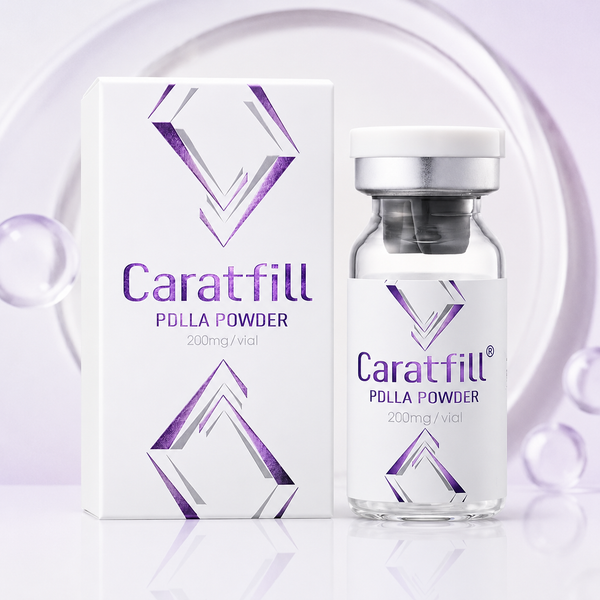
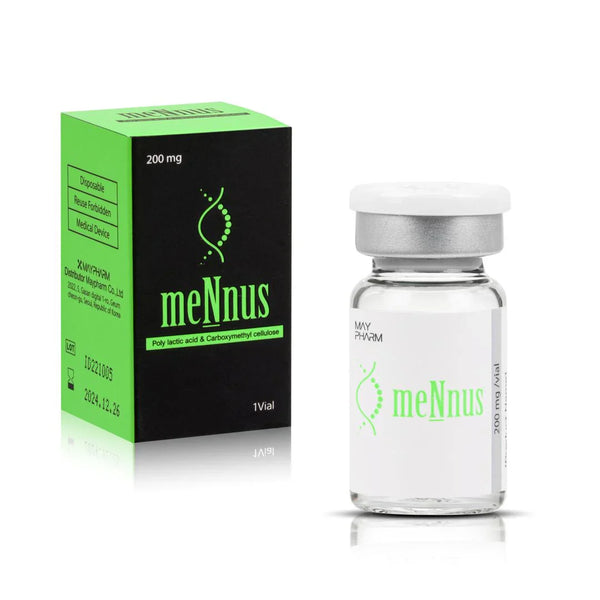
Most lactic-acid biostimulators in the Korean range are supplied as a lyophilized powder in a vial, reconstituted with sterile water and left to hydrate before use, and they are intended for administration by trained professionals. That format is not incidental: because the injected material is a fresh suspension of microparticles rather than a ready gel, the stated reconstitution volume and hydration time are part of how the product is specified. A vial that documents both is describing a material meant to be handled precisely. How to read the rest of the label is covered in reading a PLLA biostimulator.
Where they sit among the biostimulators
Lactic-acid polymers are one branch of a category that also holds polycaprolactone (PCL), polydioxanone (PDO), and calcium hydroxylapatite (CaHA). All of them prompt the body to build rather than adding volume outright; they differ in chemistry, in format, and in how long the scaffold persists, with CaHA standing apart as a mineral rather than a polyester. Reading them as one family first and then by material is more useful than memorizing products, and the full map is in the biostimulator map. For the contrast with volumizing gels, see biostimulators versus HA fillers; the neighboring hubs cover biostimulators as a category and dermal fillers directly.
Regulatory reality
Status is regional and should be stated plainly. Injectable poly-L-lactic acid is approved in the United States in one specific form: Sculptra, cleared by the FDA under premarket approval P030050, first for HIV-associated facial lipoatrophy in 2004 and later for facial wrinkles.3 That approval covers that product, not the material at large. The PLLA and PDLLA products in the Korean range are regulated domestically by the Ministry of Food and Drug Safety (MFDS) and are not FDA-approved for aesthetic use in the United States. Rules differ by market and change over time, so current status should be confirmed with the relevant authority.
How KSTATION verifies these products
A powder-and-reconstitute biostimulator is only itself if it arrives as specified and its provenance is traceable, which puts sourcing next to mechanism in any serious assessment. Manufacturer and licensing details are checked against MFDS records before a product is listed, and we stock officially sourced products only. The method is set out in our Editorial & Sourcing Policy.
Common questions
Is PLLA a filler?
No. PLLA is a resorbable lactic-acid polymer in the biostimulator category. A hyaluronic acid filler adds volume by occupying space; a biostimulator is placed as a temporary scaffold and is resorbed, and the change it is associated with is collagen-mediated and gradual.
What is the difference between PLLA and PDLLA?
The isomers in the chain. PLLA uses the L-isomer only and is semi-crystalline, which makes it the more slowly resorbed of the two. PDLLA mixes L and D, cannot crystallize, and is amorphous, so it breaks down on a shorter schedule. Both resorb to lactic acid.
Are Korean PLLA and PDLLA products FDA-approved?
No. One PLLA product, Sculptra, holds US premarket approval; the Korean lactic-acid biostimulators in this range are MFDS-regulated and are not FDA-approved for aesthetic use in the United States.
Sources & references
- Effect of poly-L-lactic acid and polydioxanone biostimulators on type I and III collagen biosynthesis (2024). pmc.ncbi.nlm.nih.gov
- Efficacy and Safety of Poly-L-Lactic Acid in Facial Aesthetics: A Systematic Review (2024), material characterization and resorption. pmc.ncbi.nlm.nih.gov
- U.S. FDA, Sculptra (injectable poly-L-lactic acid), premarket approval P030050. fda.gov
- KSTATION, Editorial & Sourcing Policy (official-channel sourcing and traceable provenance). kstations.com/pages/editorial-policy
This page is general educational information, not medical advice, and describes what these materials are rather than what any product will do for an individual. Products referenced are for professional use. Regulatory status varies by country and changes over time.
Reading on PLLA / PDLLA
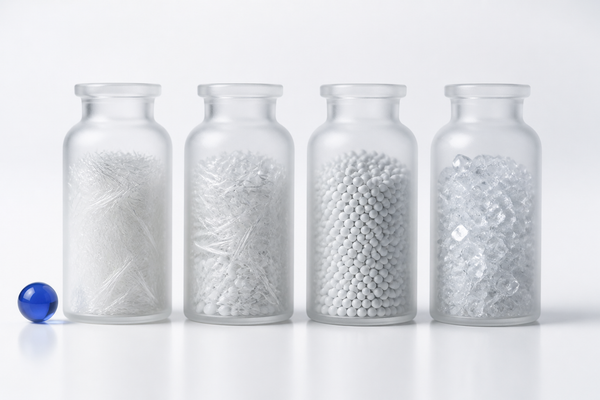
The Biostimulator Map: PLLA, PDLLA, PCL, and CaHA, by Material
Biostimulator is a category, not a product. What PLLA, PDLLA, PCL, and CaHA are made of, how each prompts collagen, and how...
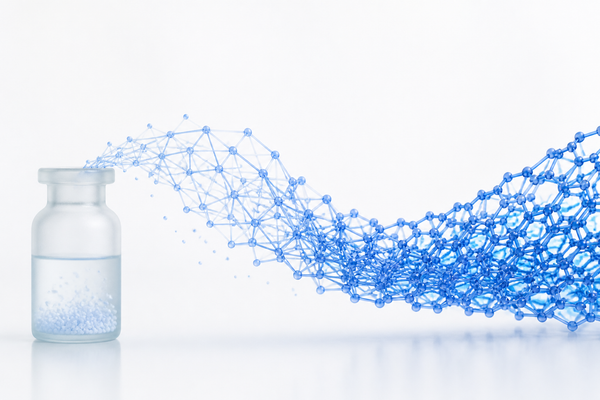
How a PLLA Biostimulator Works: Collagen Stimulation, Explained
A PLLA biostimulator does almost nothing on day one, then works over months through the body's own collagen. The mechanism, step by...
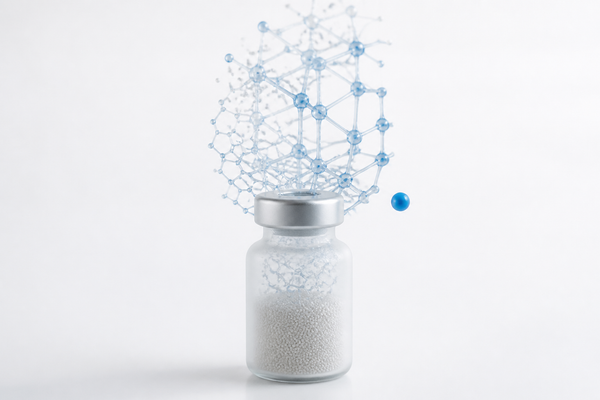
Reading a PLLA Biostimulator: Particles, Reconstitution, and Sourcing
A hyaluronic acid filler does its work the moment it is placed. A biostimulator does almost nothing on the day it is...
PLLA / PDLLA in the catalog
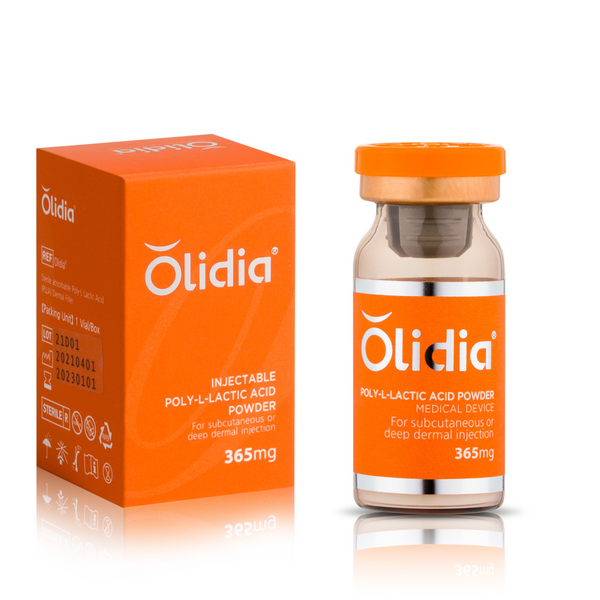
Officially sourced. Curated for North America.