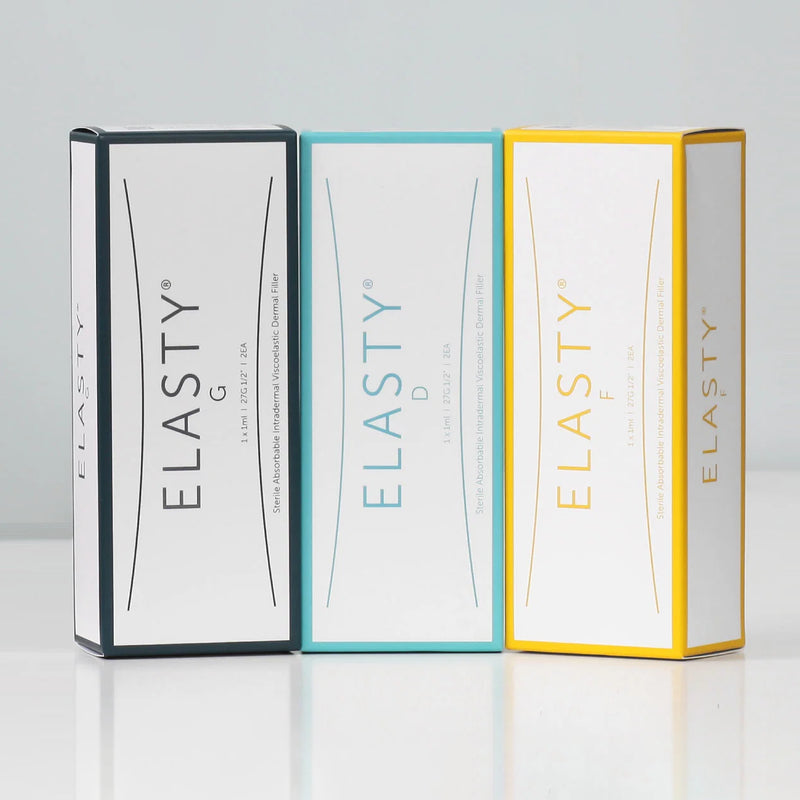
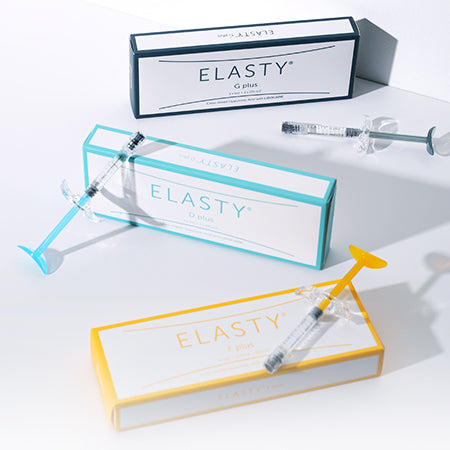
ELASTY and ELASTY Plus share a brand, three version letters and the same declared hyaluronic acid concentration. It is easy to read Plus as a stronger or newer ELASTY. The two specifications say something narrower. The gel concentration is the same. What changes is which versions contain lidocaine, how many syringes come in a box, and what one of the letters stands for.
The two specifications, side by side
| Field | ELASTY | ELASTY Plus | Same or different |
|---|---|---|---|
| Versions | G (Volume), D (Deep), F (Fine) | G Plus (Grand), D Plus (Deep), F Plus (Fine) | Same letters, one name differs |
| Hyaluronic acid concentration | 24mg/mL | 24mg/mL | Same |
| Cross-linking technology named | BDDE cross-linking with PNET | PNET | Same technology named |
| Lidocaine | 0.3% in D and F; G stated as lidocaine-free | 0.3% in all three versions | Different |
| Syringes per box | 2 × 1mL | 1 × 1mL | Different |
| Viscosity labels | High (G), Medium (D), Low (F) | High (G Plus), Medium (D Plus), Low (F Plus) | Same pattern |
| Company named on the page | Dongbang Medical | Dongbang Medical | Same |
Seven fields. Four are the same or follow the same pattern. Three differ, and none of the three is the concentration of the gel. That is the first thing worth fixing in mind, because it rules out the most common misreading of the Plus name.
What stays the same
Both lines declare hyaluronic acid at 24mg per millilitre, which is 2.4 percent. Both name the same proprietary cross-linking technology, PNET, and the base line's page also names BDDE as the cross-linking agent. Both run three versions graded from high to low viscosity, and in both lines the letters map to the same order: G is the firmest, D sits in the middle, F is the softest. Both pages name Dongbang Medical as the company behind the product.
Difference one: lidocaine in every version, or not
In the base line, ELASTY D and ELASTY F contain 0.3% lidocaine, and ELASTY G is stated on our product page as lidocaine-free. In the Plus line, all three versions contain 0.3% lidocaine, including G Plus. The D and F versions are therefore the same in this respect across both lines. The G version is not.
That makes G the version where the two lines are least interchangeable. A buyer who has used ELASTY G and orders G Plus expecting the same formulation will receive a product that declares lidocaine where the previous one did not. The reverse also applies. Whether a formulation with or without lidocaine is appropriate is a decision for the practitioner, and outside what this comparison can address. What the comparison can do is make sure the choice is made knowingly rather than by assuming that the letter G means the same thing in both lines.
Difference two: what is in the box
The base line ships two 1mL syringes to a box. The Plus line ships one. The syringes are the same fill volume, 1mL, so per millilitre the declared contents are identical, but per box the base line contains twice as much: 48mg of hyaluronic acid across two syringes against 24mg in one.
Two practical consequences follow. When comparing prices between the lines, or between suppliers quoting different lines, the comparison has to be made per syringe or per millilitre, not per box. And when a shipment arrives, the syringe count is a quick check that the right line was sent. A box described as ELASTY that contains a single syringe, or a box described as ELASTY Plus that contains two, does not match the specification for the line named on the carton.
Difference three: what G stands for
In the base line, G is labelled Volume. In the Plus line, G Plus is labelled Grand. D stands for Deep and F for Fine in both lines, so G is the only letter whose name changes.
The underlying position of G in each line is the same: the firmest, highest-viscosity version. The name difference is still worth knowing, because documents and supplier messages sometimes use the name rather than the letter. An order written as ELASTY Grand and an order written as ELASTY G Plus refer to the same product. An order written as ELASTY Volume refers to the base line G, which is the version without lidocaine. A one-word difference in a message can therefore carry the lidocaine difference with it.
What the Korean device record says about the name
ELASTY products are hyaluronic acid fillers, which in Korea are licensed as medical devices rather than drugs. Korea's public medical device information service allows a search by the product and model names recorded under each licence, and a search for ELASTY returns 36 entries, most of them under Dongbang Medical and its branch.
Most of those entries are not fillers. The ELASTY name also appears on threads, sutures and needles made by the same company. Among the tissue repair licences, which is the category fillers belong to, the ELASTY name appears under several different licences. One licence granted in 2018 lists Elasty G, Elasty D and Elasty F among its product names. Another granted in 2022 lists Elasty, Elasty Gplus, Elasty Dplus and Elasty Fplus. Other licences granted in 2016 and 2018 list further Plus names such as Elasty G Plus and Elasty Grand Plus alongside names used by other brands.
The practical conclusion is not which licence a given box belongs to. The record does not allow that to be read from the brand name, because the same name appears under more than one licence. It is that the brand name alone does not identify a licence. The licence number printed on the carton does, and a carton's licence number can be checked against the device record to confirm that the record lists that product name under it. This is the same principle we apply to every filler, set out in how to distinguish authentic Korean dermal fillers.
Reading the licence on an ELASTY carton
Korean filler licences in the device record are written in a fixed pattern: a short prefix, a two-digit year, a serial number and the character 호. The ELASTY entries we found carry numbers such as 제허 18-207호 and 제허 22-747호. The prefix 제허 marks a licence for a product manufactured in Korea, as opposed to an imported one, and the two digits after it are the year the licence was granted. So a carton that carries 제허 22-747호 is pointing to a domestic licence granted in 2022, and one that carries 제허 18-207호 to a domestic licence granted in 2018.
The device record also shows the class each licence falls into. The ELASTY tissue repair entries we checked, the category where hyaluronic acid fillers sit, are recorded as class 4, the highest of the four risk classes in the Korean system. That classification is shared by all hyaluronic acid fillers licensed this way, so it does not distinguish one ELASTY product from another. It does explain why the licence record exists at all for these products, and why a carton without a licence number is worth questioning.
To use the record, search the device information service by the product or model name printed on the carton, then look for the carton's licence number among the results. A match means the record lists that product name under that licence. A licence number that does not appear against the product name, or a carton with no licence number, is a question for the supplier before the product is used.
How to tell the two lines apart on arrival
Read the full name and the version. Plus should appear on the carton of every ELASTY Plus version, and the version letter should agree with the order.
Count the syringes. Two per box for ELASTY, one per box for ELASTY Plus.
Check the lidocaine statement for G. The G version is where the lines differ. ELASTY G should not declare lidocaine. ELASTY G Plus should.
Match the licence number. The licence number on the carton should be one under which the Korean device record lists the product name printed on that carton.
Treat a substitution offer as a different product. A supplier who offers G Plus in place of G, or the reverse, on the grounds that both are ELASTY at 24mg/mL, is offering a formulation that differs in lidocaine and a box that differs in contents.
Sourcing ELASTY and ELASTY Plus
KSTATION supplies ELASTY (G, D, F) in the two-syringe box and ELASTY Plus (G Plus, D Plus, F Plus) in the single-syringe box, through official Korean channels. The wider range of hyaluronic acid fillers sits under dermal fillers, and our delivery terms, including the duties-paid option on United States orders, are on the shipping options page.
Frequently asked
What is the difference between ELASTY and ELASTY Plus?
Both declare hyaluronic acid at 24mg/mL with PNET technology and run G, D and F versions from firmest to softest. ELASTY Plus includes 0.3% lidocaine in all three versions, where ELASTY G is lidocaine-free. ELASTY comes two 1mL syringes to a box, ELASTY Plus one. And G stands for Volume in ELASTY but Grand in ELASTY Plus.
Does ELASTY G contain lidocaine?
According to our product specification, no. ELASTY D and ELASTY F contain 0.3% lidocaine, and ELASTY G is stated as lidocaine-free. In the Plus line, G Plus does contain 0.3% lidocaine.
Is ELASTY G Plus the same as ELASTY G?
No. Both are the firmest version of their line and declare the same 24mg/mL concentration, but G Plus contains 0.3% lidocaine and G does not, and G Plus comes one syringe to a box against two for G. G Plus is also labelled Grand rather than Volume.
Sources and references
- KSTATION product specifications for ELASTY (G, D, F) and ELASTY Plus (G Plus, D Plus, F Plus), as listed on our product pages, read 18 September 2026.
- Korean medical device information service (의료기기안심책방), search by product and model name for ELASTY, 36 entries, read 18 September 2026.
- KSTATION editorial policy, on how product facts are separated from manufacturer descriptions in our writing.
This comparison reads the declared specifications of two product lines as listed on 18 September 2026 and the public Korean device record on the same date. It does not describe indications, technique, treatment areas or duration of effect, which are set by the product information and the treating professional.