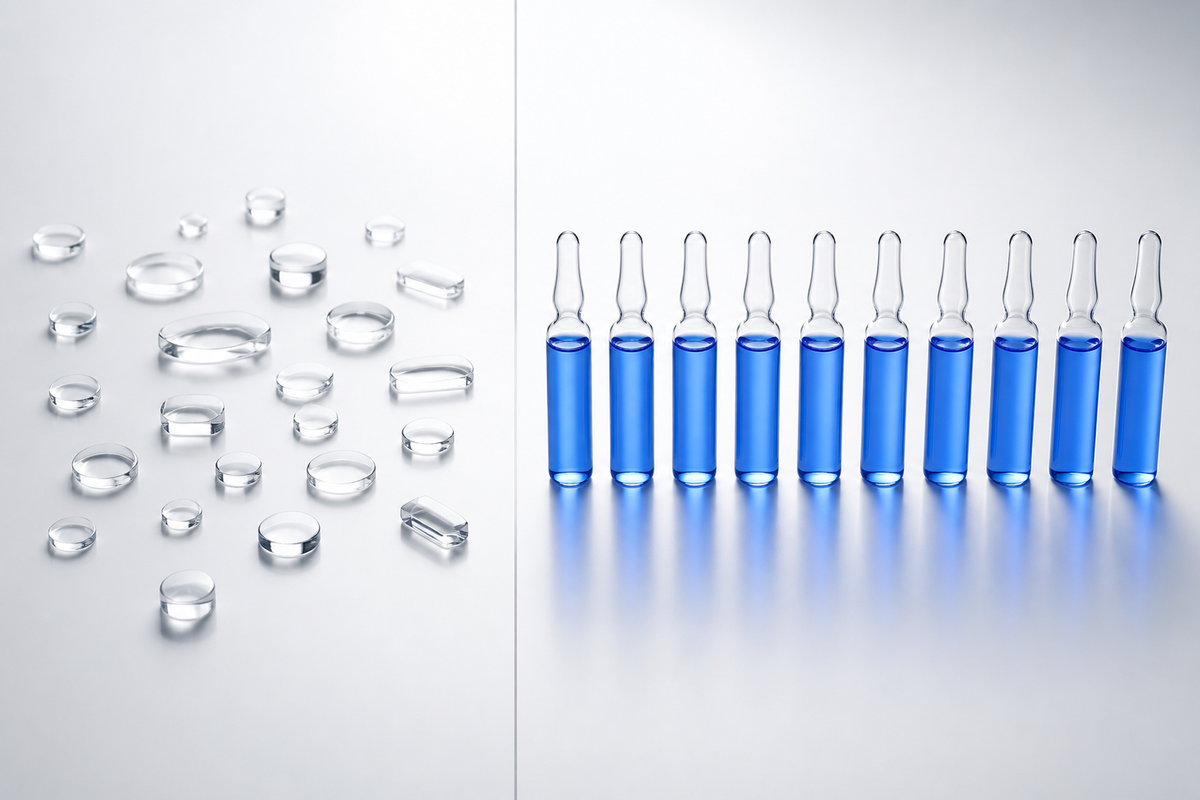
One molecule, hydroxocobalamin, holds forty-eight Korean drug licences. Thirty-three of them are live. Swallow it and the register calls it a vitamin preparation you can buy without a prescription. Inject it and the same register files it among analgesics and antipyretics, prescription-only. Nothing about the substance changed between those two lines. What changed was how it enters the body, and in Korea that single fact rewrites the classification, the supply category, and who is allowed to hand it over.
Two columns, one molecule
A register query on the active ingredient returns every filing that declares it, regardless of dosage form. Run that query on hydroxocobalamin and the result splits cleanly in two, with no overlap and no ambiguous middle.
| Oral | Injection | |
|---|---|---|
| Live licences | 21 | 12 |
| Supply category | Over-the-counter, all 21 | Prescription-only, all 12 |
| Classification code | [03190] other vitamin preparations (14) [03160] combination vitamins (6) [03130] vitamin B preparations (1) |
[01140] antipyretics, analgesics and anti-inflammatories (12) |
| Licence holders | 15 companies | 12 companies |
| Oldest live filing | 1970 | 1989 |
| Carrying an export designation | 3 | 1 |
The split is total. Not one oral filing sits in the analgesic code, and not one injectable sits in a vitamin code. A buyer who has learned that hydroxocobalamin is a B vitamin, which it is, will search the vitamin section of the register for the injectable version and find nothing, because the injectable version does not live there.
What a classification code is for
The four-digit code attached to a Korean licence is an administrative index. It groups filings for the purposes of the register itself: statistics, review routing, reimbursement classification, and the ordering of a very large list. It is assigned at the time of filing and it describes where the product sits in that filing system.
It is not a clinical claim, and reading it as one produces immediate nonsense. Code [01140] covers antipyretics, analgesics and anti-inflammatories. Twelve injectable vitamin filings sit inside it. Nobody at the ministry is asserting that a B12 injection is a painkiller. The code is where injectable preparations of this type were placed decades ago, and subsequent filings followed the placement of the ones before them.
This matters beyond one molecule because the reflex it corrects is common. Sourcing conversations routinely treat a register code as a verdict, saying a product is classified as X and therefore is X. The code answers a narrower question than the one being asked of it: not what is this, but where was this filed.
Where the real consequence sits
The classification code is the eye-catching half of the split and the less consequential one. The half that actually governs what a buyer can do is the supply category, and it moves in lockstep with the route.
All twenty-one oral filings are over-the-counter. All twelve injectables are prescription-only. That is not a coincidence of this particular molecule; it follows the general Korean treatment of injectable preparations, which are handled as prescription products as a class. The oral filings can be sold across a pharmacy counter. The injectables require a prescription in Korea and are subject to the import handling that prescription products attract elsewhere.
For anyone sourcing across a border, this is the line that has practical effect. A product's status as a vitamin in ordinary speech does nothing to change the category it was licensed under, and the category travels with the product.
The oral side splits again
Calling the oral column a vitamin column is a simplification that the register itself does not quite support. The twenty-one live oral filings sit across three different codes, and the distribution is not what the molecule would lead you to expect.
| Code | Covers | Filings |
|---|---|---|
| [03190] | Other vitamin preparations | 14 |
| [03160] | Combination vitamins, excluding A and D combinations | 6 |
| [03130] | Vitamin B preparations, excluding B1 | 1 |
Hydroxocobalamin is a form of vitamin B12. There is a code named for vitamin B preparations. Exactly one of the twenty-one filings that declare this B vitamin is in it.
The reason is compositional rather than mysterious. Almost all of these tablets are large multivitamin formulations in which B12 is one entry on a long list, and a product declaring a dozen actives across several vitamin families does not belong in a single-family code. It lands in the residual code, [03190], which is where the register puts what its narrower codes do not fit. Six more, presumably with a narrower but still multiple composition, land in the combination code. The single product in the B code is the one whose composition is narrow enough to earn it.
This is the same lesson as the analgesic code arriving from the opposite direction. In the injectable case a code looks wrong and is merely historical. In the oral case a code looks right, is available, and is almost never used, because the code describes the whole formulation rather than any one ingredient in it. In both directions the error is the same: treating a code as a statement about the molecule you happened to query on.
The two lines age differently
Put the withdrawal record beside the live one and the two routes stop looking like mirror images.
Fifteen of the forty-eight filings have left the register: seven withdrawn, six expired, one cancelled, and one recorded as a business closure. Fourteen of those fifteen are oral. Exactly one injectable filing has ever left this register: granted in 2016 and withdrawn in March 2026.
The oral line churns. Tablets appear, run for a few years and lapse, often replaced by a product from the same company under an adjacent name. One tablet granted in November 2023 was withdrawn in November 2024, and a filing under the same name was granted a month later, in December 2024. Another company's tablet, granted in 2023, was cancelled in November 2024, and a successor with a different suffix was granted in January 2025. The molecule is a minor component of large multivitamin formulations, and those formulations are reformulated and relaunched on a commercial rhythm that has nothing to do with the vitamin inside them.
The injectable line does not churn. Twelve filings granted between 1989 and 2017, twelve still live, one casualty in nearly four decades. The oldest, granted in 1989, carries an export designation. The newest is from 2017, and no injectable filing declaring this active has been granted since.
| Route | Live | Left the register | Share left |
|---|---|---|---|
| Oral | 21 | 14 | 40% |
| Injection | 12 | 1 | 8% |
A register reading taken today is a reading of a moment, and the two halves of this molecule decay at very different rates. An oral filing confirmed two years ago has roughly a two-in-five chance of no longer being what you confirmed. An injectable filing confirmed two years ago is almost certainly still standing.
Twelve filings, twelve holders
The injectable side has one filing per company, twelve of each, with no company holding two. The oral side has fifteen companies across twenty-one filings, so several hold more than one: one company holds a coated tablet alongside its older flagship tablet, another holds two chewable products differing by an added coenzyme.
The pattern is what you would expect from the two commercial logics. An injectable ampoule is close to a commodity and there is little reason for one holder to file a second, nearly identical one. A multivitamin tablet is a consumer product competing on formulation and branding, so holders file variants.
For identification, the consequence is that an injectable is pinned by its holder. Twelve holders, twelve products, no internal ambiguity: the company name resolves the product completely. On the oral side the holder narrows the field but does not close it, and you need the product name as well.
When the injectable line was built
The twelve live injectable filings are not evenly spread across the decades. They arrive in a handful of clusters and then stop.
| Period | Filings granted | Note |
|---|---|---|
| 1989 | 1 | Oldest live injectable; carries an export designation |
| 2001–2002 | 3 | Includes the filing behind HYCOMIN Inj, granted 2002 |
| 2006–2008 | 3 | — |
| 2016–2017 | 5 | The most recent cluster; nothing since |
Nine years of silence on a product line that is neither withdrawn nor in decline is a fact worth holding lightly, because a register records grants rather than reasons. What can be said is narrow and useful: the injectable field as it exists today was fully formed by 2017, and anyone comparing suppliers is comparing a closed set rather than a moving one. A newly marketed injectable claiming this active would not be a thirteenth entrant on this list; it would be an existing filing under a new commercial name, or it would be something else.
The export designation on the 1989 filing is the only one on the injectable side, against three on the oral side. Export designations are recorded on the filing and are visible in the register entry, which makes them one of the few places where a Korean licence says something directly about markets outside Korea.
Reading this on a carton
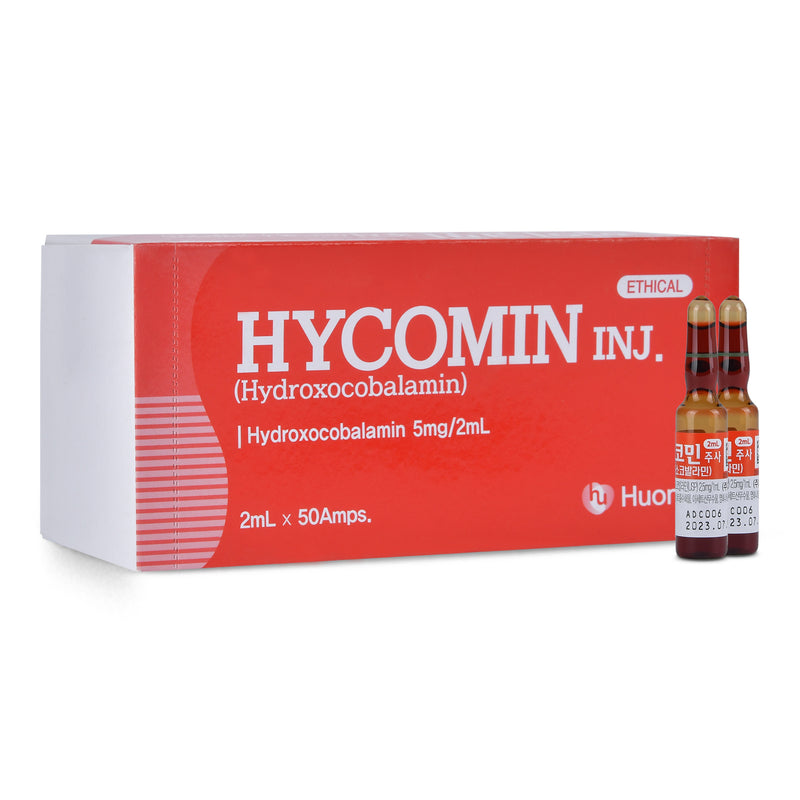
None of the above is visible on a box. A carton of an injectable preparation carries the licensed product name, the holder, the declared active with its stated figure, the volume and the ampoule count. It does not print the classification code and it does not print the supply category in a form a foreign reader will recognise.
The route, however, is legible, because it is built into the Korean product name. Korean licensed names carry the dosage form inside the string rather than beside it, and an injectable name ends in the syllable that marks it as an injection. That syllable is the most reliable single thing on the carton for a reader who cannot otherwise read the language: it tells you which of the two columns above the product belongs to, and everything else in this article follows from that column.
The practical form of this is narrow. Copy the Korean product name exactly as printed, and the register query that name supports will return the filing with its code, its category and its status attached. A romanised trade name will not, because romanisations are not index keys.
The same split, elsewhere
Hydroxocobalamin is a clean example rather than a special case, and the pattern generalises in a way worth carrying to other products.
Ascorbic acid behaves the same way, sitting in vitamin codes as an oral preparation and moving category as an injectable. Lidocaine produces a related but distinct split, where the same molecule is a licensed drug when it is the product and an undeclared constituent when it sits inside a medical device, which is a difference of what role it plays rather than how it enters. Glutathione preparations show the supply-category half of the pattern without the classification-code surprise.
The transferable rule is short. When a molecule appears in more than one dosage form, do not assume the register treats the forms as versions of one thing. Query the ingredient, then read the routes separately, because the route is frequently carrying more regulatory weight than the molecule.
How this shows up in a catalogue
A retail catalogue organises by what a buyer is looking for, which is not how a register organises. In the KSTATION range, injectable preparations of this kind sit under nutritional and antioxidant wellness alongside other injectable vitamin products, because that is the shelf a buyer looks on. HYCOMIN Inj is a hydroxocobalamin preparation in ampoule form and one of the twelve live injectable filings described above.
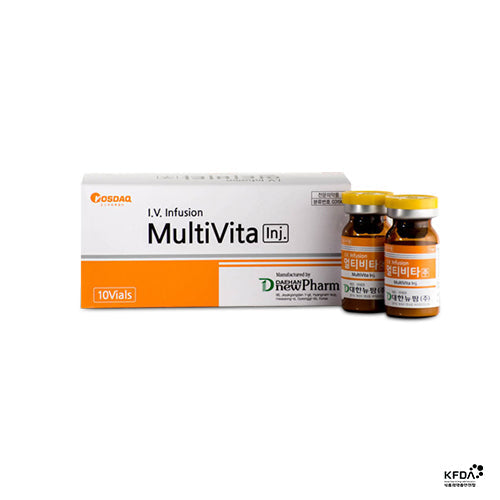
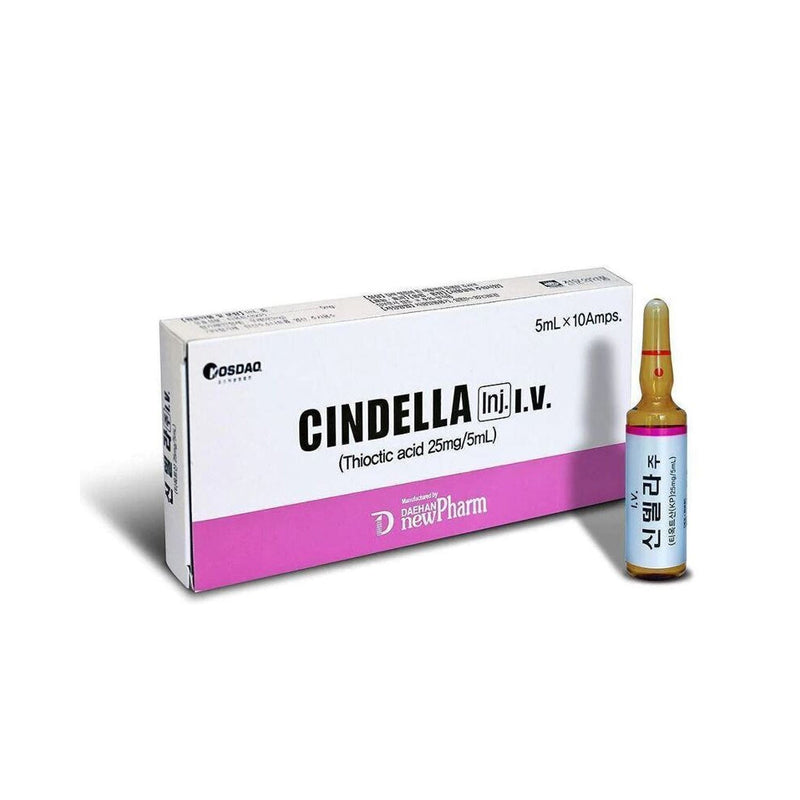
Two neighbours on the same shelf show how little the shelf itself tells you. MultiVita Inj is a multi-component injectable whose name is shared across a large number of filings by different companies. CINDELLA Inj is a different composition again. All three are injectable, all three are prescription-only in Korea, and all three will be classified in codes you would not predict from the shelf they share. The catalogue groups by purpose; the register groups by filing history. Neither is wrong, and they do not line up.
Frequently asked
Why is an injectable vitamin classified as an analgesic in Korea?
Because the classification code is an administrative index rather than a clinical statement. All twelve live injectable filings declaring hydroxocobalamin sit in code [01140], which covers antipyretics, analgesics and anti-inflammatories. The placement reflects where injectable preparations of this type were filed historically, and later filings followed the earlier ones. It is not an assertion about what the product does.
What does a Korean drug classification code actually mean?
It says where a filing is shelved in the register, for statistics, review routing and list ordering. It does not say what a product is indicated for. Indications live in the product's approved labelling, which is a separate document. Reading a code as a verdict on what something is produces confident errors.
How does route of administration change a Korean licence?
For this molecule it changes two fields completely. All twenty-one oral filings are over-the-counter and sit in vitamin classification codes. All twelve injectable filings are prescription-only and sit in a single non-vitamin code. There is no overlap between the two sets.
Does an over-the-counter tablet mean the injection is also unrestricted?
No. The supply category attaches to the individual filing, not to the molecule. An over-the-counter oral filing and a prescription-only injectable filing can declare the same active and be granted to companies in the same market, as they are here.
Why do the oral filings turn over so much faster?
Fourteen of the fifteen filings that have left are oral. The molecule is usually a minor component of large multivitamin tablets, and those are reformulated and relaunched commercially, often reappearing under an adjacent name from the same company. The injectable line has lost one filing since 1989.
Can I tell the route from the packaging without reading Korean?
Largely yes, because Korean licensed names carry the dosage form inside the name string, and an injectable name ends with the syllable marking it as an injection. Copying the Korean product name exactly is enough to run a register query, whether or not you read the language.
Sources and references
- Ministry of Food and Drug Safety, public drug product register, queried by active ingredient (hydroxocobalamin). Forty-eight filings returned, thirty-three live, retrieved 11 September 2026.
- Classification codes as published in the same register: [01140] antipyretics, analgesics and anti-inflammatories; [03130] vitamin B preparations; [03160] combination vitamin preparations; [03190] other vitamin preparations.
- Supply category (prescription-only or over-the-counter) as recorded on each individual filing.
- Cancellation reason and date as recorded on each filing that has left the register (withdrawn 7, expired 6, cancelled 1, business closure 1), re-queried on 17 September 2026.
Register figures are a reading taken on 11 September 2026. Licences are granted and withdrawn without notice, and this article records counts rather than predicting them. Nothing here describes what any product is indicated for, how it should be administered, or in what quantity; those questions belong to a product's approved labelling and to a qualified practitioner.