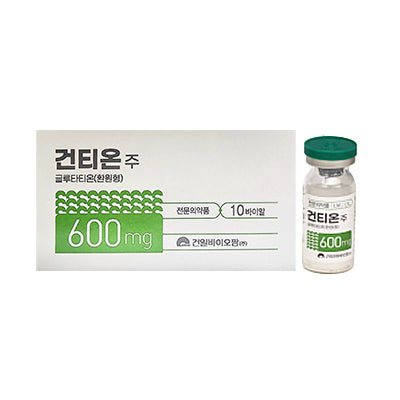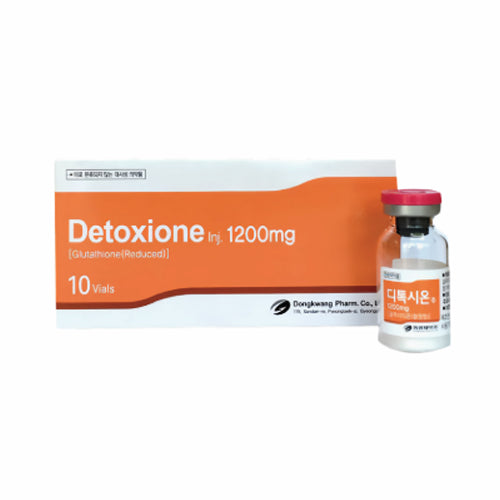
Three names sit next to each other in the same corner of a Korean catalogue, and all three resolve to the same declared active. Kuhnthione, Detoxione, and Luthione are reduced glutathione injectables, licensed in Korea, sold in boxes of ten vials. A buyer comparing them is not comparing molecules. What actually separates them is quieter and more useful: how each name handles strength, and what happens when you take that name to the public register and try to find it.
That second question turns out to be the interesting one. The Korean drug register is a public record, and a product name is supposed to be the handle you grab it by. For one of these three brands the handle works exactly as expected. For the second it works, but the company behind it is not visible from the product side. For the third the brand name does not appear in the register at all, and you have to arrive by a different route entirely.
One active, one register category, three brand names
Start with what is shared, because it is most of the product. All three declare glutathione in its reduced form, written in the Korean register as 글루타티온(환원형). That parenthetical is not decoration. Glutathione exists in a reduced state and an oxidised state, and the register names which one a licence covers, which is why the phrase repeats across nearly every entry in the category.
The category itself is large and settled. Searching the register by ingredient returns 85 glutathione licences in total, of which 75 are live. The register does not put the other ten in one box: five were withdrawn and five reached the end of their term. Those live entries split almost evenly by route: 37 oral products held across 29 licence holders, and 38 injectable products across 26. This is not a niche with two suppliers and a lot of marketing. It is a mature generic category where the active is identical by definition and the licence holders are numerous.
Which means brand names in this category are doing very little descriptive work. A name like Detoxione does not tell you a formulation choice, because there is no formulation choice to signal. The powder is the same substance under a different label. What the name can carry, and where the three diverge, is strength.
The number that is missing from the name
Two of these three brands hold two separate Korean licences each, one per strength. That is the first thing worth internalising, because it changes what a product name means. A 600mg vial and a 1200mg vial of the same brand are not one licence with two package sizes. They are two entries in the register, approved on different dates, sitting under the same holder.
Luthione shows the pattern most clearly. Daehan New Pharm, named as the manufacturer in the product documentation, holds 루치온주, approved 13 July 2012, and 루치온주1200mg, approved 22 October 2014. Read those two names side by side and the asymmetry is immediate. The 2014 entry announces its strength. The 2012 entry does not announce anything, because when it was approved there was nothing to distinguish it from.
Detoxione repeats the pattern on a compressed timeline. The licence holder recorded as 동광제약(주) holds 디톡시온주, approved 29 June 2015, and 디톡시온주1200mg, approved 25 November 2015. Five months separate them. The unnumbered name came first, the numbered one followed, and the same convention applied: the newer, higher strength took the number and the original kept its plain name.
The two-strength pair is the category convention, not a brand choice
It would be easy to read the 600 and 1200 pairing as something these three brands happen to share. It is wider than that. Across the live injectable entries whose names carry a strength, at least seven brands hold both figures side by side under one licence holder, and the pairing repeats regardless of when the company entered the category. The 600 and 1200 pair is the unit this market is built in. What the pairing does not do is make a plain name predictable. Grouping the live injectable entries by licence holder and brand stem gives 27 brands, and twelve of them carry no strength in the name. Only four of those twelve also hold a numbered sibling. The other eight are the only entry their brand has. An unnumbered name is ambiguous rather than merely terse, then, but not because a sibling is likely: it is ambiguous because the name does not say either way. Two of those four pairs were approved on the same day, number and no number together, so even the sequence that explains Luthione and Detoxione does not explain the convention itself.
What is not standardised is how that number gets written. Among the injectable entries naming a strength, roughly half use the Latin abbreviation and the rest spell the unit out in Korean, and the split does not follow company lines. One holder writes its 600 entry with the abbreviation and its 1200 entry with the Korean spelling, in the same category, in the same week of approvals. Exactly one entry in the whole set punctuates the thousands place, and one brand places the figure in the middle of the name rather than at the end, so the number is not even reliably a suffix.
For a buyer this is a search problem before it is anything else. Querying the register for a strength written one way silently misses the entries written the other way, and the miss looks like an absence rather than a formatting mismatch. It is the same failure mode that makes a brand name feel like it resolves cleanly when it has simply returned the subset that happens to match your spelling. Where a lookup matters, it is safer to search the ingredient and read the strengths off the results than to search a strength and trust the count.
Key takeaway
In this category, a Korean product name with no strength in it is usually the lower strength and an older licence, not a general entry covering the range. The number appeared when a second strength needed distinguishing from the first.
Kuhnthione, and the brand name that is not in the register
Kuhnthione breaks the pattern twice. The first break is timing. The product documentation names Kuhnil Biopharm as the manufacturer. In the register, that company holds two glutathione injectable licences, 건티온주600밀리그램 and 건티온주1200밀리그램, and both carry the same approval date: 15 November 2021. There is no founding strength and no later addition. Both strengths were approved together, and both carry their number in the name. A brand entering an established category nearly a decade after the others does not inherit the naming problem, because it never had a period where only one strength existed.
The second break is the one that matters when you go looking. The brand name Kuhnthione does not appear in the Korean register at all. Search the ingredient across all 85 entries and no product name matches it. What you can confirm is the manufacturer, because the product documentation states it, and from there the two licences are findable. The route runs through the company, not the brand.
This is unremarkable in itself. Korean manufacturers routinely carry a domestic product name and an export brand, and there is no requirement that the two match. But it means the verification method that works for Luthione, taking the name to the register and finding it, produces nothing here. The absence is a naming convention, not a gap in the record.
There is a further wrinkle worth noting carefully, because it is easy to overstate. The register also holds 글루타온주1200mg, approved 21 November 2014, under a licence holder whose name closely resembles the Kuhnthione manufacturer's. Two similarly named corporate entities appearing in the same ingredient category is exactly the kind of detail that invites an assumption about corporate structure. The register records licence holders, not group relationships, so the honest statement is narrower: these are two separate licence holders with two separate entries, and the public record does not describe how, or whether, they are connected.
Three brands, three different verification routes
Put the three side by side and what emerges is not a ranking. It is three different answers to the question "how do I confirm this product is what the label says".
| Kuhnthione | Detoxione | Luthione | |
|---|---|---|---|
| Declared active | Reduced glutathione | Reduced glutathione | Reduced glutathione |
| Brand name in register | Not present | Present | Present |
| Manufacturer in product docs | Stated | Not stated | Stated |
| Route to the licence | Via the company | Via the name | Either |
| Licences held (injectable) | Two, same date | Two, five months apart | Two, two years apart |
| Strength written in name | Both entries | Higher only | Higher only |
Luthione is the only one of the three where both routes are open. The manufacturer is stated in the product documentation and the brand name resolves in the register, so the two confirm each other. That redundancy is worth something, and it is the exception rather than the rule.
Detoxione and Kuhnthione each leave one route closed, in opposite directions. For Detoxione the product documentation does not name a manufacturer, so the register entry is what you have. For Kuhnthione the brand name is absent from the register, so the manufacturer statement is what you have. Neither is a defect. But a sourcing checklist that assumes both routes will always be available will register two false alarms out of three.
What the catalogue carries versus what the register holds
All three brands hold licences at both strengths in Korea. What reaches a given catalogue is a subset, and the subset differs by brand. In the KSTATION range, Kuhnthione lists both strengths as variants of one product page. Detoxione lists the 1200mg. Luthione lists the 600mg. Three brands with the same two-strength structure behind them present three different faces at the point of purchase.
This is ordinary distribution, not a signal about the products. Ranges are built from what is available, what moves, and what a supplier chooses to carry. But it creates a specific comparison failure. A buyer looking at these three catalogue entries sees one brand offering a choice of strength and two brands apparently fixed at one each, and may reasonably conclude that Detoxione is a 1200mg product and Luthione is a 600mg product in the way that a molecule is a molecule. Neither is true at the licence level. Both brands hold both.
The distinction matters when a buyer wants a strength a catalogue does not currently show. In a category where the brand is a label on a generic active, "this brand does not make that strength" and "this listing does not currently carry that strength" are very different statements, and only one of them is a fact about the product.
Why a brand name alone will not resolve a strength
A brand name alone is an incomplete instruction. "Luthione" resolves to two licences. "Detoxione" resolves to two licences. "Kuhnthione" resolves to zero register entries by name and two by manufacturer. In none of the three cases does the brand name by itself specify what arrives.
What does specify it is the combination that appears on the box and the order line: brand, strength in milligrams, and vial count. Those three together identify a licence. Any two of them can leave real ambiguity, and the ambiguity is not evenly distributed, which is why it goes unnoticed. A buyer who has only ever ordered Kuhnthione has always seen the number, because both Kuhnil Biopharm entries carry it. The same buyer moving to Luthione meets a name that does not, and has no reason to suspect that the omission is meaningful.
Luthione, one brand name across two dosage forms
Daehan New Pharm holds two more live glutathione licences beyond the two injectables: 루치온정100mg, approved 10 January 2020, and 루치온정50밀리그램, approved 2 March 2020. These are oral tablets. The brand name carries across the route change, so within one company the same name spans an injectable line and an oral line at four different strengths.
The register keeps these clearly separated, and the category-wide split noted earlier, 37 live oral entries against 38 injectable, shows this is a substance that routinely appears in both forms across many holders. The separation is only invisible from the outside, where a brand name searched without a route qualifier returns products that are not interchangeable and were never meant to be compared.
Reading a glutathione name before you order
Treat the strength as part of the identifier rather than a variant of it. If a name arrives without a number, that is a fact about the name and probably about the licence, and it is worth confirming rather than assuming it means "standard" or "as listed". Ask which of the two routes, brand name or manufacturer, actually resolves for the product in front of you, and expect the answer to change from brand to brand. When only one route is open, that is normal, and it tells you which document to keep.
Frequently asked
What is the actual difference between Kuhnthione, Detoxione, and Luthione?
All three declare the same active, reduced glutathione, and all three are Korean-licensed injectables sold in ten-vial boxes. The differences are in how each brand handles strength in its product naming, which company holds the licence, and which route lets you confirm the product in the public register. The active itself is defined by the ingredient, not by the brand.
Why do some of these names carry a number and others do not?
Approval sequence explains some of it, not all. Where a brand was first licensed at one strength and later added a second, the original name typically stayed as it was and the newer, higher strength took the number, which is what happened with Luthione and Detoxione. But two other brands hold a plain name and a numbered one that were approved on the same day, so sequence cannot be the explanation there. Where both strengths were approved at once and both carry a number, as with the Kuhnil Biopharm entries dated 15 November 2021, the convention is simply applied consistently. The number marks a distinction that needed making, not a special product.
Is a 600mg and a 1200mg version the same licence?
No. In the Korean register they are separate entries with separate approval dates, held by the same licence holder. Luthione's two injectable entries are dated 2012 and 2014; Detoxione's are dated June and November 2015. Treating the pair as one licence with two pack sizes misreads how the record is structured.
Why can I not find Kuhnthione in the Korean register?
Because the brand name does not appear there. The product documentation names Kuhnil Biopharm as the manufacturer, and that company holds two glutathione injectable licences under a Korean product name. A domestic product name and an export brand are not required to match, so the lookup has to run through the company rather than the brand.
If a catalogue lists only one strength, does the brand only make one?
Not necessarily, and in these three cases not at all. All three brands hold licences at both strengths. What a range carries at a given moment is a distribution decision and can differ from what the licence holder is approved to produce. The register answers what exists; a catalogue answers what is currently listed.
Where glutathione sourcing fits at KSTATION
Our approach on this line is to keep the licence identity attached to the listing rather than to the brand alone: strength stated, vial count stated, and the manufacturer identified where the product documentation states it. Where a brand name does not resolve in the public register, as with Kuhnthione, the useful record is the manufacturer, and we would rather say that plainly than present a lookup that does not exist.
The fuller antioxidant and injectable range sits under vitamins and injectables, with the brightening and pigmentation lines grouped separately. For readers who want the composition side rather than the naming side, our guide to reading a glutathione injectable covers grade and sourcing, and the freeze-dried powder explainer covers why the substance ships in the form it does.
Sources
- Korea Ministry of Food and Drug Safety, Drug Product Permit Information Service. Ingredient query: Glutathione. Retrieved 8 September 2026. Totals cited: 85 licences, 75 live, 10 no longer live and split by the register into 5 withdrawn and 5 expired; 37 live oral across 29 holders; 38 live injectable across 26 holders. Re-checked 10 September 2026, totals unchanged. The oral count was verified by dosage form rather than assumed: 33 tablets, 3 capsules and 1 other, with 34 of the 37 in the antidote class.
- Korea MFDS drug register, ingredient query: Glutathione, re-queried 16 September 2026. Totals unchanged. The 38 live injectable entries were grouped by licence holder and brand stem, giving 27 brands: 7 hold both strengths with a number in each name, 4 pair a plain name with a numbered one, 8 carry a number as their only entry, and 8 carry no number as their only entry. Of the four mixed pairs, 루치온 (2012 and 2014) and 디톡시온 (June and November 2015) were approved in sequence, while 글루타시드 (both 17 February 2017) and 하야론 (both 1 November 2017) were approved on the same day.
- Korea MFDS drug register entries: 루치온주 (13 July 2012) and 루치온주1200mg (22 October 2014), Daehan New Pharm; 루치온정100mg (10 January 2020) and 루치온정50밀리그램 (2 March 2020), Daehan New Pharm.
- Korea MFDS drug register entries: 디톡시온주 (29 June 2015) and 디톡시온주1200mg (25 November 2015), licence holder 동광제약(주).
- Korea MFDS drug register entries: 건티온주600밀리그램 and 건티온주1200밀리그램, both 15 November 2021, Kuhnil Biopharm; 글루타온주1200mg (21 November 2014), separate licence holder.
- KSTATION product documentation for Kuhnthione Inj, Detoxione Inj, and LUTHIONE Inj, manufacturer statements as published on the product pages.
This article describes product naming, licence structure, and public register records. It does not describe indications, dosing, administration, or outcomes, and nothing here is clinical guidance. Prescription-only status and permitted use are determined by the regulator in each market. Product availability and listed strengths reflect the catalogue at the time of writing and may change.