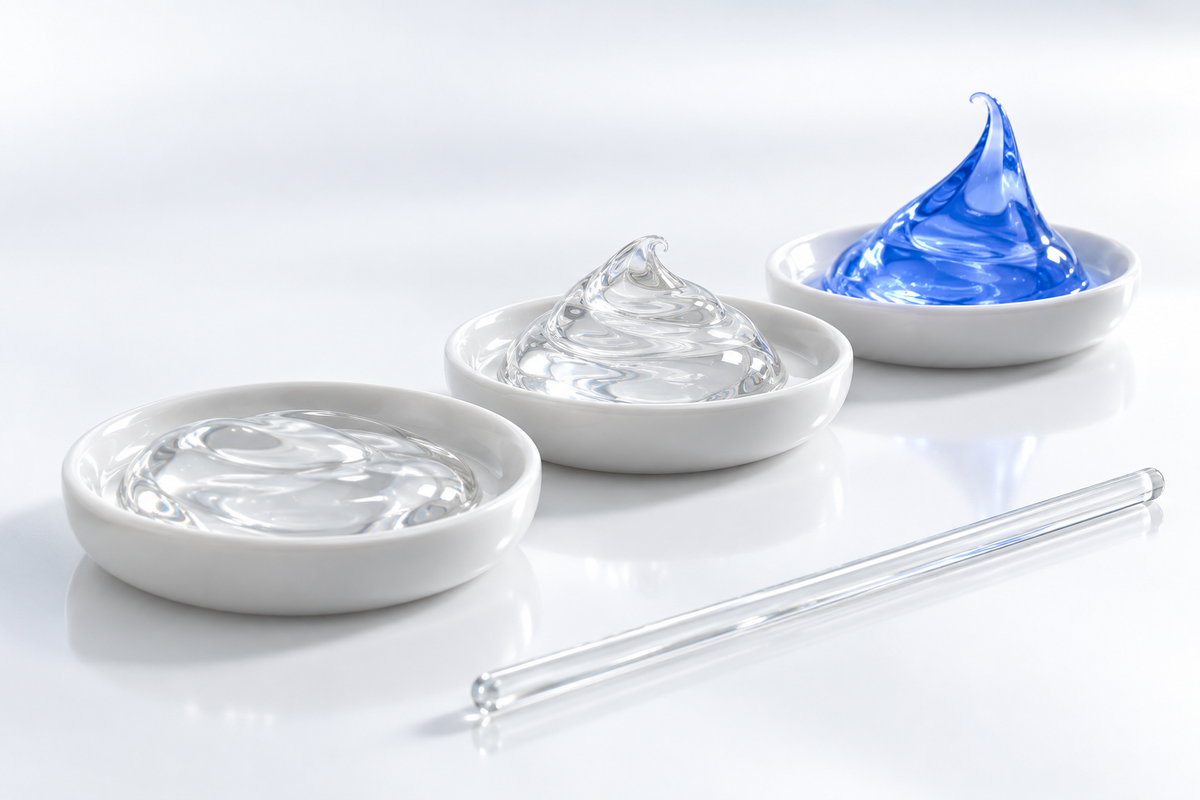
Search for a filler's G prime and you will usually find a chart: one curve or bar per product, each with a number in pascals. Try to build that chart from the product pages of the Korean hyaluronic acid (HA) fillers in our range and it cannot be done. Of 25 filler lines, three give a firmness figure with a unit, and those three use two different quantities. One gives a number with no unit. Twenty describe firmness in words, and one says nothing at all. Not one of the 25 states the conditions its figure was measured under.
What G′ and viscosity measure, and why the units differ
G′ (G prime, the storage or elastic modulus) describes how strongly a gel resists being deformed and how much of that deformation it gives back, the spring in the gel. It is measured in an oscillating rheometer, which squeezes and releases a sample at a set frequency, and it is reported in pascals (Pa), the unit of pressure. A gel with a higher G′ is stiffer under small deformations. In HA filler literature it is the figure most often used to place products on a soft-to-firm line.
Viscosity describes resistance to flow, how hard it is to make the gel move past itself. It is reported in pascal-seconds (Pa·s). For a gel tested in the same oscillating instrument, the usual figure is complex viscosity, which falls as the test frequency rises. That is the property that lets a thick gel pass through a fine needle and then sit still once placed.
The two are related but they are not the same quantity, and a figure in Pa cannot be set against a figure in Pa·s. Both also move with the conditions of the test: frequency, the size of the deformation and temperature. A G′ of 200 Pa measured at one frequency and a G′ of 200 Pa measured at another are not the same result. Published comparisons of HA fillers state those conditions for this reason.
25 filler lines, four ways of stating firmness
| How firmness is stated | Lines | What the page gives |
|---|---|---|
| A figure with a unit | 3 | REVELINA: G′ in Pa · SUNNYFILL: "viscoelasticity" in Pa · LUXFILL: viscosity in Pa·s |
| A number with no unit | 1 | E.P.T.Q.: 100, 300, 500 |
| Words only | 20 | Low to high, in scales of three, four or five steps |
| Not stated | 1 | LIP STAR |
The count leaves out two groups. Eleven large-volume listings, sold in vials or syringes of 10 mL and more, use different language and are not part of this comparison. Five filler listings are not cross-linked HA gels: two poly-L-lactic acid powders, a polylactic acid powder, a polynucleotide syringe and a calcium hydroxylapatite product. Their pages have no HA gel rheology to report. What remains is every face-sized HA syringe line we currently sell.
Three listings give a figure with a unit, in two different quantities
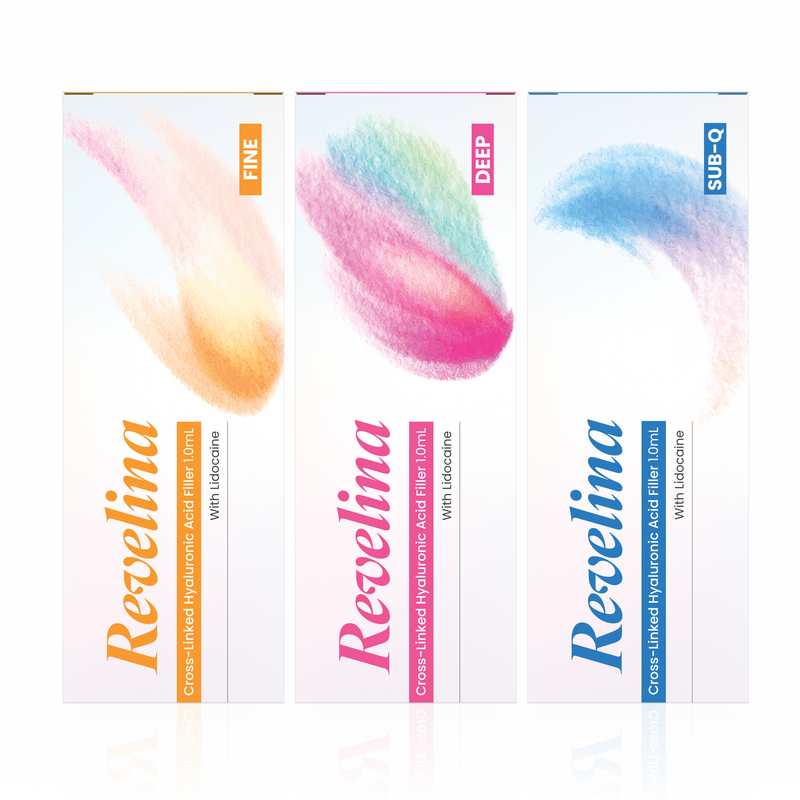
REVELINA is the only page that uses the term G′. Its three versions are listed at 20 to 100 Pa (FINE), 101 to 200 Pa (DEEP) and 201 to 300 Pa (SUB-Q), next to an elasticity scale of one, two and three plus signs. The ranges do not overlap, so they work as a ladder. The page also footnotes the figures: they are reference estimates, and the actual values are those on the manufacturer's certificate of analysis for the batch.
SUNNYFILL gives four ranges in Pa: 60 to 120 (Pink), 150 to 210 (Green), 260 to 300 (Blue) and 380 to 450 (Red). The row is labelled viscoelasticity. Pa is the unit of a modulus, so the figure is a measure of stiffness rather than of flow, but the page does not say which modulus it is: G′ alone, or the complex modulus that combines the elastic and viscous parts. For a gel that is mostly elastic, as HA fillers generally are, the two figures sit close together. They are still different definitions.
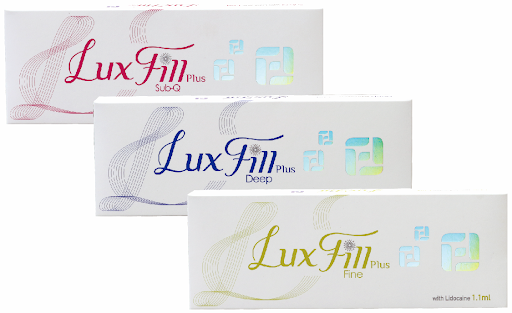
LUXFILL gives viscosity, written as 100 to 200, 200 to 300 and 300 to 500 "pa-s", that is Pa·s, for its Fine, Deep and Sub-Q versions. This is the only listing in the range that puts a unit on a viscosity figure.
Laid out together, REVELINA's DEEP (101 to 200 Pa) and SUNNYFILL's Green (150 to 210 Pa) look as if they overlap, and LUXFILL's Deep (200 to 300) looks higher than both. Neither reading holds. LUXFILL's number is a different quantity. REVELINA and SUNNYFILL use the same unit but neither page gives a test frequency, strain or temperature, and REVELINA's figures are estimates by its own account. Within each line the order is clear. Across lines, the pages do not support a comparison.
A number with no unit: E.P.T.Q.
E.P.T.Q. lists its three versions at viscosity 100, 300 and 500, labelled low, medium and high, and the numbers are also the version names: S100, S300 and S500. No unit is given. If the figures were Pa·s they would sit in the same range as LUXFILL's, but the page does not say so, and a number without a unit cannot be placed on either axis. As we noted when we set E.P.T.Q. against NEURAMIS, the numbers rank the three versions against each other and nothing more.
Twenty word scales, and why "High" on one page is not "High" on another
Twenty lines describe firmness only in words, and the scales are not built the same way.
Three steps from Low to High is the most common pattern, used by 15 lines: CARATFILL, MAYFILL, STARDERM, REGENOVUE PLUS, SOSUM, ELASTY, HYALDEW, REVOLAX, BONETTA, REPLENGEN, YOUTHFILL, VOLUDERM, REGENOVUE, WELLSFIL and VOM. Some of them add a second word. REGENOVUE and WELLSFIL pair low and high viscosity with soft and hard, VOLUDERM calls its high version hard, YOUTHFILL calls its high version the hardest, and VOM describes a firmness range from soft to high viscosity.
Starting at Low-Medium. STARFILL and BEADSMAX both have three versions, and both begin their scale at low-medium rather than low. On their own pages the softest version is not called low at all.
Four steps. CHAEUM PREMIUM runs from low to very high across No.1 to No.4. CELOSOME runs from low to highest across Soft, Mid, Strong and Implant.
Five versions on four words. NEURAMIS lists low, medium-low, medium, medium and high, with two versions sharing the medium position and differing only in lidocaine.
Each scale describes a line's versions relative to one another. "High" is the top of a three-step scale on one page and the third of four steps on CHAEUM's and CELOSOME's. A low-medium on STARFILL's page has no stated relation to a low on SOSUM's. The words tell a buyer which version of a line is the firmer one. They say nothing about how two lines compare, and no page claims that they do.
The one listing that states nothing: LIP STAR
LIP STAR is a single-version line, a 1.2 mL syringe of cross-linked HA at 24 mg/mL with a supporting ingredient at 1 mg/mL. Its page gives no viscosity, elasticity or modulus, in words or figures. The nearest statement is a particle size described as low, which is a description of the gel's texture rather than a measure of its firmness. With one version there is no internal ladder to describe either, so the absence is less of a gap than it would be on a three-version line.
What to read on a firmness figure
A firmness figure is only as useful as what comes with it. Four questions sort the 25 pages quickly.
Which quantity is it? G′ or another modulus in Pa describes stiffness. Viscosity in Pa·s describes flow. A page that gives one has not given the other.
Is there a unit? Without one, the figure ranks a line's versions and cannot leave the line.
Are the test conditions stated? Frequency, strain and temperature decide whether two figures in the same unit can be compared. On the pages in our range, the answer is no in every case.
Is it a specification or an estimate? REVELINA's page labels its G′ figures as reference estimates and points to the batch certificate of analysis for the actual values. That is where tested rheology sits for any filler, and it is the document to ask for when a figure has to be relied on. For the cross-linking and cohesivity terms that often appear beside these figures, see reading an HA filler's cross-linking and cohesivity, and for how the same pages state a gel's phase, our monophasic and biphasic comparison.
Sourcing Korean HA fillers by declared specification
KSTATION supplies all 25 lines counted here, including REVELINA in FINE, DEEP and SUB-Q, SUNNYFILL in its four colours and LUXFILL in Fine, Deep and Sub-Q, the three that give a figure with a unit. The full set sits under derma fillers. When ordering a specific version, give the full version name as it appears on the page, since the firmness words are only meaningful inside their own line.
Frequently asked
What is G prime in dermal fillers?
G′ (G prime) is the storage or elastic modulus of a gel, measured in pascals with an oscillating rheometer. It describes how strongly the gel resists deformation and how much it springs back. In filler literature it is the most common figure for placing products from soft to firm.
Which Korean HA fillers state a G′ value on their product page?
Of the 25 face-sized HA filler lines in our range, only REVELINA uses the term G′, with ranges from 20 to 300 Pa across three versions, labelled as reference estimates. SUNNYFILL gives figures in Pa labelled viscoelasticity without naming the modulus.
Can G′ values from two filler brands be compared?
Only if both were measured under the same test conditions, which means the same frequency, strain and temperature. None of the 25 product pages we read states those conditions, so their figures rank versions within a line but cannot be compared across lines.
Sources and references
- KSTATION product pages for 25 HA dermal filler lines, viscosity, elasticity and modulus statements as rendered on the page, read 23 October 2026. Figures quoted for REVELINA, SUNNYFILL, LUXFILL and E.P.T.Q. are as declared.
- Edsman K, Nord LI, Öhrlund Å, Lärkner H, Kenne AH. Gel properties of hyaluronic acid dermal fillers. Dermatologic Surgery, 2012. PubMed
- Sundaram H, Voigts B, Beer K, Meland M. Comparison of the rheological properties of viscosity and elasticity in two categories of soft tissue fillers: calcium hydroxylapatite and hyaluronic acid. Dermatologic Surgery, 2010. PubMed
- KSTATION editorial policy, on how product facts are separated from claims in our writing.
All figures are as declared on the product pages on 23 October 2026 and can change with new packaging. This article compares how specifications are stated, for professional buyers. It says nothing about treatment areas, technique, duration or clinical performance.