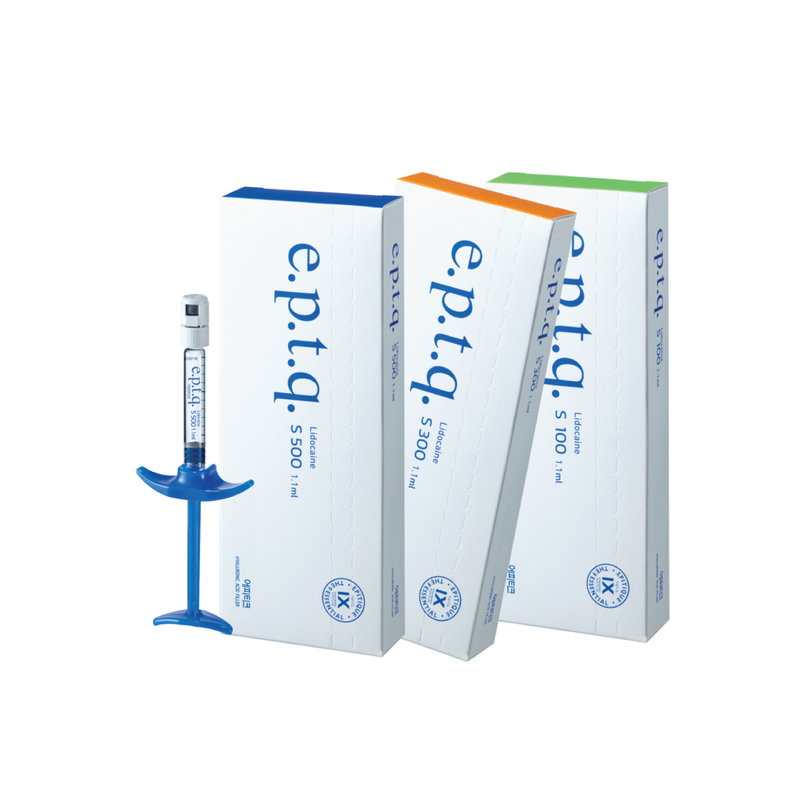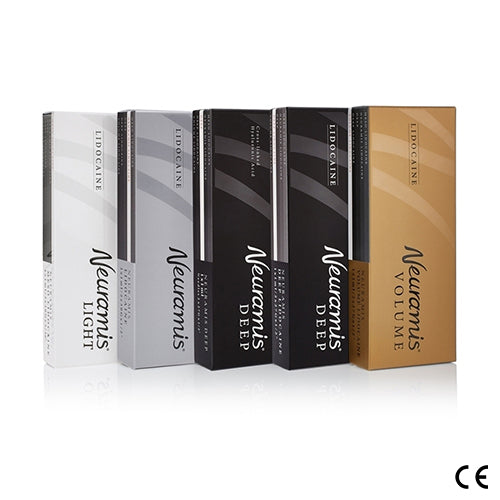
E.P.T.Q. and NEURAMIS are both Korean cross-linked hyaluronic acid (HA) filler lines sold in several versions, both with 0.3% lidocaine in most of them, and both stored the same way. Read side by side, their pages part on four things: how much HA each declares and in what fill, how each names its versions, how each describes its cross-linking, and a BDDE figure that looks comparable and is not.
E.P.T.Q. and NEURAMIS at a glance
| Declared | E.P.T.Q. | NEURAMIS |
|---|---|---|
| HA concentration | 24 mg/mL, cross-linked | 20 mg/mL, cross-linked |
| Fill per syringe | 1.1 mL | 1 mL |
| Versions | 3: S100, S300, S500 | 5: Light Lidocaine, Lidocaine, Deep Lidocaine, Deep Non-Lido, Volume Lidocaine |
| Lidocaine | 0.3% in all three | 0.3% in four; none in Deep Non-Lido |
| Viscosity stated as | A number: 100, 300, 500 | A word: low to high |
| Cross-linking named | No process name | SHAPE, a two-step cross-linking process |
| BDDE figure | Degree of modification about 1% | Uncross-linked BDDE under 0.4 ppm |
| Storage | 2 to 25°C, not frozen, out of sunlight | 2 to 25°C, not frozen, out of sunlight |
24 mg/mL in 1.1 mL against 20 mg/mL in 1 mL
The two headline numbers on these pages differ, and they differ in two places at once. E.P.T.Q. declares 24 mg of HA per millilitre and fills each syringe with 1.1 mL. NEURAMIS declares 20 mg per millilitre in a 1 mL syringe. Multiplied out, the declared HA per syringe is about 26 mg for E.P.T.Q. and 20 mg for NEURAMIS.
That arithmetic is where the comparison should stop. Concentration is set together with the degree of cross-linking and the gel's sizing, and a higher number on its own says nothing about how a gel behaves. What the figures are useful for is checking a carton: a NEURAMIS box declaring 24 mg/mL, or an E.P.T.Q. syringe of 1 mL, does not match the product as described. The way Korean filler cartons express millilitres and milligrams is set out in what one millilitre of filler declares.
What S100, S300 and S500 mean, and how NEURAMIS names its versions
E.P.T.Q.'s version names are numbers, and the page uses the same numbers as its viscosity figures: S100 is listed at 100, S300 at 300, S500 at 500, labelled low, medium and high. The page does not state the unit. So the number in the name is a relative ladder within the line, useful for telling the three apart and not for setting E.P.T.Q. against another brand's viscosity figure.
NEURAMIS takes the opposite approach. Its five names are words, Light, plain, Deep and Volume, and its viscosity column is words too, running from low through medium-low and medium to high. No figure is given. Two of the five share the medium position and differ only in lidocaine: Deep Lidocaine and Deep Non-Lido.
The practical consequence is ordering language. "S300" identifies one E.P.T.Q. product exactly. "NEURAMIS Deep" does not identify one NEURAMIS product, because there are two. Which Korean fillers split on a single lidocaine word is covered in our comparison of HA fillers with and without lidocaine.
Can the BDDE figures of two fillers be compared?
Both pages give a number connected to BDDE (1,4-butanediol diglycidyl ether), the agent most Korean HA fillers are cross-linked with. They are not the same number.
E.P.T.Q.'s page gives a degree of modification (MoD) of about 1%. MoD describes the BDDE that has become part of the gel: roughly, how much of the HA chain has been modified by the cross-linker. It is a property of the finished gel's structure. NEURAMIS's page gives uncross-linked BDDE below 0.4 ppm. That describes free BDDE left over after purification, reagent that did not end up in the gel at all, measured in parts per million.
One figure is a percentage of the gel's structure, the other a trace of leftover reagent. Neither page gives the other figure, so neither line can be ranked against the other on BDDE from what is published. A buyer who wants a like-for-like answer has to ask both suppliers for the same measure.
Cross-linking: an unnamed process against SHAPE
NEURAMIS names its process: SHAPE, which its page expands as stabilized hyaluronic acid and purification enhancement, described as two-step cross-linking followed by purification. E.P.T.Q.'s page names no process. It describes a fully cross-linked hydrogel produced with minimal BDDE and lists particle homogenisation among its features.
A process name is a description, not a specification, and neither page publishes the steps. Its use for a buyer is narrow: NEURAMIS documents that refer to SHAPE are consistent with the product page, and E.P.T.Q. documents that name a branded process should prompt a question. Neither page uses the word monophasic or biphasic; how Korean filler pages state their phase is in our monophasic and biphasic comparison.
Where the two lines are the same
Both declare cross-linked HA, 0.3% lidocaine where lidocaine is present, sterile pre-filled syringes, and the same storage instruction: 2 to 25°C, not frozen, away from direct sunlight. E.P.T.Q.'s page adds that the HA is of non-animal origin; NEURAMIS's page does not state a source. A shipment of either that needs refrigeration on arrival is being handled more strictly than either page asks; one that has been frozen falls outside both.
Sourcing E.P.T.Q. and NEURAMIS
KSTATION supplies E.P.T.Q. in S100, S300 and S500 and NEURAMIS in all five versions. When ordering, give the full version name, and check the carton's concentration and fill against the table above. Both sit with the rest of the range under derma fillers.
Frequently asked
What is the difference between E.P.T.Q. and NEURAMIS?
On their product pages, E.P.T.Q. declares 24 mg/mL HA in a 1.1 mL syringe across three numbered versions, and NEURAMIS declares 20 mg/mL in a 1 mL syringe across five named versions, one of them without lidocaine. They also state different BDDE measures and name their cross-linking differently.
What do S100, S300 and S500 mean on E.P.T.Q.?
They are the three versions, and the number matches the viscosity figure on the product page: 100 low, 300 medium, 500 high. The page does not give a unit, so the numbers rank the three versions rather than compare them with other brands.
Is there a NEURAMIS without lidocaine?
Yes, one: NEURAMIS Deep Non-Lido. The other four versions declare 0.3% lidocaine. Deep Non-Lido and Deep Lidocaine share the same medium viscosity position.
Sources and references
- KSTATION product page for E.P.T.Q. Dermal Fillers (S100, S300, S500), declared composition, fill, viscosity, BDDE and storage figures, retrieved 15 October 2026.
- KSTATION product page for NEURAMIS, declared composition, fill, versions, viscosity, SHAPE description, BDDE and storage figures, retrieved 15 October 2026.
- KSTATION editorial policy, on how product and register facts are separated in our writing.
All figures are as declared on the product pages on 15 October 2026 and can change with new packaging. This article compares declared specifications for professional buyers. It says nothing about treatment areas, technique, duration or how either product performs clinically.