This week's question came from a reader looking for "a cheaper alternative to Hyaron, obviously sterile." We are not going to name a cheaper product, and the reason is not caution for its own sake. Whether something counts as an alternative depends on what has to match, and Hyaron's Korean filing records more than most buyers check. Read that way, the field of genuine look-alikes is small: eight filings out of 89 in its class, Hyaron included.
What Hyaron's filing actually commits to
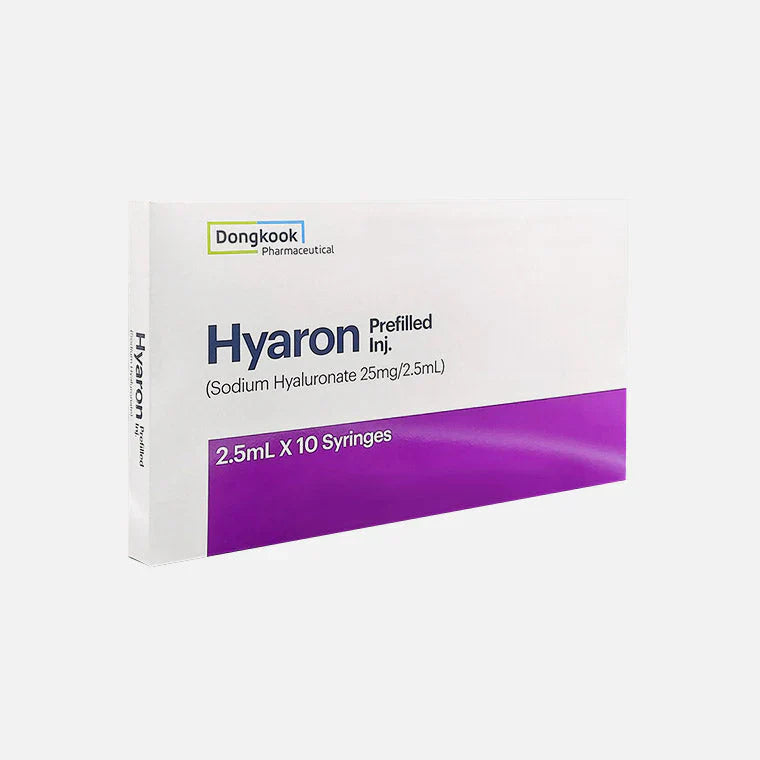
Hyaron Prefilled is filed in Korea by Dongkook Pharmaceutical as 히야론프리필드주사(히알루론산나트륨), a prescription-only sodium hyaluronate injection first filed in October 1993. Its detailed record states the following.
| Active | Sodium hyaluronate, not cross-linked, 10 mg per 1 mL (European Pharmacopoeia grade) |
|---|---|
| Note on the active | Intrinsic viscosity 1.4 to 1.9 m³/kg |
| Additives | Sodium chloride, two sodium phosphates, water for injection |
| Presentation | 2.5 mL pre-filled glass syringe, packs of 5 or 10 |
| Storage and shelf life | Light-protected sealed container, 1 to 30°C; 36 months |
| Supply class and ATC code | Prescription only; M09AX01 |
Most of those lines are what anyone would expect. The second line is the one that matters for this question. Intrinsic viscosity is a standard laboratory measure that rises with the length of the hyaluronate chains, so it works as a proxy for molecular size. Two products can both say "1% sodium hyaluronate" and still be made from chains of quite different length. Hyaron's filing pins that down to a range.
Of 89 filings in its class, 63 do not state a viscosity at all
We read every currently valid, non-cross-linked sodium hyaluronate injection filed under the same ATC code as Hyaron, 89 filings in all, and sorted them by what they declare about viscosity.
| What the filing declares | Filings | Typical presentation |
|---|---|---|
| No intrinsic viscosity stated | 63 | 2.0 or 2.5 mL, 10 mg/mL |
| 1.4 to 1.9, or 1.6 m³/kg (Hyaron's range) | 8 | 2.5 mL, 10 mg/mL, every one |
| Higher figures, mostly 3.3 m³/kg | 18 | Mostly 2.0 mL |
Two things stand out. First, the eight filings in Hyaron's viscosity range are all 2.5 mL at 10 mg/mL, while the higher-viscosity filings cluster at 2.0 mL. Volume on the carton is therefore a rough first signal of which family a product belongs to, though not a reliable one, because 17 of the 63 filings that state no viscosity are also 10 mg in 2.5 mL.
Second, the 63 filings without a viscosity figure cannot be placed at all from the open record. They may sit in Hyaron's range or well outside it. Calling one of them "the same as Hyaron" is a claim the register does not support either way.
The eight filings that match Hyaron on paper
These are the filings whose records match Hyaron on active, concentration, stated viscosity range and syringe volume. They are listed by filing date, not ranked.
| Filed product name | Holder | Filed | Stated viscosity |
|---|---|---|---|
| 히야론프리필드주사 (Hyaron Prefilled) | 동국제약 (Dongkook) | 1993 | 1.4 to 1.9 |
| 히루안주 | 엘지화학 (LG Chem) | 2005 | 1.6 |
| 히아루주사(프리필드) | 씨엠지제약 (CMG) | 2008 | 1.4 to 1.9 |
| 히나루본주(프리필드) | 일동제약 (Ildong) | 2013 | 1.6 |
| 히아름주 | 대한뉴팜 (Daehan New Pharm) | 2019 | 1.6 |
| 히루맥스펜타주(프리필드) | 구주제약 (Kukjoo Pharm) | 2019 | 1.6 |
| 와이히알루론산나트륨주 | 옵투스제약 (Optus) | 2019 | 1.6 |
| 히알파이브주 | 유니메드제약 (Unimed) | 2024 | 1.6 |
Even inside this group the records are not identical. LG Chem's filing requires refrigeration at 2 to 8°C, where Hyaron and the others are stored at room temperature. Seven were filed by notification and the 2024 filing by full licensing, a distinction explained in our piece on licensed versus notified Korean drug filings. And every one of them lists its full specification separately from the open record, so matching fields on paper is not a statement that the contents are interchangeable.
"Obviously sterile" is a filing question
The reader's instinct is right, and the register is where it gets settled. Every product in the tables above is filed as an injectable medicine. Some products sold in similar packaging, such as ampoule serums and booster solutions marketed for skin, are filed as cosmetics or not filed as medicines at all, and for those the drug register holds no injectable record to check a sterility claim against. A lower price on one of those is not a price on the same category of product.
The simplest check is the one that also confirms identity: take the Korean product name from the carton and look for a drug filing under that name and holder. If there is none, the product is not a sodium hyaluronate injection in the register's sense, whatever its listing says. We would add one boundary. Hyaron is filed as an injection, and its record says nothing about any other way of using it. This article does not address use, and neither does the register.
Where Hyaron fits in our range
KSTATION supplies Hyaron Prefilled, 2.5 mL × 10 syringes. None of the other seven filings above is in our range, so we do not quote their prices. How Hyaron Prefilled differs from the two other filings that carry the Hyaron name, one of which is a cross-linked gel, is covered in our Hyaron monograph, and the difference between free and cross-linked hyaluronate in cross-linked versus uncross-linked HA.
Frequently asked
Is there an alternative to Hyaron?
On the Korean register, seven other sodium hyaluronate injections match Hyaron Prefilled on concentration (10 mg/mL), stated intrinsic viscosity range and 2.5 mL syringe volume. Matching record fields do not establish that the products are interchangeable.
What is the intrinsic viscosity of Hyaron?
Hyaron Prefilled's Korean filing states an intrinsic viscosity of 1.4 to 1.9 m³/kg for its sodium hyaluronate, a measure that rises with chain length.
Are all 1% sodium hyaluronate injections the same?
No. Among 89 valid non-cross-linked filings in Hyaron's class, eight state a viscosity in Hyaron's range, 18 state higher figures (mostly 3.3 m³/kg), and 63 state none. The same 10 mg/mL label can describe different molecular sizes.
How can I tell whether a cheaper product is a registered injection?
Look up the Korean product name and holder on the carton in the MFDS drug register. A product with no drug filing under that name is not a registered sodium hyaluronate injection.
Sources and references
- Ministry of Food and Drug Safety (MFDS), Korean drug product register, detailed record for 히야론프리필드주사(히알루론산나트륨), retrieved 8 October 2026.
- MFDS drug product register, ingredient query for sodium hyaluronate, 132 injection filings with detailed records read for concentration, declared intrinsic viscosity, presentation, storage and ATC code, retrieved 8 October 2026.
- KSTATION product record for Hyaron Prefilled, retrieved 8 October 2026.
- KSTATION editorial policy, on how product and register facts are separated in our writing.
Register figures are a reading taken on 8 October 2026. Filings and their detailed records change without notice. This article compares filing records for professional buyers. It does not compare how products perform, recommend any product as a substitute, or describe how any product is used.