A dermal filler is rarely a single object. It is usually a small family of gels tuned for different planes of the face, and the line you reach for says as much about where you are injecting as what you are correcting. REVELINA is a recent addition to the KSTATION catalog that makes that logic explicit: one cross-linked, non-animal hyaluronic acid (HA) gel, offered in three depth tiers. This is an editorial look at how the line is built, not a claim about how it performs.
What REVELINA is
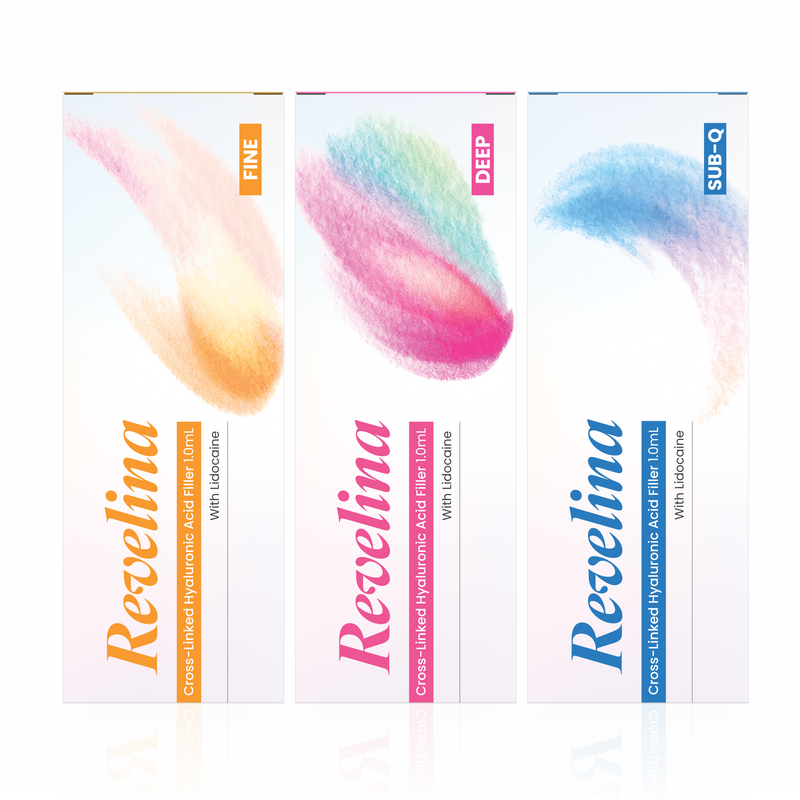
REVELINA is a cross-linked, non-animal hyaluronic acid (HA) dermal filler line. It is a medical device for professional use, meaning a licensed practitioner placing it in a clinical setting, and it is not a cosmetic, a skincare serum, or anything intended for home use. Each unit is a 1.0 mL pre-filled syringe, and the gel carries lidocaine at 3 mg/mL, a local anesthetic mixed into the filler itself rather than applied separately. The HA concentration is 24 mg/mL. Those three numbers, HA content, lidocaine content, and fill volume, are the spec a practitioner reads first, because they define the gel before any discussion of technique.
The more telling design choice sits one level deeper. REVELINA is built as a single HA gel in a shared chemistry, then presented across three injection depths rather than as three unrelated products. That is a curation decision as much as a formulation one, and it is the reason the line is worth explaining on its own terms.
Monophasic, not particle-based
HA fillers fall into two broad structural families, and REVELINA sits clearly in one of them. It is a dense monophasic filler, meaning a single, homogeneous gel matrix in which the cross-linked HA forms one continuous phase. The alternative is a biphasic, particle-based design, where discrete gel particles are suspended in a carrier fluid. Neither is a quality grade above the other; they are different ways of organizing the same raw material, and they behave differently under the needle.
The practical interest in a monophasic gel is consistency. Because the matrix is uniform rather than a suspension of particles, the gel tends to extrude evenly, which is often described in terms of injection force, the resistance a practitioner feels at the plunger. Structural studies of HA fillers have linked this kind of gel architecture to how a product spreads and holds its shape once placed.1 For REVELINA specifically, the design talking point is balance: a dense monophasic matrix is positioned to combine smoothness on delivery with shape retention in tissue, with an optimized viscoelasticity that the manufacturer frames as a formulation goal. We report that framing rather than endorsing an outcome.
Three depths, one gel
The core of the line is its depth map. Rather than ask one viscosity to serve every plane, REVELINA splits into FINE, SUB-Q, and DEEP, each intended for a different layer of tissue and a different class of correction. The naming follows a convention common across Korean HA filler lines, which is part of why it reads quickly to practitioners already working in the category.
| Line | Injection depth | Typical indication |
|---|---|---|
| FINE | Superficial dermis | Fine lines and delicate volume correction |
| SUB-Q | Subcutaneous fat layer | Mid volume, contour, nasolabial folds, midface |
| DEEP | Supraperiosteal (just above bone) | Structural lifting and large-volume contour |
Reading the table top to bottom is reading the face from surface to bone. The three tiers separate cleanly by what they are asked to do:
- FINE is placed in the superficial dermis, the upper skin layer, for fine lines and small, delicate refinements.
- SUB-Q sits in the subcutaneous fat layer for mid-volume work, including nasolabial folds, the lines from nose to mouth corner, and broader midface support.
- DEEP is placed supraperiosteal, meaning just above the bone, where a firmer gel handles structural lifting and large-volume contour.
The depth dictates the choice; the gel follows the plane, not the other way around.

Cross-linking and residual BDDE
What turns soluble HA into a gel that can sit in tissue is cross-linking, the chemical step that bonds HA chains into a network. The agent used across most modern HA fillers is BDDE (1,4-butanediol diglycidyl ether). Cross-linking is what gives a filler its structure, but a portion of the agent can remain in the finished gel as residual BDDE, so the formulation aim across the category is to keep that residue low while still building a stable network.
REVELINA describes its approach as MCO Technology (Minimising Cross-linking agent by Optimising reaction), a process framed as optimizing the cross-linking reaction to minimize residual BDDE. We present this as a design intent, a stated quality goal in the formulation, not a measured or proven result. The general direction is consistent with where the literature on HA filler chemistry has moved, including work on lower-modification gels that pair a controlled cross-linking approach with a clinical safety focus.2 The point worth holding is the distinction between a manufacturing objective and an outcome claim: REVELINA states the former, and we are not asserting the latter.
Where it sits, and where it comes from
From a sourcing standpoint, the part of REVELINA that fits the KSTATION catalog is its manufacturing transparency. The line is OEM-manufactured by AQUABANK INC. under an ISO 13485:2016-certified quality management system, the international standard for medical device manufacturing quality. The gel is described as pyrogen-free with endotoxin minimized, both manufacturing-side properties of how the device is produced and handled. An ISO 13485:2016 quality system is a statement about the production environment, not a product approval or an efficacy endorsement, and we cite it on exactly those terms.
Within the broader category, REVELINA reads as a manufacturer-direct, monophasic HA line whose value proposition is structural clarity: a known composition, a single gel chemistry, and a clean three-depth map. For practitioners weighing where it fits against other HA options, the useful comparison is structural, not promotional. Our general overview of how dermal fillers address volume and wrinkle correction sets the wider context, and where the question is HA versus the regenerative category, our look at biostimulators versus HA fillers draws that line.
Across the K-derma catalog, KSTATION's role is curation rather than claim. We source authentic, manufacturer-direct Korean lines for professionals and keep lot-level documentation with them, so a line like REVELINA arrives with its composition, its quality system, and its sourcing on the record. What the gel does in a given face, and which depth and product suit a given correction, stays with the practitioner. The catalog those terms apply to sits across the hyaluronic acid range and the wider filler shelf, supplied for professional use.
Frequently asked questions
Frequently asked
What is REVELINA?
REVELINA is a cross-linked, non-animal hyaluronic acid (HA) dermal filler line for professional use. It is a medical device, supplied as a 1.0 mL pre-filled syringe with HA at 24 mg/mL and lidocaine at 3 mg/mL, offered in three depth tiers: FINE, SUB-Q, and DEEP.
What does "monophasic" mean?
Monophasic means the filler is one homogeneous, continuous gel matrix, rather than a biphasic suspension of discrete HA particles in a carrier fluid. REVELINA is a dense monophasic gel, a structural design associated with uniform extrusion and consistent injection force.1
How do FINE, DEEP, and SUB-Q differ?
They map to injection depth. FINE goes into the superficial dermis for fine lines and delicate corrections, SUB-Q into the subcutaneous fat layer for mid-volume work and contour such as nasolabial folds, and DEEP at the supraperiosteal plane just above bone for structural lifting and large-volume contour. The plane drives the choice.
Does it contain lidocaine?
Yes. REVELINA includes lidocaine at 3 mg/mL, a local anesthetic mixed into the gel itself. The HA concentration is 24 mg/mL, both stated for a 1.0 mL pre-filled syringe.
Disclaimer. This article is general educational information and is not medical advice. The product described is a medical device intended for use by trained, licensed professionals in a clinical setting. Certifications and rheological specifications are not asserted here and should be confirmed against the manufacturer's official documentation. Whether a given product may be lawfully imported and used in a particular market, and the eligibility to do so, is the buyer's responsibility to verify with the relevant authorities.
Sources & references
- Rheological and Structural Analysis of Hyaluronic Acid Fillers (gel architecture and structure relate to how an HA filler spreads, extrudes, and retains shape in tissue). PubMed Central. pmc.ncbi.nlm.nih.gov
- Clinical safety study of a low-modification hyaluronic acid filler (controlled, lower cross-linking modification paired with a clinical safety focus, on the BDDE cross-linking question in HA fillers). PubMed Central. pmc.ncbi.nlm.nih.gov