EGF stands for epidermal growth factor, a small signaling protein the body makes during the ordinary work of skin renewal. In skincare it belongs to a family usually labeled growth factors, and that category framing tells you more than any single marketing line. It places EGF in the conversation about skin quality and renewal rather than volume or contour.
From a sourcing standpoint, the first thing worth clarifying is what EGF is not. It is not a filler, which adds structure, and it is not a neuromodulator, which relaxes muscle movement. It sits instead in the regenerative category, the same broad family that includes ingredients like PDRN (polydeoxyribonucleotide) and certain peptide complexes. When a Korean skin booster lists EGF among its actives, the intent is generally to work with the skin's own renewal signaling rather than to fill or freeze.
What EGF actually is
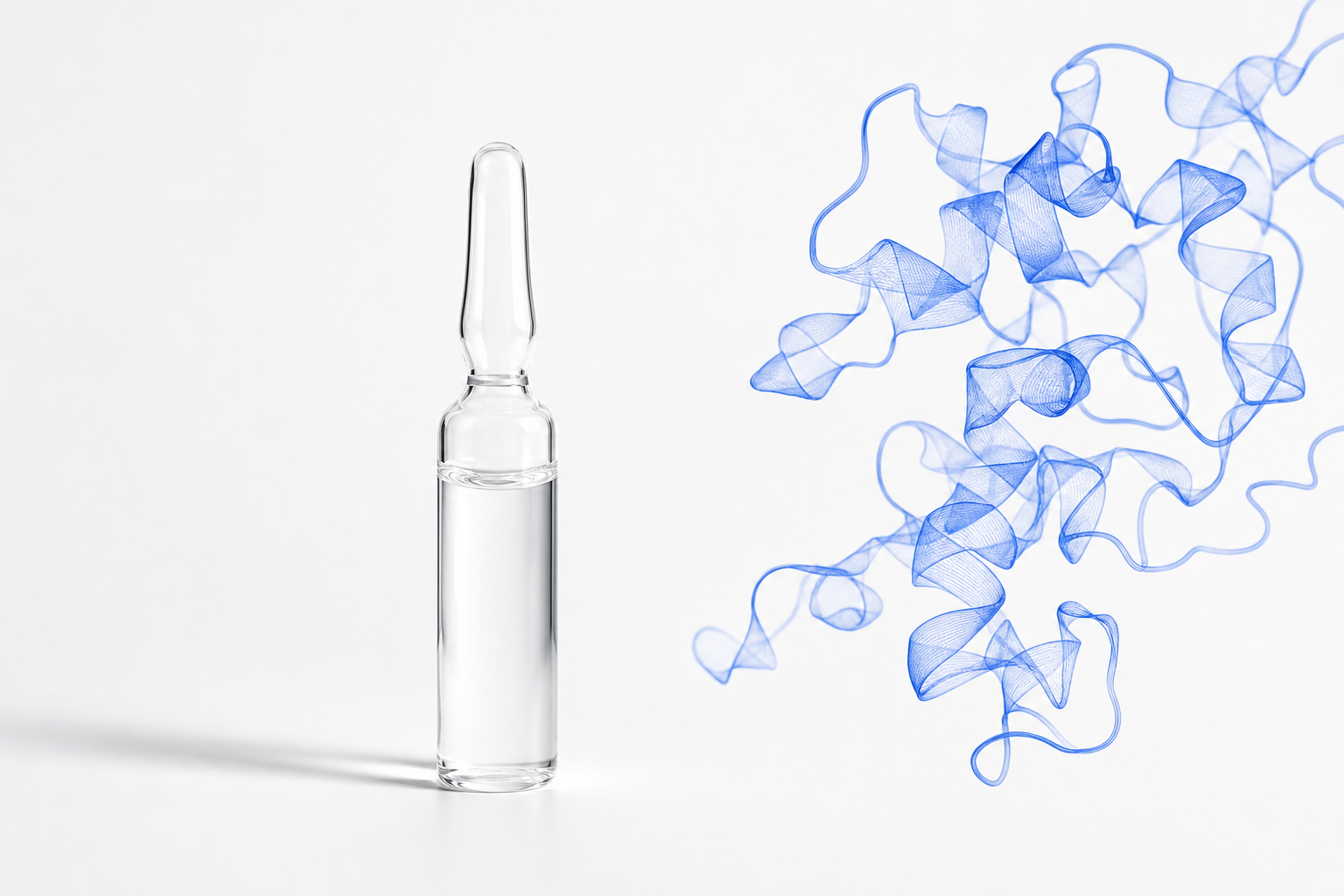
Epidermal growth factor is a 53-amino-acid polypeptide, roughly 6 kDa, folded by three internal disulfide bonds into the precise shape that lets it bind the EGF receptor (EGFR) on a cell surface.1 That binding is the entire point: it signals epithelial cells to proliferate and migrate. The molecule was identified by Stanley Cohen, who noticed that a salivary-gland extract injected into newborn mice made their eyelids open and teeth erupt early, and the work earned a share of the 1986 Nobel Prize in Physiology or Medicine.2 None of that is a claim about what a cream will do. It is simply what the ingredient is, and that is the right place to start.
Why the category framing matters
Across the K-derma catalog, growth factor boosters tend to be discussed in terms of texture, recovery, and overall skin condition. That vocabulary is deliberate. A regenerative ingredient is asked to participate in a process the skin already runs, so the honest way to describe it is in terms of supporting that process, not overriding it. This is also why formulation and concentration carry so much weight with growth factors. The same named ingredient can appear in very different products, and the surrounding formula, the delivery, and the professional context all shape what the booster is actually for.
EGF, PDRN, and peptides are not the same tool
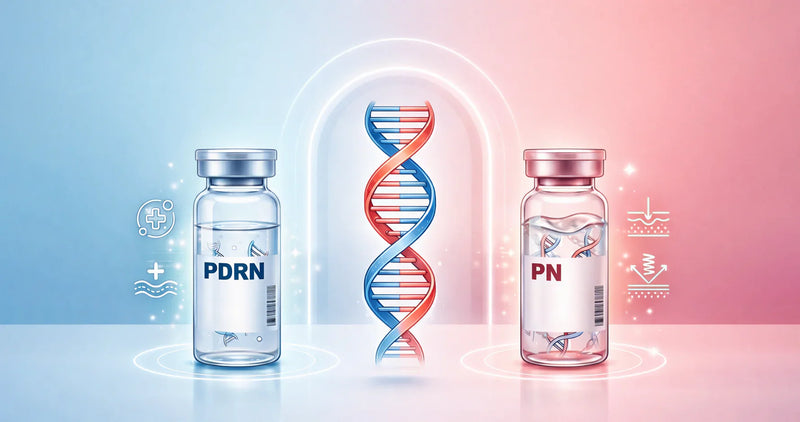
For anyone comparing options, EGF is frequently mentioned next to other regenerative actives, and the comparison is rarely a matter of one being better in the abstract. The three work through different molecular units. EGF is a protein growth factor acting through the EGFR receptor. PDRN is built from salmon-derived nucleotide fragments, and its activity is generally attributed to adenosine acting on the A2A and A2B receptors rather than to a protein signal. Peptides operate at the protein-signal level toward structural proteins such as collagen.3 Same regenerative conversation, different mechanism, which is why a considered protocol usually starts from what a given skin concern calls for rather than from a single ingredient name.
The penetration debate, stated plainly
There is an honest scientific debate worth knowing before you read any topical EGF claim. EGF's molecular weight, around 6 kDa, sits well above the rough 500 Da ceiling usually cited for passive penetration of intact stratum corneum, so how much applied EGF actually reaches living skin is contested, and delivery technologies are an active research area precisely because of it.4 The point here is not to settle the debate but to frame it: concentration on a label and delivered dose in skin are two different questions.
Why storage and authenticity decide whether any of it matters
EGF is a protein, and proteins are fragile. Studies place its thermal transition temperature near 79 degrees Celsius, and under 70 degree heat stress the share of intact monomer drops sharply as the structure unfolds.7 A growth factor that has been heat-stressed somewhere in transit is, functionally, a different thing from the one printed on the label. That is the supply-side reason provenance and cold chain sit right next to formulation in any serious assessment. Knowing a booster is genuine, stored correctly, and intended for professional use is part of evaluating it at all.
None of this is a verdict on what EGF will do for a particular person, and it is not meant to be. The durable takeaway is narrower: EGF is a renewal-signaling protein in the regenerative category, it is best understood next to its neighbors rather than in isolation, and the questions that actually decide value are formulation, delivery, regulatory honesty, and authenticity. For anyone mapping the skin booster landscape, that is a more reliable place to begin than any single claim about results.
Where the supply side fits
This is the part a distributor can actually stand behind. We do not promise what a growth factor will do for your skin, because the science above is exactly why no honest sourcing partner should. What we do is curate official-channel products by ingredient and keep provenance traceable, which is the variable that decides whether a heat-sensitive protein is still the molecule on its label by the time it reaches a practitioner.
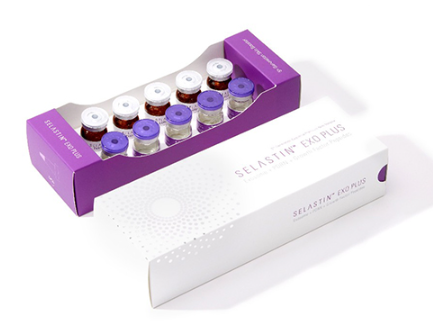
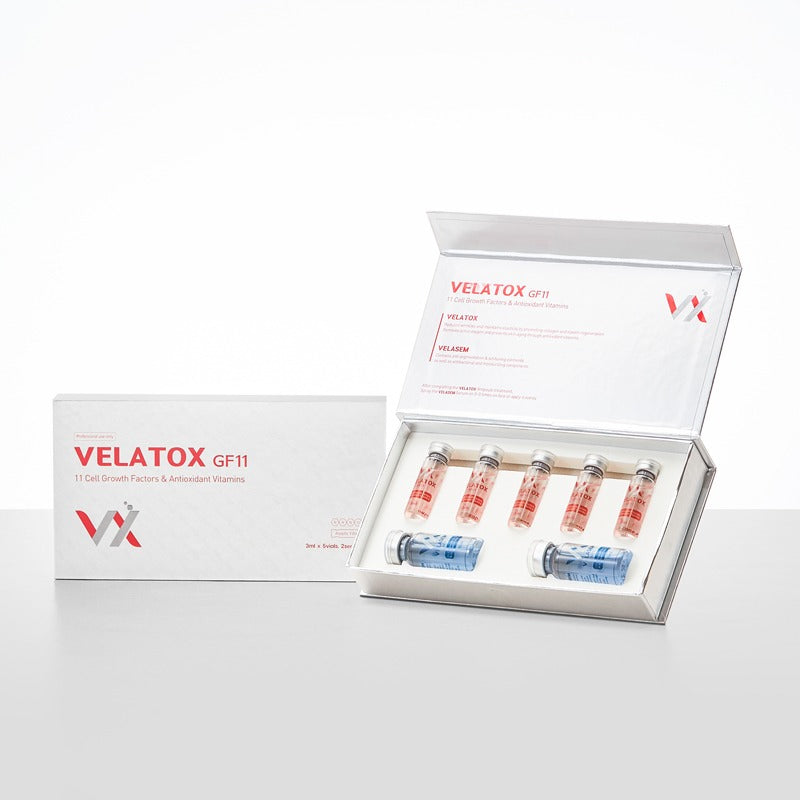
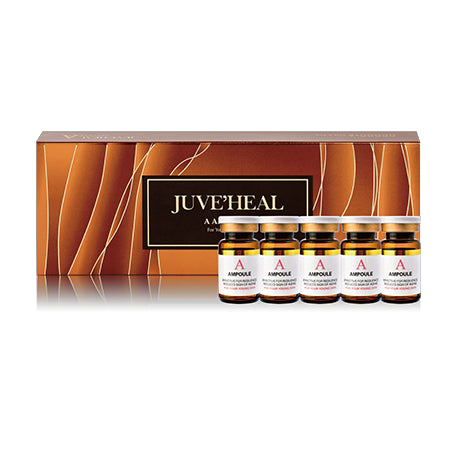
For readers who want to see how EGF appears in practice, a few growth factor boosters in the K-derma range include SELASTIN EXO PLUS, which pairs EGF with exosome and PDRN, VELATOX GF11, and Juveheal A. The fuller set sits under skin recovery and regeneration, intended for professional use.
Frequently asked questions
Frequently asked
What is EGF (epidermal growth factor)?
How does EGF differ from PDRN or peptides?
EGF and peptides work through protein-level signaling, while PDRN works through salmon-derived nucleotide fragments acting on adenosine receptors. Same regenerative context, different molecular unit.3
Can EGF in skincare actually penetrate the skin?
It is debated. EGF's molecular weight (~6 kDa) sits above the rough ceiling for passive penetration of intact stratum corneum, so absorption is contested and delivery technologies are an active research area.4
Why do storage and authenticity matter for growth factor products?
EGF is a heat-sensitive protein. Its transition temperature is near 79 degrees Celsius, and heat stress sharply reduces intact monomer, so cold chain and genuine sourcing are what keep the labeled molecule intact.7
Disclaimer. This article is general information for educational purposes and is not medical advice. It describes what EGF is and how it is discussed and regulated, not what any product will do for an individual. Growth factor products referenced are intended for use by trained professionals. Cosmetic claims and ingredient rules vary by country and change over time; confirm current requirements with the relevant authority.
Sources & references
- UniProt, Pro-epidermal growth factor (EGF), human, entry P01133 (53-aa mature EGF, ~6 kDa, disulfide structure). uniprot.org
- The Nobel Prize in Physiology or Medicine 1986 (Stanley Cohen & Rita Levi-Montalcini), press release. nobelprize.org
- Peer-reviewed reviews on PDRN mechanism (adenosine A2 receptor pathway) and regenerative actives. pmc.ncbi.nlm.nih.gov
- Reviews on topical growth factor / EGF skin penetration and delivery (molecular-weight limits of the stratum corneum). pmc.ncbi.nlm.nih.gov
- U.S. FDA, "Is It a Cosmetic, a Drug, or Both? (Or Is It Soap?)", structure/function vs. drug claims. fda.gov
- South Korea MFDS, EGF (sh-Oligopeptide-1) cosmetic limit and enforcement against drug-like claims (2020). cosmeticsdesign-asia.com
- Peer-reviewed study on EGF thermal stability (transition temperature, heat-stress monomer loss). pmc.ncbi.nlm.nih.gov