Alpha lipoic acid is one name in English. On the Korean drug register it is three, and the difference is not cosmetic. The register keeps a separate ingredient string for the racemic acid, for its tromethamine salt, and for the single enantiomer version of that salt, and it does not treat them as variants of one entry. Sort the live licences by which string they carry and one of the three turns out not to exist as an injectable at all.
We swept the register in full on 10 August 2026 using the ingredient index, and it returned 181 records under this active, of which 158 are live.1 This article is about how to tell which of the three substances a given product actually is, using information that is printed on the licensed product name and therefore checkable without any database at all. It says nothing about what any of them does, which is a clinical question the register does not answer.
Three ingredient strings, not one
The register stores an ingredient field for every licence, written in English, and for this active it holds three distinct values across the live set. They are not evenly distributed, and they are not distributed at random.
| Ingredient string on the licence | Injectable | Non-injectable |
|---|---|---|
| Thioctic Acid | 24 | 68 |
| Thioctic Acid Tromethamine | 6 | 0 |
| R-Thioctic Acid Tromethamine | 0 | 57 |
| Other ingredient-string values | 0 | 3 |
| Total live | 30 | 128 |
Two of those cells are zeros, and they are the most useful numbers in the table. The tromethamine salt appears only as an injectable. The single enantiomer version appears only as an oral product, across 57 licences, without one exception.
So if a supplier offers you an injectable and describes it as R-ALA, or as the R-isomer, or as anything implying the single enantiomer form, the Korean register has no licence matching that description. Not a scarce one. Zero, out of 30 live injectable licences.
The answer is printed on the name
Here is the part that makes this checkable without a database. Korean licensed product names for this active almost always carry the substance in parentheses immediately after the brand name, and the three substances are written differently.
| In the name | Means | Exists as |
|---|---|---|
| 티옥트산 | Thioctic acid, racemic | Injectable and oral |
| 티옥트산트로메타민 | Thioctic acid tromethamine, the salt | Injectable only |
| 알티옥트산트로메타민 | R-thioctic acid tromethamine, single enantiomer salt | Oral only |
The leading 알 in the third form is the Korean rendering of the letter R. That single syllable is the entire difference between a substance with 57 oral licences and one with none, and it sits in plain view inside the licensed name on the carton and the approval record.
Reading it requires no special access. It requires knowing that the parenthesis after a Korean brand name is not decoration.
Two ampoules, one English word, two register entities
An example from our own catalogue, checkable in both directions.
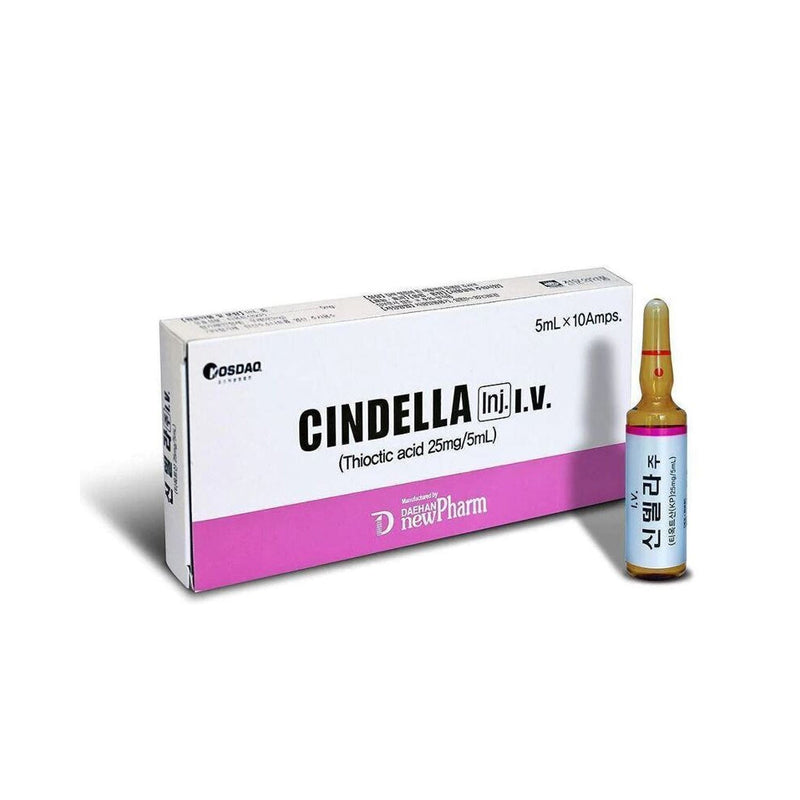
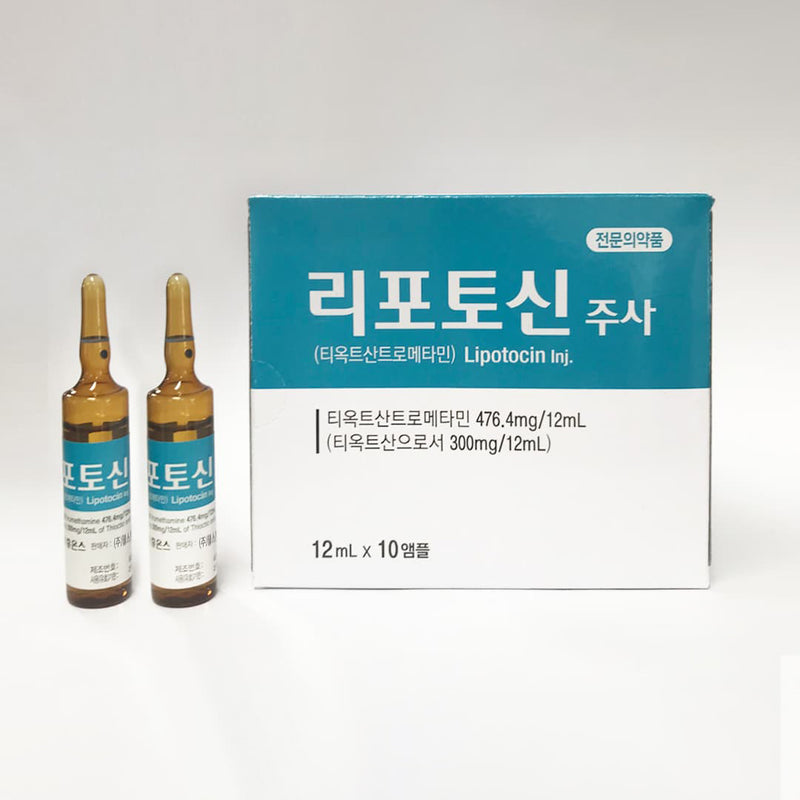
CINDELLA is licensed in Korea as 신델라주(티옥트산), held by 대한뉴팜, granted on 13 September 2012. Lipotocin is licensed as 리포토신주사(티옥트산트로메타민), held by 휴온스, granted on 16 April 2007. Both are prescription only. Both are filed under the same class, which the register names as metabolic agents not otherwise classified. Both arrive as ampoules. In English both would be described as an ALA injectable.
The register does not record them as the same substance. One carries Thioctic Acid in the ingredient field; the other carries Thioctic Acid Tromethamine. Two different licence holders, five years apart, two different entries in the national ingredient index.
Both product names return exactly one record each on a name search, which is what makes this a usable verification step rather than a curiosity. You can take the Korean name from a carton, query it, and get back a single licence with a holder and a grant date to compare against what your supplier told you. Where a supplier sheet and the register disagree about who made something, the register is the one that was filed with a regulator.
One company opened all three lines
The oldest live licence in each of the three substances belongs to the same company.
| Substance | Oldest live licence | Granted |
|---|---|---|
| Thioctic acid, oral | 치옥타시드정200밀리그램, 부광약품 | 4 February 1998 |
| Thioctic acid tromethamine, injectable | 부광치옥타시드주, 부광약품 | 31 March 2005 |
| R-thioctic acid tromethamine, oral | 덱시드정480밀리그램, 부광약품 | 21 November 2013 |
Three substances, three formats, fifteen years apart, one holder first in every case. Whatever else the register shows about this category, it shows that a single Korean company opened each of its three lines before anyone else filed in them.
All four of that company's licences are still live, including the 2002 two-strength record described further down. In a register where 23 licences have lapsed in the last three years, the four oldest entries in three separate substance lines have all been kept current by their original holder.
What happened after 2013
The R-enantiomer side of this register has the sharpest shape in the entire set, and it is worth reading as a shape rather than as a list of dates.
For four years after that first 2013 grant, nothing. Then 23 licences in 2017, 22 more in 2018, nine in 2019, two in 2020, and since then not one. Forty-five licences arrived inside 24 months, in a category that had held exactly one for the previous four years, and the door closed as abruptly as it opened.
The holder count tells the rest. Fifty-seven live licences are held by 57 different companies. Not one company holds two. That is the signature of a field that opened to generic entry all at once and was entered by everyone at once, rather than one built up gradually by a few firms.
All 57 are prescription only, and all 57 are filed under the same metabolic class as the injectables. The enantiomer distinction does not move a product into a different part of the register. It only changes which of the three ingredient strings the licence carries.
And the wave is already receding
Fifty-seven live licences is not the same as 57 licences ever granted. Sixty-seven records carry the R-enantiomer string in total, and ten of them have already left the register.
That is worth putting next to the exit pattern for the active as a whole. Twenty-three records have left the live set, and all 23 left inside the last three years: 16 during 2024, six during 2025, one so far in 2026. Twenty of the 23 left by reaching the end of their validity period rather than by being withdrawn by the holder, and ten of the 23 carry the R-enantiomer string.
So the cluster of exits in 2024 sits roughly six years downstream of the cluster of entries in 2017 and 2018. The register records that both things happened and does not say they are connected, and we are not going to assert a mechanism it does not state. What can be said plainly is that this is not a category quietly accumulating licences. It gained 45 in two years and has been shedding them since, and about one in seven of the R-enantiomer licences ever granted is already gone.
The injectable side is small, flat and old
Against 128 non-injectable licences there are 30 injectable ones, held by 28 companies. Only two holders carry two licences each, 휴온스 and 대한뉴팜, and each of those two holds one of each salt form, which is the same split the category shows overall reproduced inside a single firm.
Grants run from March 2005 to August 2021, with the bulk arriving between 2014 and 2019. Since August 2021 the register records no new injectable licence for this active at all. Four have left in the same period, one withdrawn and three lapsed at the end of their validity period.
One of those exits is instructive about how the register counts. 아주약품 holds 아이델라주, granted June 2014 as an ampoule, and separately held 아이델라주(바이알), granted February 2019, which lapsed in February 2024. Same brand, same holder, two licences, because the vial and the ampoule are separate licensed products. A licence is not a product and a product is not a brand.
Nothing new anywhere since 2021
Widen the view from the injectable side to the whole active and the picture is the same, only starker. The five most recent live licences in the entire set were granted in April, April, April and July of 2020, and then in August 2021. That last one is the 파마리서치 injectable.
One licence in five years, across 158 live records and three substances. The oral racemic line last added in July 2020, the R-enantiomer line last added in April 2020, and the injectable line last added in August 2021. Meanwhile 23 records have gone the other way in the same period.
This matters for a practical reason rather than a strategic one. If you are handed a specification sheet for a Korean thioctic acid product and it references a recent licence, recent is doing no work: there are no recent licences. Any live Korean licence for this active was granted in 2021 or earlier, and most of them considerably earlier.
A field we can count but not interpret
The register also records how a licence was obtained, with two values that we will leave in Korean because translating them would imply a distinction we cannot verify: 신고 and 허가. All 30 injectable licences carry the first. The non-injectable side is mixed, 92 carrying the second and 36 the first, and every one of the 57 R-enantiomer licences carries the second.
That is a real and countable pattern. What it means about the underlying application process is not something the register states, and we are not going to infer it. We flag it because it is visible in the data and because an importer who notices it should know it is not a quality tier, a grade, or a statement about the product.
Export designation clusters on the salt
Four of the 30 live injectable licences carry export wording in the licensed product name. Three of those four are tromethamine salt products, out of only six salt injectables in total. The racemic injectables contribute one out of 24.
Half the salt-form injectable licences in Korea are export designated, against four percent of the racemic ones. We would not build an argument on six records, and neither should anyone else, but it is worth knowing before reading anything into an export marking on a salt-form product. As covered previously, that marking is a Korean licensing category and not a quality tier or an approval anywhere else.
Three things the licensed name will not tell you
The name carries the substance reliably. It carries much less than that reliably.
Strength. Only two of the 30 injectable licensed names state one, at 25 mg and 5 mg. The other 28 name a brand and a substance and stop. If strength matters to you, the name is not where you will find it.
One licence, one strength. Usually, but not always. 부광약품 holds a single licence named 치옥타시드에이취알정200,600밀리그램, which covers two strengths under one record and is stored with the ingredient listed twice. Counting licences is not counting products.
Purity, source and specification. None of these are register fields. The register settles which substance, who holds the licence, what class it sits in, whether it is prescription only, and when it was granted. Everything that distinguishes two products carrying the same ingredient string comes from manufacturer documentation instead.
One caveat on the 158
An ingredient index sweep returns every licence in which the molecule appears, including ones where it appears alongside many others. Two live records here are combination capsules carrying 24 ingredients each, in which thioctic acid is one entry on a long list. A third carries the ingredient listed twice on a single licence, which is the two-strength record described above.
Those two combination capsules are also, not coincidentally, the only records in the whole live set that fall outside the metabolic class, and the only two that are over the counter rather than prescription only. Both apparent exceptions to the register's uniformity dissolve once you notice they are not thioctic acid products in any ordinary sense. So 158 live licences containing this active is a correct sentence, and 158 thioctic acid products is not.
How to check a carton
Take the Korean product name exactly as printed, including whatever sits in the parentheses. Read the parenthesis first: 티옥트산, 티옥트산트로메타민, or 알티옥트산트로메타민 tells you which of the three substances you have, and the third one should not be on an injectable. Then query the name against the register and confirm the holder and the grant date against what your supplier told you. If a name returns nothing, that is information too.
Licensing and manufacturer details are checked against the MFDS register before a product is listed, and where a supplier sheet and the register disagree, the register wins. We stock officially sourced products only, and the method is set out in our Editorial & Sourcing Policy.2
Our stocked range in this area sits under vitamins and injectables and nutritional and antioxidant wellness, including CINDELLA Inj and Lipotocin Inj, the two licences worked through above. For the same register read on other actives, see what the register calls tranexamic acid and reading a hyaluronidase vial. For what the numbers on a box mean generally, see reading an injectable's label.
Frequently asked questions
Frequently asked
What is the difference between thioctic acid and thioctic acid tromethamine?
On the Korean register they are two separate ingredient strings, and a licence carries one or the other. The tromethamine form is a salt. Among live licences, 24 injectables carry plain thioctic acid and six carry the tromethamine salt, while the salt appears on no oral licence at all. The Korean licensed product name states which one a product is, in parentheses after the brand name.
Is R-thioctic acid available as an injection in Korea?
No. The register holds 57 live licences for R-thioctic acid tromethamine and every one of them is a non-injectable oral product. There are zero injectable licences carrying that ingredient string as of 10 August 2026. An injectable described as an R-isomer product does not correspond to any Korean licence we can find.
Is thioctic acid injection prescription only in Korea?
Yes, for all 30 live injectable licences without exception, and for 126 of the 128 non-injectable ones. The two over the counter records are 24-ingredient combination capsules rather than thioctic acid products as such. Korean classification is a fact about Korea and does not determine status in any other market.
How many thioctic acid products are licensed in Korea?
The register returned 181 records on 10 August 2026, of which 158 are live, split 30 injectable and 128 non-injectable. Three of the 158 are multi-ingredient combination products, so the number of licences containing the active is not the same as the number of thioctic acid products. Licence counts also differ from product counts because one licence can cover two strengths.
Why did the number of licences change between two readings?
Because the register is live. Our sweep on 7 August 2026 returned 159 live records; the same query on 10 August returned 158, after one oral prescription licence exited. Three days. Any figure quoted from this register should carry the date it was read, and any figure older than a few weeks should be re-queried before it is relied on.
Does the register tell me a product's purity or specification?
No. Purity, source, concentration and manufacturing detail are not register fields. The register settles substance identity, licence holder, class, supply classification and grant date. Everything that separates two products carrying the same ingredient string comes from manufacturer documentation.
Disclaimer. This article is general educational information and is not medical advice. It describes how the Korean drug register identifies, classifies and records products containing this active; it makes no claim about what thioctic acid does, achieves, or is suitable for, and it is not a selection, preparation, or administration guide. It is not a statement of regulatory status in any market outside Korea. Products classified as prescription only are intended for professional use by trained practitioners. Regulatory and customs requirements vary by country and change over time; confirm current requirements with the relevant authority.
Sources & references
- Ministry of Food and Drug Safety (MFDS), drug product approval register, queried on the active ingredient field for "Thioctic Acid" on 10 August 2026, all pages retrieved (181 records; 158 live, 23 exited). Ingredient strings, route, class, supply classification, licence holders, grant dates and export wording were read from the licence records themselves. Individual product names were confirmed by separate name queries returning a single record each. Figures are complete counts of that result set, not samples. data.go.kr
- KSTATION, Editorial & Sourcing Policy (official-channel sourcing and traceable provenance). kstations.com/pages/editorial-policy