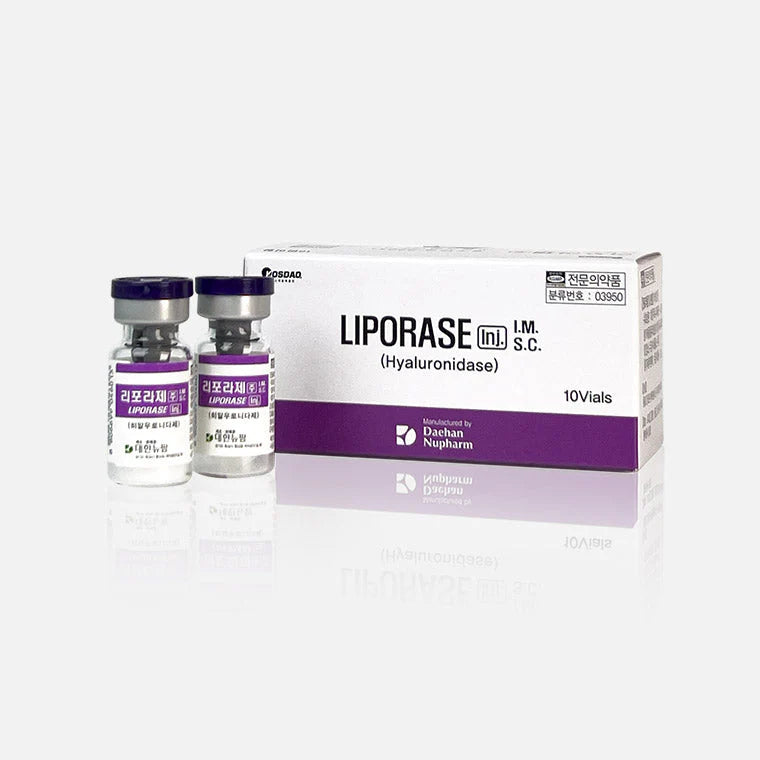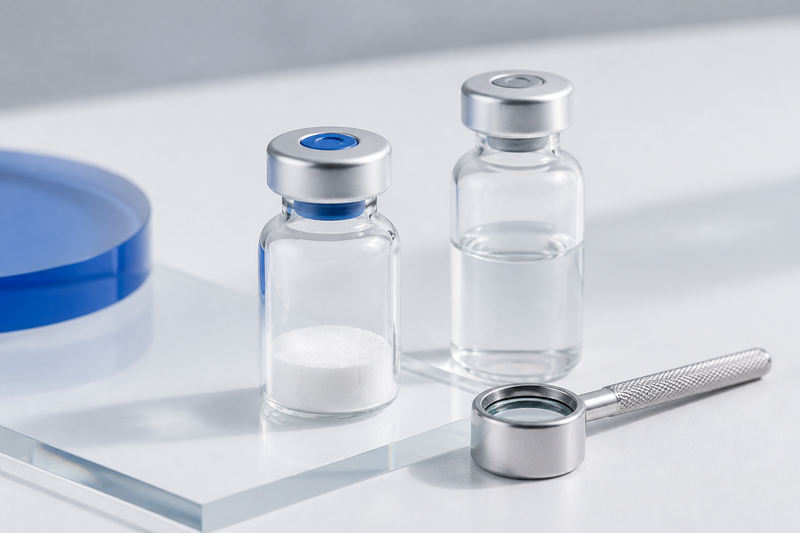
A hyaluronidase vial tells you remarkably little. A brand name, a parenthetical ingredient, sometimes a potency figure, and a company name in Korean. Most of what a buyer actually needs to know is not printed on the vial at all. It sits in the Korean drug approval register, which records every licensed product under a fixed set of fields, and which almost nobody outside Korea reads because it exists only in Korean.
We read it on 7 August 2026, in full, and this article is what it says. It covers what the register files hyaluronidase as, how many licences are live, who holds them, and what the record does and does not settle. It is not a guide to clinical use, dosing, preparation, or administration. Those questions belong with a qualified professional and the relevant authority in your market, and nothing below should be read as answering them.3
What the register files it as
The Korean drug approval register is maintained by the Ministry of Food and Drug Safety and published as open data. Every licensed drug product carries the same core fields: the licensed product name, the licence holder, the date the licence was granted, a supply classification, a numeric class code, and a status showing whether the licence is live, withdrawn, or expired.
Queried on the active ingredient, hyaluronidase returns 34 records.1 Thirty-two are live. Two have been withdrawn. And the thirty-two live records are strikingly uniform:
| Field | What the register shows |
|---|---|
| Records returned | 34 total: 32 active, 2 withdrawn |
| Route | Injectable, 32 of 32 active licences |
| Supply classification | Prescription only, 32 of 32 active licences |
| Register class | [03950] enzyme preparations, 32 of 32 active licences |
| Licence holders | 28 companies |
| Oldest active licence | 10 February 2003 |
| Licences naming export use | 4 of 32 |
There is no split to interpret here, and that is itself the finding. Some actives sit in the register as two different regulatory objects depending on how they are supplied. Glutathione is the clearest case: the oral licences and the injectable licences carry different supply classifications and different class codes, so the same molecule appears as two distinct things. Hyaluronidase does not do that. Every live licence is injectable, every live licence is prescription only, and every live licence sits under one class code. The register treats it as a single category with no exceptions.
The register spells it two ways
Here is the detail that makes this data hard to reproduce, and it has nothing to do with pharmacology. The register does not spell the ingredient consistently.
Korean transliterations of the same foreign term drift over time, and the register preserves whatever spelling was current when each licence was granted rather than normalising retroactively. Hyaluronidase appears in licensed product names under two spellings, and they are not interchangeable in a search box.
| Spelling in the licensed name | Records | Examples |
|---|---|---|
| 히알루로니다제 | 26 of 34 | Most licences granted from 2006 onward |
| 히알우로니다제 | 8 of 34 | Includes the oldest licence on the register and LIPORASE |
The consequence is direct. Search the register by product name using the spelling most Korean sources use today, and you get 26 records back. Eight are missing, including the 2003 licence that is the oldest on the register and one of the products most widely sourced internationally. Nothing warns you. The search simply returns a smaller number that looks complete.
Searching on the ingredient field rather than the product name avoids the spelling problem, but only if you already know that field is keyed in English. Query the ingredient index for the Korean spelling in either form and it returns zero. Query it for "Hyaluronidase" and it returns all 34. So the register holds Korean product names and an English ingredient index at the same time, and a reader who assumes one language throughout will either find nothing or find three quarters of it.
The English index has its own trap, and it is sharper. It matches on substrings and it is case sensitive. Query it for "hyaluronidase" in lower case and you get a single record. Query it capitalised and you get thirty-four. Nothing separates the two results except one letter's case, and the smaller one looks like a complete answer to a reasonable question. Two-word ingredient names make it worse, because the second word has to be capitalised as well: the ingredient behind vitamin C injectables returns 839 records under "Ascorbic Acid" and zero under "Ascorbic acid".
Thirty-two licences, granted in three waves
Spread the grant dates out and the register stops looking like a list and starts looking like a history. Licences did not accumulate steadily. They arrived in clusters separated by long silences.
| Period | New live licences | What the record shows |
|---|---|---|
| 2003 to 2007 | 6 | Opens 10 February 2003. Fewer than two per year. |
| 2008 | 10 | Ten licences granted between April and August of a single year. |
| 2009 to 2017 | 9 | Steady, roughly one a year, ending 13 December 2017. |
| 2018 to 2023 | 0 | Six years and two months with no new licence. |
| 2024 to 2025 | 7 | Five in 2024, two in 2025, including the first recombinant entries. |
The 2008 cluster is the one that shapes the market a buyer sees today. Nearly a third of every live hyaluronidase licence in Korea was granted in a five-month window that year, which is why so many of the products in circulation are contemporaries of each other rather than successive generations. Products that look like competing modern lines frequently turn out to be near-simultaneous entries from eighteen years ago.
The six-year gap matters for a different reason. Between the end of 2017 and the start of 2024 the register recorded nothing new in this category at all. Any product presented as a recent Korean launch in that window was not a new licence. It was a new brand, a new presentation, or a new distribution arrangement attached to a licence that already existed. That distinction is invisible on a product page and plain in the register.
What arrived in 2024
The seven licences granted from February 2024 onward are the first genuinely new entries in this category in six years, and two of them are different in kind rather than merely in date. Both name a recombinant origin in the licensed product name itself, which the earlier thirty do not.
For a reader of labels, that is the whole point. Where a register writes a production route into the licensed name, the label inherits the distinction for free. A product whose licensed name states a recombinant origin has that fact on the record; one whose name does not has nothing on the record either way. What follows from the difference clinically is outside this article's scope.
Four licences carry export wording in the name
Four of the thirty-two live licences carry export wording inside the licensed product name itself. Three are marked as export use and one carries a separately registered export name in Latin script.
This wording is frequently misread in both directions, so it is worth being exact about what it does and does not establish.
- It is a fact about the Korean licence. The product is licensed in Korea under a name designating it for export. That designation lives in the Korean record and describes its status there.
- It is not an approval anywhere else. An export designation says nothing about whether a destination market permits import, holding, or use. Those are separate determinations made by separate authorities under separate rules.
- It is not a quality tier. Export wording is a licensing category, not a grade. Twenty-eight live licences carry no export wording at all, and nothing in the register ranks one group above the other.
- It is checkable. Because the wording sits in the licensed name rather than in a supplementary field, it can be confirmed against the register by anyone who can locate the entry.
The same pattern appears across other categories we have read, and hyaluronidase is on the low side of it. Ten of the sixteen live injectable tranexamic acid licences carry export wording, as do eighteen of the thirty live injectable lidocaine licences. Against those, four in thirty-two is unremarkable. Export designation is an ordinary feature of the Korean register rather than an unusual marking, and treating it as a red flag misreads it as badly as treating it as a credential.
Twenty-eight holders, thirty-two licences
The licence holder field is where the register does the work that no product page can do. Thirty-two live licences are held by twenty-eight companies, so a handful of holders carry more than one.
Two companies hold three each, and their histories could hardly be more different. One took all three inside a single twelve-week window in late 2024, which is three of that year's five new licences concentrated in one holder. The other accumulated its three across seventeen years, one in 2007, one in 2011, one in 2024. Same count on a summary line, completely different companies underneath, and only the grant dates in the register tell them apart.
The reason to care is that the holder is the entity standing behind the product in its home market. A brand name can be licensed, transferred, or invented for a single market. A licence holder filed for and maintains an authorisation, is named in a public record, and can be checked by anyone. As we set out in reading an injectable label, the named holder is the anchor that makes every other check possible.
A worked example
LIPORASE is the case we can check against our own records, so we did. The register entry is a licence granted on 21 April 2008 to 대한뉴팜(주), listed under the older of the two spellings discussed above. Our own product record names the same manufacturer. The two agree.
Two further details are worth noting for anyone reading vials rather than pages. Only two of the thirty-two live licences state a potency figure inside the licensed product name, so potency has to be read from the label and the manufacturer's specification rather than inferred from the name. And the two withdrawn records, one from 2006 and one from 2010, are ordinary withdrawals: a register status of withdrawn means the licence is no longer live and nothing more.
What prescription only means at a border
Thirty-two of thirty-two live licences are classified prescription only. For a buyer outside Korea, that single field carries more practical weight than anything else in the record.
Korean supply classification is a fact about Korea and does not determine what any other market permits. But it establishes something useful: there is no reading of the Korean register under which a hyaluronidase product is an over-the-counter item. If a listing implies otherwise, the register contradicts it, and that contradiction is checkable in about a minute.
The pattern generalises past this one ingredient. Across the injectable categories we have read, prescription-only classification is close to universal: glutathione injectables at thirty-eight of thirty-eight, hyaluronidase at thirty-two of thirty-two. Oral formulations behave completely differently, with the large majority of oral glutathione licences classified over the counter. The line the Korean register draws is drawn by route of administration far more than by molecule.
What the register does not tell you
Being precise about the limits is part of using the source honestly. The register is a licensing record, not a product specification, and there are ordinary questions it simply does not answer.
- Storage conditions. Not a register field. Stated conditions come from the manufacturer's documentation for the finished product, and evidence that a chain honoured them comes from the chain.
- Potency and presentation. Only two live licences carry a potency figure in the licensed name. Vial count, fill volume, and presentation are not register fields at all.
- Lot, expiry, and serialisation. Entirely product-level. The register identifies which licence a product belongs to; it says nothing about the individual unit in front of you.
- Whether your unit is genuine. The register confirms that a licensed product with that name and holder exists. Matching a physical vial to that licence is a separate exercise involving the carton, the code, and the channel, set out in what a counterfeit injectable actually costs.
- Anything clinical. The register records classification, not use. Indications, suitability, technique, and outcome are outside it and outside this article.
Used within those limits, though, it settles questions that are otherwise argued from assertion. Whether a product is licensed in Korea, by whom, since when, under what supply classification, and under what class code are all matters of public record, and the record is the same one for every product in the category.
How KSTATION uses this
How we weigh a supplier sheet against the register is set out in our Editorial & Sourcing Policy.2
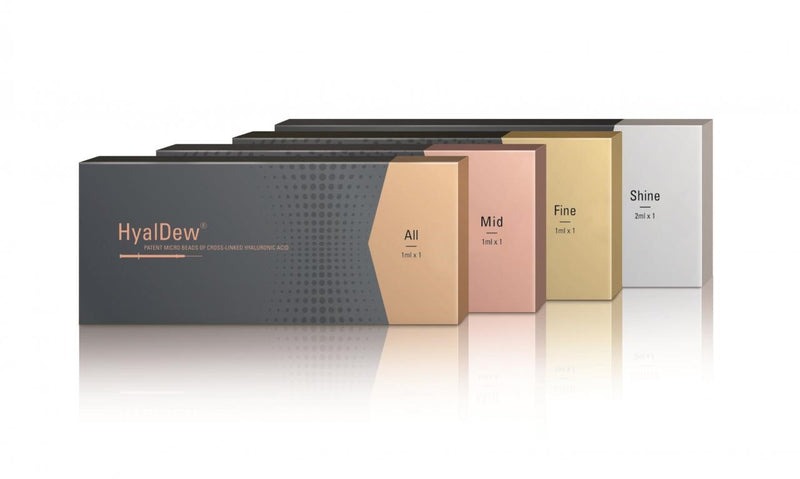
The reason we publish the register figures rather than just consulting them is that they are checkable. Every count in this article comes from a full sweep of the licence records on 7 August 2026, and a reader with the ingredient name in English can reproduce it. Our stocked range in this area sits under special functionals, alongside the hyaluronic acid range in derma fillers whose material properties we cover in reading an HA filler. For how the Korean regulatory system fits together more broadly, see our guide to MFDS regulation.
Frequently asked questions
Frequently asked
Is hyaluronidase prescription only in Korea?
Yes, on every live licence. All 32 active hyaluronidase licences on the Korean drug register as read on 7 August 2026 are classified prescription only, and all 32 are injectable. There is no over-the-counter or non-injectable entry in the category. Korean classification is a fact about Korea and does not determine status in any other market.
How many hyaluronidase products are licensed in Korea?
Thirty-four records exist, of which 32 are live and 2 have been withdrawn. The 32 live licences are held by 28 companies, so a small number of holders carry more than one. The oldest live licence dates to 10 February 2003.
Who holds the licence for LIPORASE?
The register records a licence granted on 21 April 2008 to 대한뉴팜(주), Daehan New Pharm. That is the manufacturer attribution on our own product record, and the two agree. The entry uses the older Korean spelling of the ingredient, which is why a name search using the more common modern spelling does not return it.
What does an export-only Korean licence mean?
It means the Korean licence designates the product for export, and that designation is written into the licensed product name. It is not an approval in any destination market, and it is not a quality grade. Four of the 32 live hyaluronidase licences carry this wording. Whether a product may be imported or used elsewhere is determined by that market's authority.
Why do register searches return different numbers of results?
Because the ingredient is spelled two different ways in licensed product names, and the register preserves the spelling current when each licence was granted. A product-name search using the more common spelling returns 26 of 34 records with no warning that eight are missing. The ingredient index is keyed in English and matches case sensitively, so the Korean spelling returns nothing, the lower-case English name returns one record, and only the capitalised English name returns all 34.
Disclaimer. This article is general educational information and is not medical advice. It describes how products in this category are licensed, classified, and recorded in a public register; it makes no claim about what any product does, achieves, or is suitable for, and it is not a selection, preparation, or administration guide. Products referenced are intended for professional use by trained practitioners. Regulatory and customs requirements vary by country and change over time; confirm current requirements with the relevant authority.
Sources & references
- Ministry of Food and Drug Safety (MFDS), drug product approval register, queried on the active ingredient field for "Hyaluronidase" on 7 August 2026, all pages retrieved (34 records; 32 active, 2 withdrawn). Route, supply classification, register class, grant dates, licence holders, potency wording and export wording were all read from the licence records themselves. data.go.kr
- KSTATION, Editorial & Sourcing Policy (official-channel sourcing and traceable provenance). kstations.com/pages/editorial-policy
- Ministry of Food and Drug Safety (MFDS), official portal. Supply classification and product class codes referenced above are the register's own fields. mfds.go.kr