Search the Korean drug register for sodium hyaluronate and 302 licences come back. Search the same register for hyaluronic acid and four come back. These are two names for the same underlying substance, the searches were run minutes apart against the same index, and the results differ by a factor of seventy-five. Nothing is broken. The gap is the register telling you something specific about how this material is recorded, and it is a useful warning about what an ingredient search can and cannot establish.
One substance, two index entries
Hyaluronic acid and sodium hyaluronate are related in the way an acid and its salt are related. In water at physiological pH the acid form largely exists as the salt anyway, which is why product literature treats the two words as interchangeable and why almost nobody in this market distinguishes them out loud.
A register index does distinguish them, because an index matches strings rather than chemistry. Whichever name a licence holder entered on the application is the name the record carries, and a query for the other name will not find it. Korean pharmaceutical practice has settled overwhelmingly on the salt form, 히알루론산나트륨, which is why one query returns 302 rows and the other returns four.
The practical rule that follows is short and applies well beyond this ingredient. A zero or a small number from an ingredient search is a statement about the string you typed, not about the market. Before treating a low count as a finding, run the obvious variants: the salt form, the acid form, the hyphenated spelling, and the Korean transliteration. This series has already had to do exactly that with trichloroacetic acid, where three English spellings and two Korean forms all had to return nothing before the zero could be trusted.
The reverse error is just as easy. A large count invites the assumption that the market being counted is the one you care about, and that assumption fails constantly. Which is what the 302 turns out to demonstrate.
It is worth being precise about what "same substance" means here, because the looseness is what makes the trap work. The two entries are not a parent and a subset. Running both queries does not return four rows that also appear among the 302; it returns two disjoint populations, one of 302 and one of four, that never overlap. An index built on submitted strings has no mechanism for noticing that two strings describe the same chemistry, so it keeps two separate ledgers and answers whichever one you asked about.
What the 302 licences actually are
Of the 302 sodium hyaluronate licences, 266 are currently valid. They split 153 non-injectable and 113 injectable, and the composition of each group is nothing like what an aesthetics buyer would predict.
On the non-injectable side, 141 of the 153 licences are classified under [01310], the ophthalmic preparations code. Eye drops. The remaining twelve scatter across dental and oral preparations, ear-and-nose preparations, and wound protection. So the overwhelming majority of what the Korean drug register knows as sodium hyaluronate is eye medicine, and the oldest entry, from May 1996, is a lubricating eye drop.
The injectable side is more mixed but still not aesthetic. All 113 injectable licences are prescription-only. Ninety-four are filed under [03990] for metabolic preparations not otherwise classified, and another nineteen are ophthalmic. The oldest dates to April 1993.
| Non-injectable (153) | Injectable (113) | |
|---|---|---|
| Supply class | 139 prescription-only / 14 over-the-counter | 113 prescription-only, no exceptions |
| Largest classification | [01310] ophthalmic, 141 licences | [03990] metabolic, 94 licences |
| Other classifications | dental and oral 5, ear and nose 4, wound protection 3 | [01310] ophthalmic 19 |
| Oldest licence | 1996-05-31, a lubricating eye drop | 1993-04-08 |
Put plainly: a buyer who runs this search hoping to learn about HA fillers or skin boosters will retrieve 302 rows, almost none of which concern either. The count is real, the material is the same, and the relevance is close to zero. This is the single most common way an ingredient lookup misleads someone, and it does not announce itself, because the rows all genuinely contain the ingredient that was searched for.
The dates reinforce the point. A 1993 injectable and a 1996 eye drop place this material in Korean pharmaceutical practice roughly three decades before the aesthetic HA market existed in its current form. The register is not recording a beauty ingredient that later found medical uses; it is recording a medical material that a newer industry subsequently adopted for different purposes under a different framework. Reading the 302 as background for an aesthetics purchase inverts that history.
There is also a supply-class detail that runs against intuition. On the non-injectable side, 139 of 153 licences are prescription-only and just 14 are over-the-counter, which means most of the eye preparations in this population require a prescription. Anyone assuming that non-injectable implies freely available would get this backwards, and it is the second ingredient in this series to break that assumption after lidocaine.
The four, and why they matter more than the 302
The four licences returned by the acid-form query are a different story, and they are worth more attention than their number suggests.
All four are injectables, all four are prescription-only, and all four are filed under [03990]. The oldest is from March 2019, which makes this a recent group rather than a legacy one. And the entry name itself is the interesting part: it records a hyaluronic acid gel cross-linked with 1,4-butanediol diglycidyl ether, the reagent usually written as BDDE.
Cross-linked HA gel is the material category that dermal fillers are built from. An earlier piece in this series established that HA fillers sit in the medical device framework rather than the drug framework, which is why a drug-register search for a filler returns nothing; the reasoning is in why your HA filler is not in the drug register. These four licences do not overturn that. Fillers remain device-classified and the general rule holds.
What they do establish is that the boundary is not a property of the material. A cross-linked HA gel can be licensed as a drug in Korea, because four of them are, filed under a metabolic classification rather than anything aesthetic. Whatever separates those four from the filler population, it is the intended use and the approval route taken, not the chemistry in the syringe.
Four licences also make a poor basis for generalisation in either direction, and that limit deserves saying out loud. Four is enough to establish that the case exists and far too few to describe a pattern. If a fifth were added tomorrow under a different class, nothing in the reasoning above would need revising, because the claim being made is only that the boundary is not chemical. Counting arguments break down at this scale, which is precisely why the interesting content of a four-row result is the row contents rather than the row count.
One more asymmetry sits in the injectable column and is easy to skim past. Ninety-four of the 113 injectable licences are filed under [03990], a code whose full name is metabolic preparations not otherwise classified. That is a residual category, the drawer a filing system uses when a product does not fit the drawers that have names. So the largest single group of injectable sodium hyaluronate in Korea is filed under a heading that says, in effect, that it did not match anything else. A classification code is often read as a positive statement about what something is; here the most common one is a statement about what it is not.
Where skin boosters sit in all this
Non-cross-linked HA skin boosters occupy yet another position, and the position depends on the product rather than on the ingredient.
Some are supplied as cosmetics. Some are device-classified. Some declare hyaluronic acid alongside other actives such as polynucleotide or amino acids, and the classification follows the finished article rather than the most recognisable name on the box. A buyer cannot determine which case applies by looking at the ingredient list, and the drug-register search examined above will not help either, because if the product is not drug-classified it was never going to appear.
This is the same structure seen with lidocaine, where the molecule is a licensed drug in one position and a declared component of a device in another, covered in lidocaine twice. Hyaluronic acid runs the pattern one step further, because it appears in at least four positions: as ophthalmic medicine, as a prescription injectable in a metabolic class, as a cross-linked gel in device-classified fillers, and as an ingredient in cosmetic-facing boosters. One name, four regulatory homes, and the label alone rarely says which one applies.
The practical consequence for sourcing is that the ingredient name is the wrong unit of verification for this material. What can be verified is the specific product: its manufacturer, the framework it was approved under, and the record that approval sits in. Starting from the molecule and working outward produces 302 rows of eye drops.
None of this makes the boundaries arbitrary. Each framework exists because it asks a different question of a product: a drug approval asks about pharmacological action, a device approval asks about physical performance, and a cosmetic framework asks about topical safety. A material that can act in more than one of those ways will legitimately appear in more than one system, and hyaluronic acid is unusually capable in that respect. The multiplicity is a property of the material, not a gap in the regulation.
Running a hyaluronate lookup without being misled
The checks below take a few minutes and mostly consist of not stopping too early. Every failure mode described in this article comes from accepting the first result a query returns, whether that result was 302 rows or four.
- Search the salt form first. Korean records overwhelmingly use 히알루론산나트륨, sodium hyaluronate. The acid form returns a small, distinct set rather than a subset, so running only the acid query will make you think the ingredient is rare.
- Read the classification split before the total. 302 is a real number attached to a mostly ophthalmic population. A total with no breakdown is not information about your category.
- Do not use a drug-register absence as evidence about a device. Fillers are approved under a separate framework and will not appear no matter which spelling you use. A zero there is a category mismatch, not a red flag.
- Treat the four cross-linked entries as a boundary case, not a rule. They show a cross-linked HA gel can hold a drug licence. They do not make filler products drug-classified, and they do not tell you what those four are for.
- Verify the product, not the molecule. For HA specifically, the ingredient name spans at least four regulatory positions, so it cannot carry a verification claim on its own.
A final practical note on how this plays out at a supplier conversation. Asking "is this HA licensed in Korea" produces an answer that sounds substantive and settles nothing, because a supplier can answer yes truthfully while pointing at a population of eye drops. The questions that do settle something are narrower: which framework was this specific product approved under, which record holds that approval, and what is the manufacturer name attached to it. Those have single answers that can be checked, and none of them starts from the molecule.
HA products in KSTATION sourcing
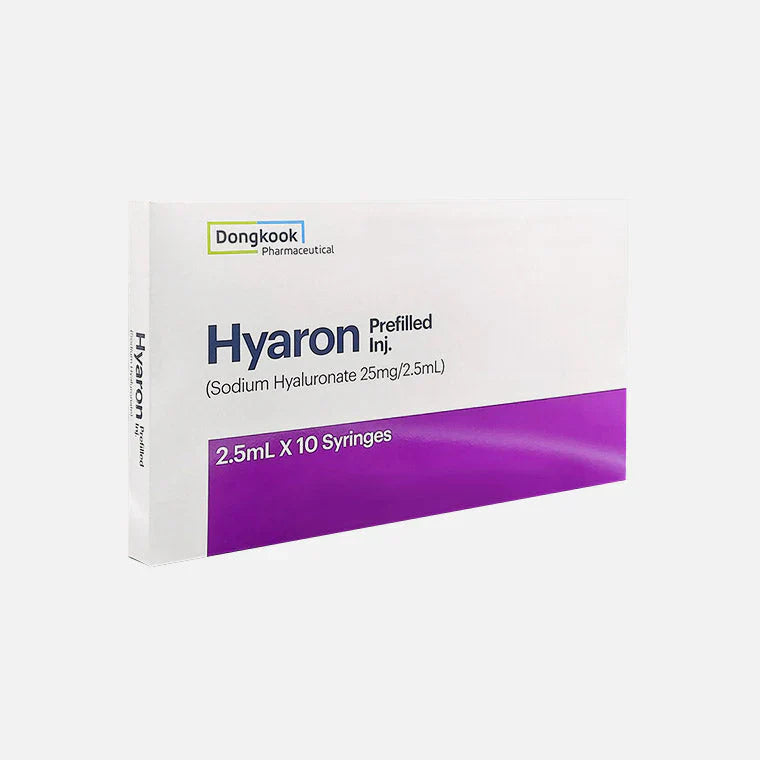
The HA range spans several of the positions described above, and the pre-listing check follows the framework each product actually falls under rather than the ingredient it declares. Hyaron Prefilled Inj is a non-cross-linked HA preparation supplied in pre-filled syringes; cross-linked HA fillers are checked against device records instead, since a drug-register query would return nothing regardless of the product's standing.
The listing itself reflects that: HA products are described by what they are, not grouped under the ingredient they share. A non-cross-linked pre-filled preparation and a cross-linked gel filler have almost nothing in common operationally despite sharing a headline molecule, and putting them under one heading would reproduce the exact confusion this article is about.
The method is set out in the Editorial and Sourcing Policy. The reason it is framework-first rather than ingredient-first is exactly what this article describes: for a material recorded under two names across four positions, an ingredient search answers a question nobody asked. Related items sit in the skin boosters and ampoules range.
Frequently asked
What is the difference between sodium hyaluronate and hyaluronic acid on a label?
Chemically they are the salt and acid forms of the same material, and in solution the distinction largely collapses. For a register search it matters a great deal: sodium hyaluronate returns 302 Korean drug licences and hyaluronic acid returns four, because an index matches the string a licence holder entered rather than the chemistry behind it.
How many hyaluronic acid products are licensed in Korea?
Under sodium hyaluronate, 302 licences with 266 currently valid. Of those, 153 are non-injectable and 113 injectable. The acid-form spelling returns a separate set of four injectable licences. Neither figure counts device-classified dermal fillers, which are recorded elsewhere.
Is hyaluronic acid a drug in Korea?
In some forms, yes. 141 of the non-injectable licences are ophthalmic preparations and all 113 injectable licences are prescription-only. In other forms it is not: cross-linked HA fillers are regulated as medical devices, and cosmetic-facing boosters fall under yet another framework. The ingredient does not determine the answer; the finished product does.
Are HA fillers in the Korean drug register?
As a rule, no, because they are approved as medical devices. The register does contain four licences for a cross-linked hyaluronic acid gel, the oldest from 2019, which shows the boundary is about approval route and intended use rather than about the material itself. Those four do not change how filler products are classified.
Why do most sodium hyaluronate licences turn out to be eye drops?
Because ophthalmic use is where this material has the longest and largest pharmaceutical presence in Korea, going back to a 1996 lubricating eye drop. 141 of 153 non-injectable licences sit in the ophthalmic class. It is a reminder that a large ingredient count usually belongs to a market other than the one you are researching.
Sources & references
- Ministry of Food and Drug Safety (MFDS), Korean drug product licence register, ingredient query "Sodium Hyaluronate" (302 licences, 266 valid), retrieved 2026-08-24. data.go.kr
- MFDS Korean drug product licence register, ingredient query "Hyaluronic Acid" (4 licences, all valid, oldest 2019-03-08, recorded as a BDDE cross-linked hyaluronate gel), retrieved 2026-08-24. data.go.kr
- KSTATION, Editorial & Sourcing Policy (framework-first verification for materials spanning multiple regulatory positions). kstations.com
Disclaimer. This article is general educational information and is not medical advice. It describes how hyaluronic acid and sodium hyaluronate are indexed in the Korean drug licence register, how those licences are distributed by route and classification, and why device-classified products do not appear there. It makes no claim about what any product does, does not infer clinical use from classification codes, and provides no guidance on administration. Products referenced are supplied for professional use by qualified practitioners. Regulatory status varies by country and changes over time.