Ask about vitamin C injections and you will get answers about two entirely different things. One is a bag on a stand in a clinic room, delivering grams of ascorbate into a vein over an hour. The other is a small Korean ampoule of compounded solution, bought by the box, shipped in a cold chain, and read by its composition. They share a molecule and a common name, and past that the resemblance ends: different route, different scale, different regulatory handle, and different questions at a border.
Confusing them is not a pedantic error. It changes what a buyer is legally purchasing, what a customs officer sees on a manifest, and which verification actually matters. This piece separates the two categories and stays on the sourcing and regulatory reading. What either format is appropriate for, and for whom, is a clinical question that belongs with a qualified professional, and none of what follows is treatment guidance.
One vitamin, two products
The clean way to hold the distinction is to stop thinking about the active and start thinking about the format, because in this category the format is what everything else follows from. Route, scale, where the solution is prepared, who holds the approval, and what crosses a border are all consequences of the format rather than of the molecule.
| Dimension | Intravenous infusion | Injectable ampoule or vial |
|---|---|---|
| Route | Intravenous, over a set period | Small-volume injectable product |
| Typical scale | Grams of ascorbate per session | Milligram to low-gram quantities per unit |
| Where the solution is made | Often prepared or compounded near the point of care | Manufactured, filled, and released at a licensed plant |
| What is bought | A prepared or compounded preparation, frequently per patient | A finished, packaged product with lot and expiry |
| What the buyer verifies | Who compounded it, under what authority, to what standard | Manufacturer, license, composition, lot, storage chain |
| What crosses a border | Usually nothing; it is made where it is used | A physical, declarable, temperature-sensitive good |
The last row is the one that matters most for anyone reading this from outside Korea. Cross-border sourcing questions apply almost entirely to the second column. An infusion prepared in a clinic room is a local matter of professional authority and pharmacy law. A boxed Korean ampoule is an imported medical good, and it inherits every obligation that attaches to importing one.
Why two formats exist in the first place
The split is not arbitrary, and understanding why it exists makes the rest of the distinction easier to hold. Vitamin C absorption from the gut runs through saturable active transport, which means oral intake has a ceiling that no larger tablet gets past. The pharmacokinetic work on this is decades old and consistent: plasma concentration as a function of oral dose follows sigmoid kinetics that flatten out, bioavailability is complete at modest single doses and then declines as the dose rises, and the excess is simply excreted.5 Injection bypasses that transport step entirely, and the measured difference is large. In direct comparison, a 1.25 gram oral dose produced mean peak plasma concentrations near 135 micromol per litre, while the same amount given intravenously produced roughly 885.5
That is a statement about pharmacokinetics and nothing more. It describes what happens to a concentration, not what any concentration achieves, and it is deliberately where this article stops on the physiology. The relevant point for a buyer is structural: the two formats exist because the routes behave differently, which is also why they ended up under different regulatory mechanisms rather than as two sizes of the same product.
The regulatory line follows the format
Because the two formats are regulated through different mechanisms, a claim about one tells you nothing reliable about the other. This is where most of the confusion in the category originates, and it is worth setting out by jurisdiction.
In the United States: one narrow approval, and everything else
There is an FDA-approved intravenous ascorbic acid product, and its indication is specific: short-term treatment of scurvy in adult and pediatric patients for whom oral administration is not possible, insufficient, or contraindicated, with an explicit limitation of use excluding vitamin C deficiency that is not accompanied by the signs and symptoms of scurvy.1 That is the approved use in its entirety. No injectable vitamin C is FDA-approved for aesthetic or skin-related purposes.
Preparations that fall outside that approval are generally compounded, and compounded drug products occupy a distinct regulatory position: they are not FDA-approved, meaning they have not undergone premarket review for safety, effectiveness, and quality, and they are made under sections of the Act that exempt them from certain requirements while imposing others.2 Compounding under one section is tied to patient-specific prescriptions; outsourcing facilities registered under the other are subject to current good manufacturing practice requirements and may supply without a patient-specific prescription. Neither route converts a preparation into an approved product, and neither status transfers to an imported finished good.
The parallel boundary on the cosmetic side is equally firm. Topical ascorbic acid is sold as a cosmetic only for as long as no drug-like claim is attached to it; the moment a product is presented as affecting the structure or function of the body, it is being marketed as a drug regardless of how it is labeled.3 An injectable never had access to that lane in the first place.
In South Korea: a drug, not a cosmetic
Korean injectable vitamin C is handled as a drug under the Ministry of Food and Drug Safety, not as a cosmetic, which is why these products carry drug-style labeling, a licensed manufacturer, and a designated Korean license holder rather than a cosmetic ingredient list. It is a stricter frame than most buyers expect for something they think of as a vitamin, and it is the reason the paperwork exists to verify in the first place.
It also means the domestic status does not travel. A product properly licensed in Korea is a properly licensed Korean product; it does not arrive in another market carrying that authorization with it. Every serious cross-border assessment in this category starts by separating what is true in the country of manufacture from what is true in the country of destination.
What "for professional use" is actually saying
Korean injectable cartons in this category carry professional-use language, and it is worth reading as a regulatory statement rather than as a disclaimer. It signals that the product was authorized on the premise of administration by a qualified professional, which shapes how it may be supplied domestically and who the intended purchaser is. It is not a marketing softener, and it is not equivalent to the "for external use only" line on a cosmetic.
That framing carries weight at a border, because the intended user is part of what an authority evaluates when deciding whether goods are admissible and to whom. A product whose authorization assumes professional administration does not become a general consumer good by being shipped somewhere that has not authorized it at all; if anything, it becomes a product with no local status, which is a weaker position rather than a freer one. Reading the professional-use marking as a restriction that stops at the Korean border gets the logic exactly backwards.
What a border actually reads
Customs authorities do not evaluate a product the way a buyer does. They read a declaration, and their questions run to classification, composition, quantity, and admissibility rather than to quality or provenance. Two features of vitamin C shipments matter here.
Composition and quantity, not branding
What a shipment is, for classification purposes, comes from its declared composition and quantity. A compounded ampoule with several declared components is not the same customs object as a single-active vial of ascorbate, and neither is decided by the name on the carton. This is one reason the full quantitative declaration matters as much as it does: it is the document that follows the goods, and a vague ingredient list creates ambiguity at exactly the point where ambiguity is expensive. The broader mechanics of why shipments of imported aesthetics get stopped, and the line between duties owed and admissibility refused, are set out in the US customs squeeze on imported aesthetics.
A cold chain does not pause for paperwork
The second feature is specific to this molecule. Ascorbate degrades in aqueous solution on a schedule set by temperature and time, accelerated by light and by dissolved oxygen, which is why these products are labeled for refrigerated, light-protected storage in the first place.4 A delayed shipment is therefore not only a delayed shipment. Time spent in an unrefrigerated warehouse during a customs hold is time spent degrading, and unlike a mechanical damage claim, there is nothing to see afterward: a vial that lost potency in transit looks exactly like one that did not.
That asymmetry is the argument for treating customs performance as part of the product specification for temperature-sensitive goods rather than as a shipping detail. KSTATION ships DDP, with duties and taxes settled in advance so the parcel is not waiting on a payment decision to move, and maintains a customs clearance rate of about 97 percent across shipments. Neither fact makes a hold impossible; both reduce the number of days a fragile solution spends in an unknown environment. The full mechanics of that arrangement are in DDP, explained, and the regional variations for European buyers in buying K-aesthetics from the UK and EU.
Someone is the importer of record
The third feature is procedural, and it is the one buyers most often discover late. Every import has an importer of record: the party responsible for the declaration being accurate, for duties and taxes, and for answering when an authority asks what the goods are. That responsibility exists whether or not anyone at the receiving end thought about it, and it does not disappear because a supplier arranged the shipping.
This is where the two vitamin C categories separate one final time. An infusion compounded in a clinic room raises no import question at all. A boxed ampoule raises every one of them, and the answers depend on who the receiving party is and in what capacity they are receiving. A clinic importing for its own professional use, a distributor importing to resell, and an individual receiving a parcel are three different postures with three different sets of obligations, and the difference is decided by local law in the destination market rather than by the seller. Establishing which one applies to you, before ordering rather than after a shipment is held, is the least expensive step in this whole sequence.
What this means when you are buying across a border
Reduced to a working sequence, a cross-border purchase in this category comes down to five checks, in order of what most often goes wrong.
- Establish which category you are in. A finished, boxed, lot-numbered product from a licensed manufacturer is a different purchase from a compounded preparation, with different verification and different obligations. Almost every downstream question depends on this answer.
- Read the composition quantitatively. Component names with amounts per unit volume, the form of the vitamin C stated as ascorbic acid or sodium ascorbate, and no gaps. This is what you verify against, and what the shipment is classified by.
- Verify the manufacturer and the license, not the brand. A designated license holder and a licensed plant, checkable against MFDS records, rather than a distributor's assurance.
- Confirm destination-market status separately. Korean licensing is a fact about Korea. Whether the product may be imported, held, or used where you are is a separate question, answered by the relevant authority for that market and subject to change.
- Treat the cold chain as part of the specification. Storage terms, packaging, transit time, and what happens if the parcel is held. For an antioxidant, this is a potency question rather than a logistics preference.
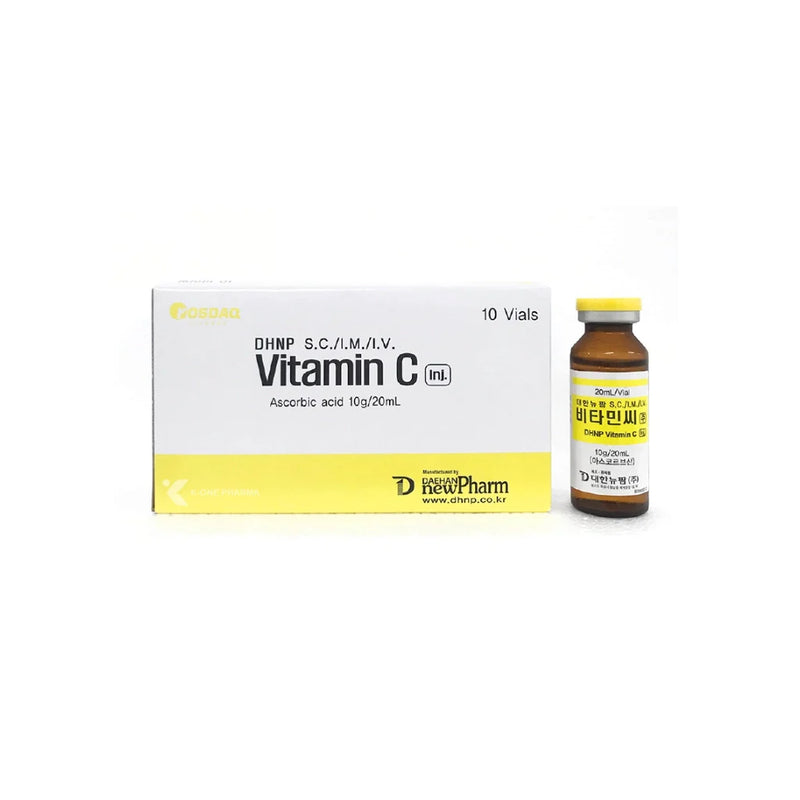
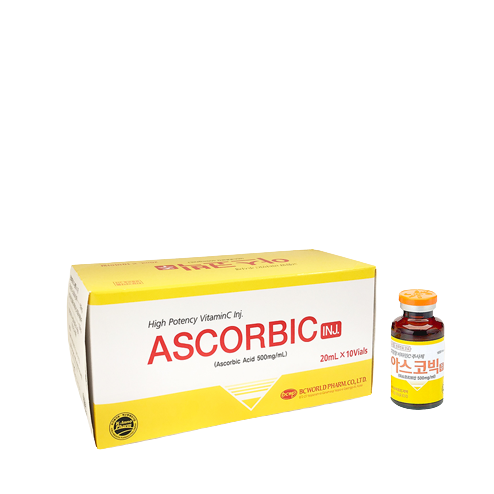
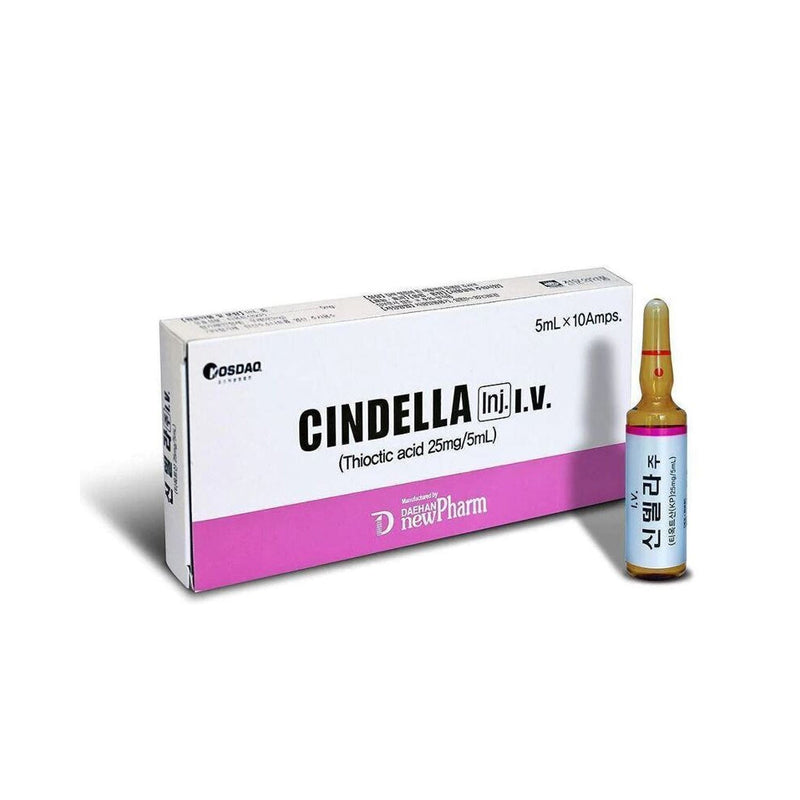
None of this makes the category difficult, but it does make it specific. Straight single-active products such as VITAMIN C Inj and BC ASCORBIC Inj are read on form, concentration, and storage; compounded ampoules such as CINDELLA Inj are read on the full declaration and the stability of the finished blend, a distinction we take apart in vitamin C in a mesotherapy cocktail. For the single-molecule reading underneath both, see reading an injectable vitamin C, and the fuller range sits under vitamins and injectables.
Manufacturer and licensing details are checked against MFDS records before a product is listed here, and we stock officially sourced products only; the method is set out in our Editorial & Sourcing Policy. The product-level authenticity checks that apply across injectables are in our guide to verifying an authentic Korean booster.
Frequently asked questions
Frequently asked
Is an IV vitamin C drip the same as a Korean vitamin C ampoule?
No. They share the active but differ in route, scale, where the solution is prepared, and how each is regulated. An infusion is typically prepared or compounded near the point of care; an ampoule is a finished, packaged product manufactured and released at a licensed plant, and it is the format that raises import and customs questions.
Is injectable vitamin C FDA-approved?
One intravenous ascorbic acid product holds US approval, indicated for short-term treatment of scurvy where oral administration is not possible, insufficient, or contraindicated, and explicitly not for vitamin C deficiency without the signs and symptoms of scurvy. No injectable vitamin C is FDA-approved for aesthetic or skin-related use.
Are compounded vitamin preparations FDA-approved?
No. Compounded drug products are not FDA-approved and have not undergone premarket review for safety, effectiveness, and quality. They are made under provisions that exempt them from certain requirements while imposing others, and that status does not transfer to an imported finished product.
Why does a customs delay matter more for vitamin C than for other products?
Because ascorbate degrades in solution at a rate set by temperature and time, and the loss is invisible. A vial that spent days in an unrefrigerated warehouse looks identical to one that did not, so transit conditions are part of what determines the potency of what arrives.
Disclaimer. This article is general educational information and is not medical advice. It describes how vitamin C products are categorized, regulated, and imported, not what any product achieves for an individual, and it is not a preparation or administration guide. Products referenced are intended for professional use. Regulatory and customs requirements vary by country and change over time; confirm current requirements with the relevant authority.
Sources & references
- DailyMed, ASCOR (ascorbic acid injection) prescribing information: approved indication for scurvy, limitation of use, and refrigerated light-protected storage. dailymed.nlm.nih.gov
- U.S. FDA, Compounding and the FDA: Questions and Answers (compounded drugs are not FDA-approved; sections 503A and 503B). fda.gov
- U.S. FDA, Is It a Cosmetic, a Drug, or Both? (Or Is It Soap?), structure/function vs. drug claims and market-specific regulation. fda.gov
- Stability of aqueous solutions of ascorbate for basic research and for intravenous administration (2023), oxidation in near-neutral solution and the role of temperature, light, and trace metals. pubmed.ncbi.nlm.nih.gov
- Vitamin C pharmacokinetics: implications for oral and intravenous use (2004), saturable absorption, sigmoid dose-concentration kinetics, and measured oral versus intravenous peak plasma concentrations. pubmed.ncbi.nlm.nih.gov