Search for a Korean eye booster and you will find a tidy-sounding category: small syringes, eye in the name, positioned for the area around the eyes. Read what six of those products actually declare and the category comes apart. Three declare polynucleotide at the same one percent. One adds lidocaine. One is built around a peptide. Two do not declare any quantities at all, and one of those is not a syringe product in the first place. The label describes where a product is marketed. It does not describe what is inside.
Why "which eye booster is best" is the wrong first question
A natural first question in this category is which product is best. The specifications cannot answer that, and neither can we. What they can answer is a more useful question: are these products even the same kind of thing? For six of the products in our range that are positioned for the eye area, the answer is no. They fall into at least five different formulations, and treating them as interchangeable is an easy way to end up with something other than what was intended.
The six, side by side
| Product | Main declared actives | Quantities declared | Lidocaine | Presentation |
|---|---|---|---|---|
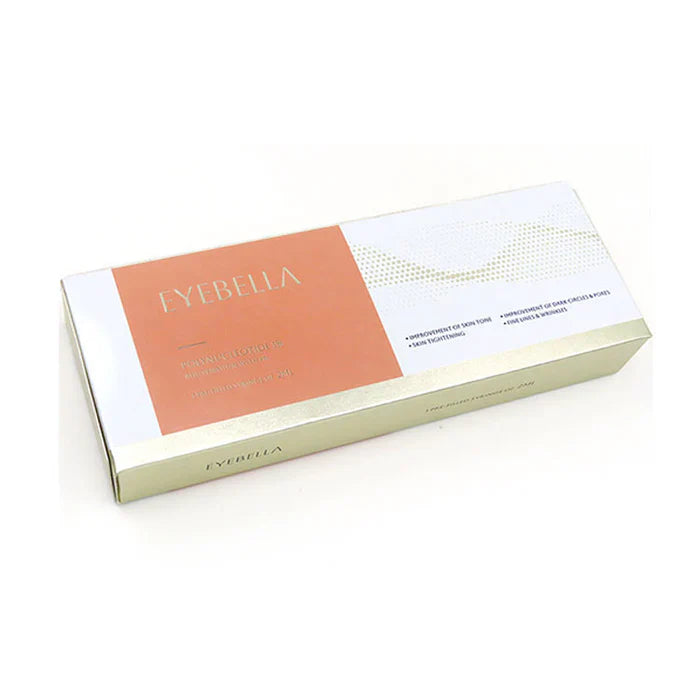
| EYEBELLA | Polynucleotide (PN) | PN 1% (20mg per 2mL) | Not stated | 2mL × 1 syringe |
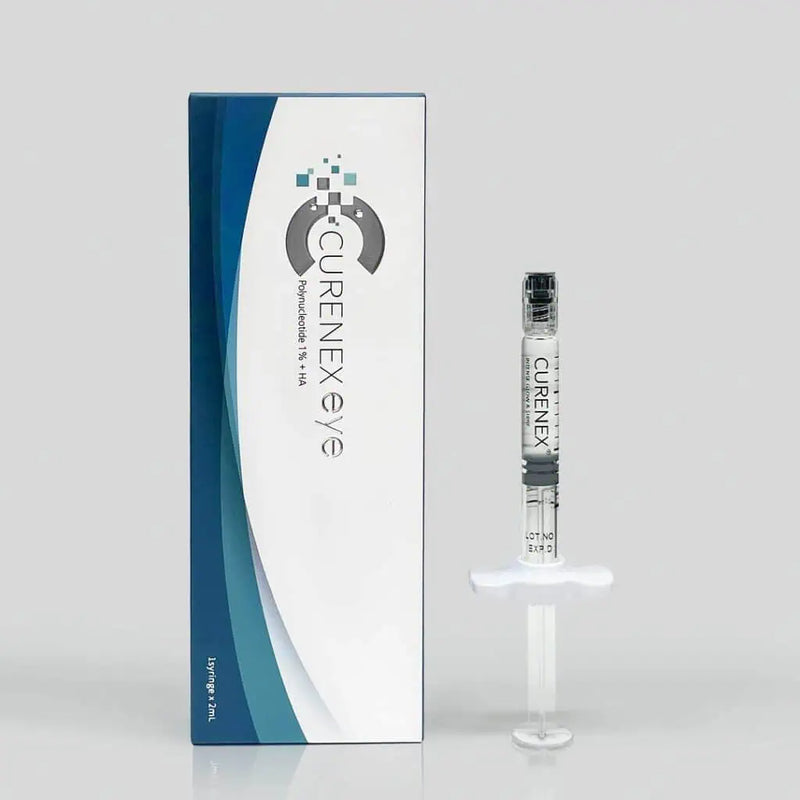
| CURENEX eye | PN, hyaluronic acid | PN 1%, HA 1% | 0.3% | 2mL × 1 syringe |
| REJUBEAU Eye Deal | PN, sodium hyaluronate, plus glutathione, collagen peptides, mannitol | PN 1%, HA 0.5%; supporting ingredients not quantified | Not stated | 2.5mL × 1 syringe |
| Rejuva Eye | Hyaluronic acid (high and low molecular weight), PDRN, PN | PDRN 5mg, PN 5mg per syringe | Not stated | 2mL × 1 syringe |
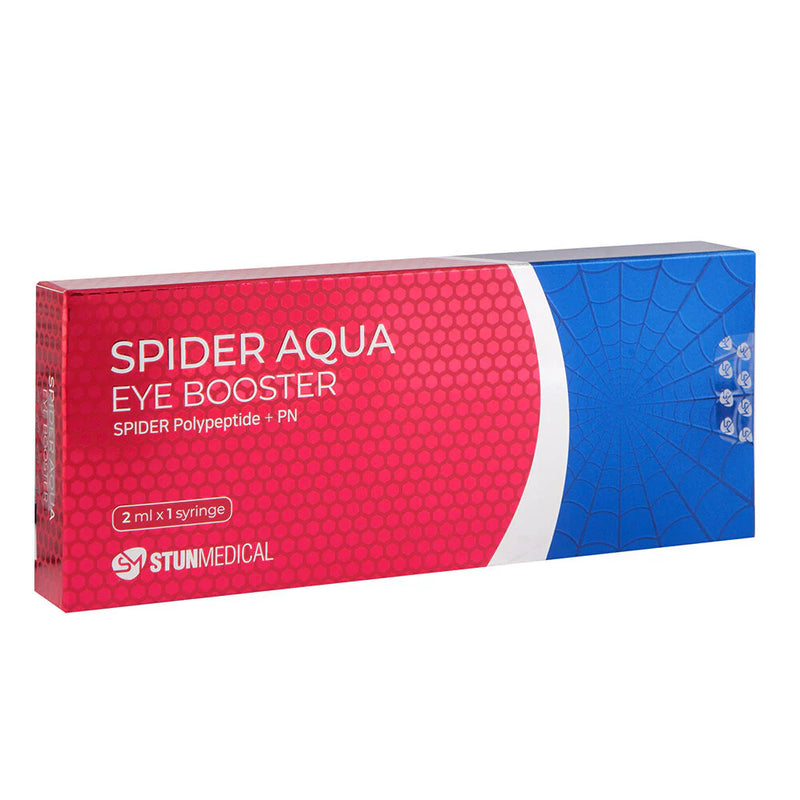
| SPIDER AQUA EYE BOOSTER | Spider polypeptide, PN, non-crosslinked HA, plus tetrapeptide-44, urea | Not stated | Not stated | 2mL × 1 syringe |
| Fiola Eyebag Solution | Hyaluronic acid, peptides, botanical extracts, aloe vera | Not stated | Not stated | 2mL × 5 vials |
Before reading anything into the table, one note on Rejuva Eye. Its page also declares an amount of hyaluronic acid, and that figure is out of line with every other booster in our range. We have not been able to confirm it, so it is left out of this comparison. The PDRN and PN figures are shown as declared.
Formula one: polynucleotide on its own
EYEBELLA is the simplest declaration in the group. One active, polynucleotide, at one percent, which in a 2mL syringe is 20mg. The page states that the PN is derived from salmon DNA. Nothing else is declared as an active.
Formula two: polynucleotide with hyaluronic acid
CURENEX eye and REJUBEAU Eye Deal both declare PN at one percent alongside hyaluronic acid, and on the headline figures they look close. They are not the same product, and the differences are all in the details.
Hyaluronic acid. CURENEX eye declares HA at 1%. REJUBEAU Eye Deal declares sodium hyaluronate at 0.5%, half the concentration.
Volume. CURENEX eye is a 2mL syringe. REJUBEAU Eye Deal is 2.5mL. At the same one percent, that puts 20mg of PN in the CURENEX syringe and 25mg in the REJUBEAU syringe. A percentage that matches does not mean the amount in the box matches.
Supporting ingredients. REJUBEAU Eye Deal lists glutathione, collagen peptides and mannitol as supporting ingredients, without quantities. CURENEX eye lists none beyond its actives and lidocaine.
Lidocaine. CURENEX eye declares 0.3% lidocaine. It is the only one of the six whose page declares a local anaesthetic.
So even the two products that share a formula family differ in one active's concentration, in fill volume, in supporting ingredients and in whether they contain lidocaine. A buyer who switches from one to the other because both say PN 1% is switching more than the brand.
Formula three: several nucleotide and hyaluronic acid actives together
Rejuva Eye declares a combination: hyaluronic acid in both high and low molecular weight forms, PDRN at 5mg and PN at 5mg in a 2mL syringe. It is the only product of the six that declares both PDRN and PN, and the only one that gives its nucleotide content in milligrams rather than as a percentage.
Converted to the same basis, 5mg of PN in 2mL is 0.25%, a quarter of the PN concentration declared by EYEBELLA, CURENEX eye and REJUBEAU Eye Deal. The product is built on a different idea: smaller amounts of two nucleotide ingredients alongside hyaluronic acid, rather than a single nucleotide at a higher concentration. Neither approach is better on the page. They are different formulations, and a buyer choosing between them is choosing between formulations rather than between brands of the same thing.
There is also a small inconsistency on our own page worth flagging: the short description refers to HA and PDRN, while the specification lists PN as well. For this comparison we have used the specification.
Formula four: a peptide-led booster
SPIDER AQUA EYE BOOSTER declares a different lead ingredient: a spider polypeptide, alongside PN and non-crosslinked hyaluronic acid, with tetrapeptide-44 and urea as supporting ingredients. It does not declare quantities for any of them.
That makes it the hardest of the syringe products to compare numerically. It shares PN and HA with others in the group, but without amounts there is no way to place it against them on those ingredients. What can be compared is its presentation, a single 2mL syringe, and its storage statement, room temperature between 1 and 30°C. Its distinguishing feature on the page is the peptide it leads with, and that is where a buyer should expect it to differ.
Formula five: not a syringe booster at all
Fiola Eyebag Solution sits in the eye-area group by name, but its specification describes a different kind of product. It comes as five 2mL vials rather than a single syringe, and our page classifies it as a skin booster and a fat-dissolving solution. It declares hyaluronic acid, peptides, botanical extracts and aloe vera, with no quantities.
Of the six, it is the one most likely to be mistaken for something it is not. A buyer looking for a pre-filled eye-area syringe and ordering by name could receive a multi-vial solution with an entirely different declared composition. That is not a problem with the product. It is a reminder that the word eye in a product name tells you about positioning, not format or formula.
Storage and shelf life, where the pages state them
EYEBELLA's page gives a storage range of 2 to 25°C, away from direct sunlight, and a shelf life of about 24 months from manufacture. SPIDER AQUA EYE BOOSTER's page gives room temperature, 1 to 30°C, with a note not to freeze, and a shelf life of 24 to 36 months with a pointer to the date on the package. CURENEX eye's page gives 1 to 30°C away from direct sunlight and tells the buyer to check the expiry date, without stating a term. Rejuva Eye's page gives room temperature, 1 to 30°C, and a shelf life of typically 24 to 36 months unopened. Fiola Eyebag Solution's page says to store it in a cool, dry place, typically 1 to 30°C, without a shelf life. REJUBEAU Eye Deal's page does not state a storage range or a shelf life.
Two practical points follow. None of the five pages that state a range calls for refrigeration; the stated ranges top out at 25 or 30°C. Two of the pages also carry a general line about maintaining cold-chain storage, so the pages do not settle the question on their own, and the storage conditions printed on the carton are the reference. And where a page gives a range of shelf lives or none at all, the date printed on the carton is the only reliable reference. Reading that date alongside the manufacture date, and what the two together should show, is covered in reading an injectable label.
What each page leaves unstated
It helps to count, product by product, how many of five basic fields each page actually declares: the quantity of its main active, whether it contains lidocaine, its fill volume and unit count, its storage range, and its shelf life.
EYEBELLA declares four of the five, all except a statement on lidocaine. SPIDER AQUA EYE BOOSTER declares three: presentation, storage and shelf life, but no quantities. CURENEX eye declares four: quantities, lidocaine, presentation and storage, but no shelf life term. Rejuva Eye declares four: quantities for its nucleotide actives, presentation, storage and shelf life, but nothing on lidocaine. REJUBEAU Eye Deal declares two: quantities for its main actives and presentation. Fiola Eyebag Solution declares two: presentation and storage.
What the comparison says about the category
The label is not a formula. Six products marketed for the same area declare at least five distinct combinations of actives. There is no single thing that an eye booster is.
Declared quantities are uneven. Three products give a percentage, one gives milligrams, and two give no quantities at all. A like-for-like comparison is possible only among the four that declare amounts, and even then only after converting to the same basis.
The details that matter most are the easy ones to miss. Fill volume turns the same percentage into different amounts. Lidocaine appears in one product only. Format ranges from a single syringe to five vials. None of these are hidden, but none of them is in the product name either.
How to check an eye-area product before and after it ships
Order by product name and format, not by category. Name the product, the fill volume and the number of units per box. "An eye booster" is not an order.
Match the declared actives on the carton. For the products that declare quantities, the carton should carry the same percentage or milligram figure as the specification. For the two that do not, check that the named actives on the carton match the product ordered.
Check lidocaine where it matters. If the presence or absence of a local anaesthetic is relevant to how the product will be used, confirm it from the carton rather than assuming it from the category. In this group, only one product declares it.
Count the units. One syringe for five of the six; five vials for one. A mismatch in count is the simplest sign that the wrong product has been sent.
Eye-area products in our range
KSTATION supplies all six products compared here, including EYEBELLA, SPIDER AQUA EYE BOOSTER, CURENEX eye, Rejuva Eye, REJUBEAU Eye Deal and Fiola Eyebag Solution, through official Korean channels. They sit within the wider range of skin boosters and ampoules. Our delivery terms, including the duties-paid option on United States orders, are on the shipping options page.
Frequently asked
What is in Eyebella?
According to our product specification, EYEBELLA declares polynucleotide at 1%, which is 20mg in its single 2mL syringe, derived from salmon DNA. No other active is declared.
What is in Spider Aqua Eye Booster?
Our specification lists a spider polypeptide, polynucleotide and non-crosslinked hyaluronic acid as main ingredients, with tetrapeptide-44 and urea as supporting ingredients. No quantities are declared. It comes as a single 2mL syringe.
Which Korean eye boosters contain lidocaine?
Of the six compared here, only CURENEX eye declares lidocaine, at 0.3%. The others do not declare it on our product pages. Confirm from the carton if it matters for your use.
Is Fiola Eyebag Solution a syringe product like the others?
No. It comes as five 2mL vials rather than a single pre-filled syringe, and our specification classifies it as a skin booster and fat-dissolving solution with hyaluronic acid, peptides, botanical extracts and aloe vera, without quantities.
Sources and references
- KSTATION product specifications for EYEBELLA, SPIDER AQUA EYE BOOSTER, CURENEX eye, Rejuva Eye, REJUBEAU Eye Deal and Fiola Eyebag Solution, as listed on our product pages, read 18 September 2026.
- KSTATION editorial policy, on how product facts are separated from manufacturer descriptions in our writing.
This comparison reads declared specifications as listed on 18 September 2026. It does not describe indications, treatment areas, technique or results, which are set by the product information and the treating professional.