TOXTA is made by Jetema, and Jetema's own toxin filings in the Korean drug register carry a different English name, JETEMA THE TOXIN, with six registered barcodes between them. Since 21 September 2026 a fourth filing exists: a 100 unit licence whose English name is TOXTA Inj., held by Pearson and made by Jetema under contract. Verifying a TOXTA carton now means working out which of these four filings it belongs to.
What TOXTA is, as the Korean register records it
TOXTA is a botulinum toxin type A injection made by Jetema, a Korean company that also holds a long list of dermal filler licences. KSTATION's product record attributes TOXTA to Jetema, and the toxin filings Jetema holds in the Korean drug register are three, all currently valid and all prescription-only medicines. Their Korean product name is 제테마더톡신주, and the English name on file is JETEMA THE TOXIN Inj. Neither contains the word TOXTA.
| Licensed product name (English name on file) | Units per vial | Granted | Export-only | Registered barcodes |
|---|---|---|---|---|
| 제테마더톡신주100U (JETEMA THE TOXIN Inj. 100U, for export) | 100 | 4 June 2020 | Yes | 8800600000101, 8800600000118 |
| 제테마더톡신주200단위 (JETEMA THE TOXIN Inj. 200U) | 200 | 29 October 2021 | No | 8800600000200, 8800600000217 |
| 제테마더톡신주100단위 (JETEMA THE TOXIN Inj. 100U) | 100 | 5 December 2024 | No | 8800600000309, 8800600000316 |
The rest of the record is the same on all three. The declared active is Clostridium botulinum toxin type A. The two declared additives are human serum albumin and sodium chloride. The pack unit is one vial per box, the shelf life on file is 36 months from manufacture, and the ATC code is M03AX01, the international code every botulinum toxin carries. The field for a contract manufacturer is empty on every filing: Jetema holds these licences and makes the product itself.
That last point is worth stating because it is not true of every Korean toxin. Our WONDERTOX monograph describes a product whose licence holder and manufacturer are different companies. For these three filings there is only one company name to expect on the paperwork, and it is Jetema. The TOXTA-named filing granted in September 2026 is different, as set out below.
A brand name the register does not use
Korean drug filings record a product name, and many toxins sold abroad carry that same name or a recorded export name. LIZTOX, for example, carries its export name Hutox inside the licensed product name itself, and Coretox records its export name in the same way. A buyer can type either name into the register and land on the right filing.
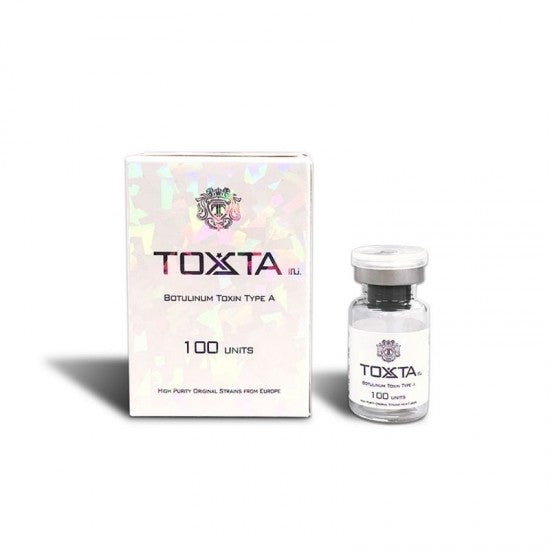
TOXTA does not work like that. The word appears on the carton and the vial, styled as TOXTA Inj., and it is the name under which the product is sold and searched for outside Korea. It is not a field in any of the three Jetema filings. Until September 2026 a search by brand returned nothing, and a buyer who stopped there could conclude, wrongly, that the product was unlicensed.
The bridge between the two names is the company. Jetema is the maker named in our product record, and Jetema's toxin filings are the three above. From there the check stops depending on names at all. It depends on numbers that the carton and the register both carry: unit content and barcode.
Since September 2026: a licence named TOXTA, held by Pearson
On 21 September 2026 the register added 톡스타주100단위, English name TOXTA Inj. 100U. Its licence holder is Pearson (퍼슨), not Jetema, and its contract manufacturer field names Jetema. It is a domestic licence with no export designation, for 100 units per vial and one vial per box.
Where the fields can be compared, its record matches Jetema's own 2024 domestic 100 unit filing: the same description of a white or pale yellow vacuum-dried powder in a colourless glass vial, the same refrigerated storage instruction and the same 36 month shelf life. Its barcodes are its own, 8806574019408 and 8806574019415, separate from Jetema's codes beginning 8800600.
The first version of this article searched Jetema's filings by product name and did not include this one. The register does not say how Pearson's licence relates to TOXTA cartons already sold abroad, and we do not assume which licence a particular carton belongs to. The barcode settles it.
Two 100 unit licences, and how to tell them apart
The table has a feature that matters more than anything else in it. Jetema itself holds two separate licences for 100 units.
The first, granted in June 2020, is an export-only licence. Its product name ends in 수출용, for export. A Korean licence with that designation permits manufacture for sale abroad and not for sale in Korea, a structure we explain in more detail in what the export-only suffix on a Korean licence means. The record shows the name on this filing was changed on 26 October 2020, a few months after it was granted.
The second 100 unit licence came four years later, in December 2024, without the export designation. It is a domestic licence for the same unit content from the same company. It also carries a four-year re-examination period running to 4 December 2028. Re-examination is the post-marketing review window Korea attaches to some newly licensed medicines, during which the licence holder reports on use after approval. Neither of the other two Jetema filings shows one.
The register describes the two 100 unit products in slightly different words. The 2020 export filing describes a white or pale yellow dried powder in a colourless glass vial. The 2024 filing, and the 200 unit filing, describe a vacuum-dried powder. That is a difference in the recorded description, and the register does not say whether it reflects a difference in the product. What it does mean is that a 100 unit TOXTA carton corresponds to one of Jetema's two distinct licences, or to the Pearson filing below, and the carton alone, in English, does not tell you which.
The barcode does. Each filing has its own pair of registered codes, and none is shared. A 100 unit carton whose barcode is 8800600000101 or 8800600000118 belongs to the export-only filing. One whose barcode is 8800600000309 or 8800600000316 belongs to the domestic 2024 filing. Either is a licensed product. A code that matches neither, or that matches the 200 unit filing on a carton that says 100 units, is a contradiction worth stopping on.
The 200 unit filing, revised in November 2025
The single 200 unit licence was granted in October 2021 and has never carried an export designation. Its record shows a substantial revision on 20 November 2025, covering the product name, the description, and the approved indications, dosage and precautions text in one change. The register does not publish the earlier wording alongside the new, so it cannot tell you what each field said before.
For a buyer this has one practical consequence. Cartons and inserts printed before and after that date may not read identically, even though they belong to the same licence. A wording difference between two 200 unit cartons is therefore not, on its own, evidence of substitution. The register does not keep a history of barcodes, so check the carton against the pair registered to the filing today, 8800600000200 or 8800600000217, and treat a mismatch as a question to put to the supplier rather than a verdict.
How to verify TOXTA before it ships
Confirm the company. Jetema's three filings are held and made by Jetema. The September 2026 TOXTA filing is held by Pearson and made by Jetema. A document naming any other licence holder or maker does not match the register.
Match the unit content to a filing. Jetema holds toxin licences at 100 and 200 units per vial, one vial per box. There is no filing for 50, 150 or 300 units. A carton stating any of those does not correspond to a Korean licence.
Read the barcode, and let it decide the licence. Eight codes are registered across the four filings, two per filing. For 100 unit cartons this is the only way to tell the three 100 unit licences apart. Our general method for checking a carton's barcode against the register, and what a match does and does not prove, is set out in the barcode on a Korean injectable carton, checked against its licence.
Do not search by brand alone. A search for TOXTA returns only Pearson's 100 unit filing. Documentation may lead to that filing or to 제테마더톡신주 and JETEMA THE TOXIN. Both are licensed, and the barcode shows which one a carton belongs to.
Read carton claims for what they are. The carton carries a line about the strain's European origin. The register's ingredient field for these filings names the toxin type and not a strain, so that line is a statement by the maker rather than something the public record lets you confirm.
Sourcing TOXTA
KSTATION supplies TOXTA 100 Units, one vial per box, through official Korean channels. For readers weighing it against the other Korean toxins, how the main brands differ by maker and by physical form is covered in Korean botulinum toxins compared, and the general steps for checking any toxin before purchase are in how to verify an authentic Korean botulinum toxin. The full range sits under botulinum toxins.
Frequently asked
What is TOXTA?
TOXTA is a botulinum toxin type A injection made by Jetema in Korea. Jetema's own prescription-only licences are filed as 제테마더톡신주, English name JETEMA THE TOXIN Inj.: two at 100 units per vial and one at 200 units, with human serum albumin and sodium chloride as declared additives. Since 21 September 2026 a further 100 unit licence carries the English name TOXTA Inj., held by Pearson and made by Jetema.
Who makes TOXTA?
Jetema makes the product under all four filings. It holds three of them itself. The fourth, granted in September 2026 under the TOXTA name, is held by Pearson with Jetema named as contract manufacturer.
Is TOXTA licensed in Korea?
Yes. Jetema's own filings use the name JETEMA THE TOXIN, and one of its two 100 unit licences, granted in June 2020, is export-only. Since 21 September 2026 a domestic 100 unit licence also carries the English name TOXTA Inj., held by Pearson. The other 100 unit licence, granted in December 2024, and the 200 unit licence, granted in October 2021, carry no export designation.
How can I tell which TOXTA licence a carton belongs to?
By the barcode. The export-only 100 unit licence is registered with 8800600000101 and 8800600000118, the domestic 100 unit licence with 8800600000309 and 8800600000316, the 200 unit licence with 8800600000200 and 8800600000217, and Pearson's TOXTA licence with 8806574019408 and 8806574019415. A barcode that matches none of these, or matches a different unit size from the one printed on the carton, is a contradiction.
Sources and references
- Ministry of Food and Drug Safety (MFDS), Korean drug product licence register, product name query 제테마더톡신 (3 valid filings, licence holder Jetema), with detailed records including English name, additives, dosage form description, barcodes, change history and re-examination period, retrieved 1 October 2026.
- MFDS drug product licence register, detailed records for LIZTOX and Coretox, for the comparison of how export names are recorded, retrieved 1 October 2026.
- MFDS drug product licence register, detailed record for 톡스타주100단위 (TOXTA Inj. 100U), holder Pearson, contract manufacturer Jetema, granted 21 September 2026, retrieved 15 October 2026.
- KSTATION product record and carton image for TOXTA 100 Units, retrieved 1 October 2026.
- KSTATION editorial policy, on how product and register facts are separated in our writing.
Updated 15 October 2026: added the TOXTA Inj. 100U licence granted to Pearson on 21 September 2026, and revised the statements that the register held no filing under the TOXTA name. Other register figures are a reading taken on 1 October 2026. Licences and their detailed records change without notice. This article describes licence holders, filings, barcodes and carton facts for professional buyers. It says nothing about what the product is indicated for, how it is prepared or used, or how it compares clinically with other products.